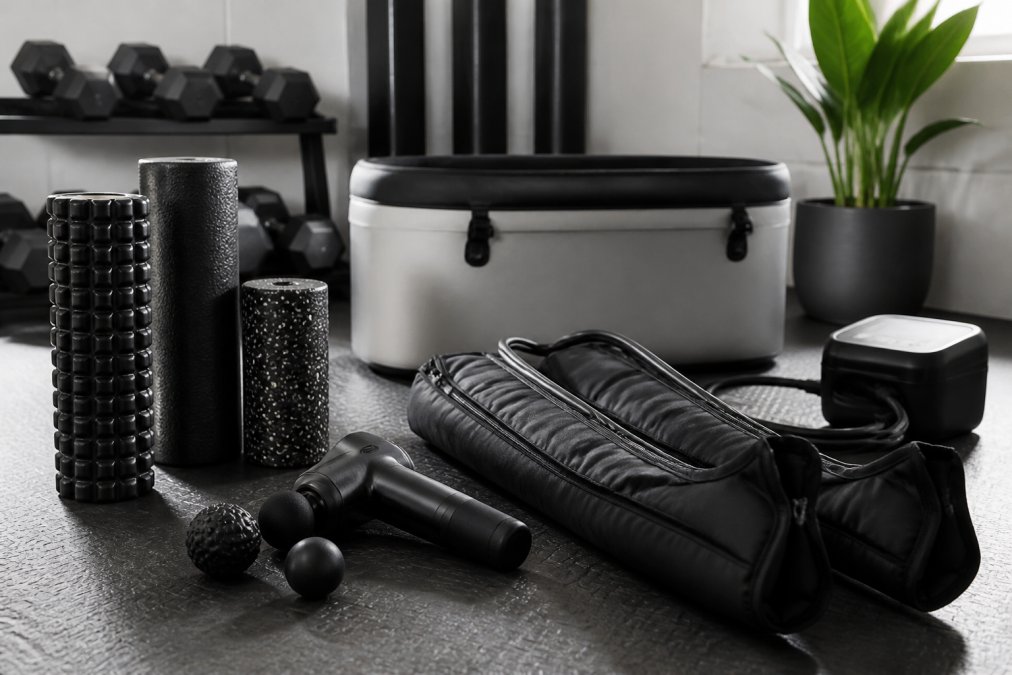
 listicle
Best Recovery Modalities for Small Gyms: 2026 Guide
Table of Contents
- Why Small Gyms Are Adding Recovery Services Now
- The Best Recovery Modalities for Small Gyms: A Comparison
- How to Add Recovery Services to Your Gym Without Major Renovations
- Gym Recovery Room Design Ideas That Maximize Every Square Foot
- Recovery Equipment ROI for Fitness Centers: What to Expect
- Maintenance and Hygiene for Shared Recovery Tools
- Which Recovery Modality Should You Pick First?
- Frequently Asked Questions
Last Updated: September 9, 2026
Member retention is the single biggest profit lever a gym owner controls, yet most facilities under 5,000 square feet treat recovery as an afterthought. The best recovery modalities for small gyms are no longer reserved for luxury athletic clubs; compact red light therapy panels, targeted compression systems, and thermal tools now fit into corners that currently hold unused equipment. Eternall Wellness helps facility owners evaluate these technologies as revenue-generating services that strengthen retention without requiring a major buildout.
Why Small Gyms Are Adding Recovery Services Now
Members no longer measure value by equipment count alone; they measure it by how fast they feel better after a hard session. Recovery services directly answer that demand, turning a transactional membership into a wellness destination.
A recovery service gives members a reason to visit on rest days, deepening the habit loop that drives retention. For a gym with roughly 150 members, adding a single high-use modality can differentiate you from the big-box competitor without needing their square footage.
The Best Recovery Modalities for Small Gyms: A Comparison
Choosing where to start means matching a modality to your space, staff capacity, and members' training profile. The table below ranks the leading options for a compact commercial setting.
| Modality | Space Needed | Staff Oversight | Best For | Maintenance | Typical Session Length |
|---|---|---|---|---|---|
| Red Light Therapy | Minimal (wall-mount panel) | Low | Muscle recovery, inflammation reduction | Minimal cleaning | 10-20 min |
| Compression Therapy | Small (chair or leg sleeves) | Low | Post-exercise blood flow, perceived fatigue | Wipe-down surfaces | 15-30 min |
| Thermal Recovery (sauna/cold plunge) | Large footprint | Moderate | Full-body recovery, client experience | High (water/air hygiene) | 10-20 min |
| Foam Rolling Stations | Minimal (floor space) | None | Self-myofascial release, mobility | Surface cleaning | 5-10 min |
Red light therapy is the most space-efficient entry point. A single wall-mounted panel serves multiple members per hour, requires no water or plumbing, and operates with minimal staff oversight. The mechanism is photobiomodulation: specific wavelengths (typically 630-850 nm) penetrate superficial tissue and are absorbed by cytochrome c oxidase in mitochondria, supporting ATP production and reducing oxidative stress (peer-reviewed research). While the research base is still maturing, systematic reviews show consistent benefits for exercise-induced muscle damage and perceived soreness when sessions are repeated over several days. The practical protocol is simple: expose target muscle groups for 10 to 20 minutes within a few hours post-workout, 3 to 5 sessions per week, making it a strong first purchase because it creates a daily habit loop.
Compression therapy systems are the next logical step. They take up roughly the footprint of a recliner, are simple for members to operate independently, and directly address post-exercise soreness. The proposed mechanism is that sequential pneumatic compression mimics the muscle pump action of the calf and thigh, enhancing venous return and clearing metabolic byproducts like lactate and creatine kinase. The evidence is mixed but leans positive: a 2019 meta-analysis in the Journal of Athletic Training found that pneumatic compression devices significantly reduced delayed-onset muscle soreness at 24, 48, and 72 hours post-exercise compared to passive recovery. The effect on performance markers like vertical jump or sprint time is less consistent, which matters for setting member expectations. These systems are a favorite for high-volume strength training clientele because the perceived relief is immediate.
Thermal recovery options like saunas or cold plunges deliver a premium experience but consume significant square footage and demand rigorous water and air hygiene protocols. The evidence for cold water immersion is stronger for reducing soreness than for improving long-term adaptation, and some research suggests regular cold exposure may blunt muscle protein synthesis signaling when used immediately after every session. Saunas are better understood for cardiovascular and psychological benefits than for direct muscle repair (the CDC). They work best with a dedicated recovery room and require a conversation with your insurance provider about liability and usage rules.
Foam rolling and self-myofascial release are the lowest-cost entry point and the most underrated. The mechanism is not actually "releasing fascia" in the way popular content suggests; rather, the pressure stimulates mechanoreceptors and reduces pain perception through central nervous system pathways. A 2015 review in the International Journal of Sports Physical Therapy concluded that foam rolling before or after exercise produces small but meaningful reductions in soreness and small improvements in range of motion without decrements in performance (peer-reviewed research). The equipment cost is trivial, the space requirement is a mat, and maintenance is a surface wipe-down. The limitation is that members rarely do it consistently without coaching, so it works best as a supervised cool-down station rather than a self-serve amenity.
No single modality is a silver bullet. The gyms that see the strongest retention gains pair one high-engagement tool (red light or compression) with a low-cost self-directed option (foam rolling or stretching) so members have both a passive and an active recovery choice.
How to Add Recovery Services to Your Gym Without Major Renovations
The fear of construction stops many owners before they start. The reality is that most recovery modalities for small gyms install in a day with zero structural changes.
Start by auditing your floor plan for dead zones: the corner behind the front desk, the wall beside the locker room entrance, or the storage area holding broken equipment. A red light therapy panel mounts directly to an existing wall and needs only a standard electrical outlet. Compression chairs require a similar footprint to a massage chair and can be positioned along a hallway wall.
For a phased approach, begin with equipment that requires no plumbing or ventilation. This keeps your compliance burden low and lets you prove member demand before committing to a larger buildout. When ready for thermal or hyperbaric systems, consult with a provider who handles site evaluation and integration planning, as these modalities carry specific electrical and safety requirements.
Gym Recovery Room Design Ideas That Maximize Every Square Foot
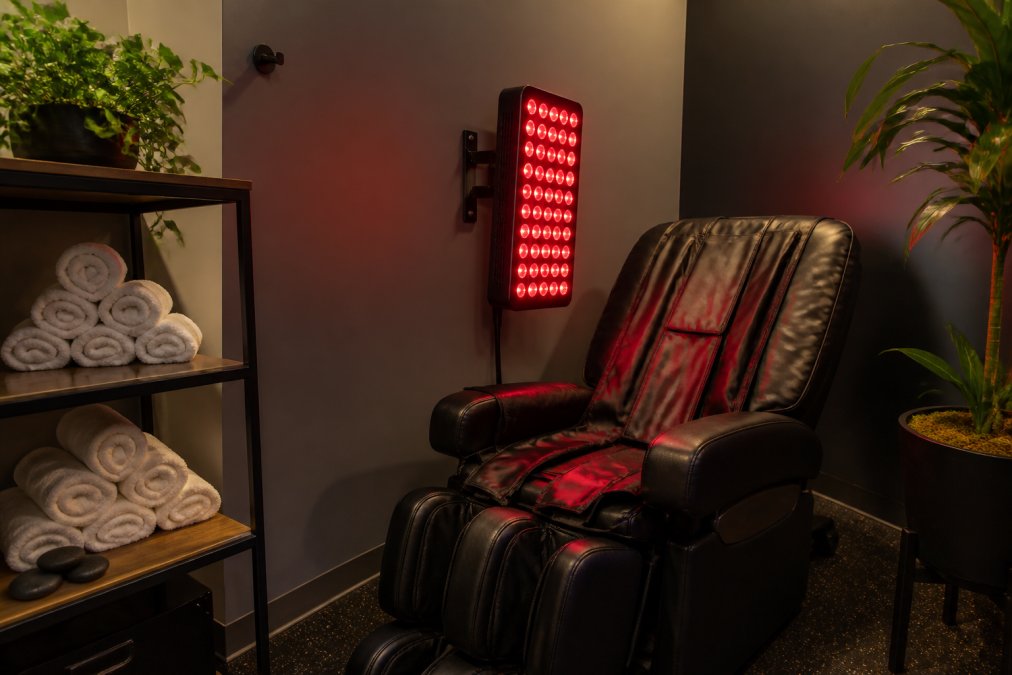
Most recovery design content assumes a dedicated 300-square-foot room. Small gym owners rarely have one. Recovery zones must coexist with active training space, foot traffic, and equipment storage. The solution is not a room; it is a system of zones that share infrastructure and serve multiple purposes throughout the day.
Zone 1: The Wall-Mounted Passive Recovery Strip
Identify one underused wall, the side of a column, the wall behind the front desk, or the stretch between the locker room door and the water fountain. Mount red light therapy panels at standing or seated height along that wall. Below each panel, install a fold-down bench or wall-mounted shelf that doubles as a seat. This configuration uses zero floor space when not in use and creates a defined recovery lane that does not block traffic. A single 48-inch wall strip can accommodate two panels and serve four members per hour in rotation.
Zone 2: The Convertible Active Recovery Corner
Take the corner that currently holds a broken leg press or a pile of battle ropes. Clear it out and install a compression chair angled toward the wall. Beside it, leave a 6x6-foot mat area for foam rolling and stretching. This same corner serves as a cool-down zone during peak hours (5-8 PM) and as a mobility or stretching area during off-peak times. Use a retractable privacy curtain on a ceiling track to section it off when members want quiet, and roll it back when you need floor space for a group cool-down or personal training session.
Zone 3: The Multi-Purpose Thermal Alcove (If You Have the Footprint)
If considering a sauna or cold plunge, do not place it in the middle of the training floor. Look for an underused office, storage closet, or hallway dead-end that is at least 6x8 feet. A barrel sauna fits in a 6x6 footprint, and a cold plunge tub fits in roughly 4x8 feet. Position them back-to-back with a shared changing bench between them, so members can transition from heat to cold without walking through the main gym. This layout also keeps water and humidity away from electrical panels and cardio equipment.
The Traffic Flow Principle
Design the recovery zone so members move from high-activity to low-activity tools in a natural line. A member finishes their workout, walks past the foam rolling mats, spends 10 minutes under the red light panel, then sits in the compression chair while checking their phone. This linear flow prevents bottlenecks and makes the recovery area feel intentional. If you have only one wall, place the compression chair at the far end so members walk past the other tools to reach it, this passive exposure increases usage of everything else.
Lighting and Acoustics as Spatial Tools
Lighting does more than set a mood; it defines territory. Install dimmable LED strips along the baseboard of the recovery zone and use a warmer color temperature (2700-3000K) to visually separate it from the bright, cool lighting of the training floor. Add a small Bluetooth speaker or white-noise machine to mask gym noise. These two elements cost under $200 combined and make a 50-square-foot corner feel like a dedicated spa area.
The 60-Day Spatial Test
Before committing to a permanent layout, run a 60-day test with temporary equipment. Place a foam roller, a massage gun, and a red light panel in the proposed zone. Track how many members use it, at what times, and whether it blocks traffic. Most owners find the zone gets heavy use immediately after peak class times (7-9 AM and 6-8 PM) and is dead midday. Use that data to adjust placement, move the zone closer to the locker room if members use it post-shower, or closer to the training floor if they use it as a cool-down. The goal is not to build the perfect room on day one; it is to find the highest-traffic corner in your existing footprint and make it work harder.
Recovery Equipment ROI for Fitness Centers: What to Expect
Recovery equipment ROI for fitness centers depends less on the price of the machine and more on use and pricing strategy. A modality that runs 10 sessions per day at a modest add-on price generates recurring revenue that quickly offsets the initial investment, but only if members know it exists and staff actively promote it.
Build your pricing model around membership tiers. Include basic recovery access in your premium tier to drive upgrades, and offer single-session or package pricing for standard members. This creates two revenue streams: higher membership fees and à la carte purchases.
Financing changes the math significantly. When you preserve capital through equipment financing, the monthly payment becomes a fixed cost that a predictable number of sessions covers. Eternall Wellness offers financing options so facilities can expand services without draining operating cash. The key metric to track is sessions per day, not the sticker price.
Maintenance and Hygiene for Shared Recovery Tools
Shared equipment lives or dies by its cleaning protocol. A visible hygiene routine builds member trust; a neglected one drives members away and invites compliance issues.
Establish a simple checklist that staff run between every use. Wipe down all contact surfaces with an approved disinfectant, replace any disposable covers, and check for wear on hoses, straps, or panels. For compression sleeves and similar fabric components, rotate multiple sets so one is always clean and dry.
Thermal and water-based systems carry stricter requirements around filtration and water quality. Follow the manufacturer's maintenance schedule precisely and document every service. For hyperbaric systems, compliance with safety standards is non-negotiable, and your provider should offer clear guidance on operational protocols.
Which Recovery Modality Should You Pick First?
Start with the modality that requires the least space, the least staff training, and serves the broadest swath of your membership. For most small gyms, that means red light therapy or compression therapy as the first purchase.
If your members are predominantly strength athletes and CrossFit-style trainees, compression therapy directly targets their most common complaint: delayed onset muscle soreness. If your membership skews toward general fitness and wellness, red light therapy offers broader appeal with its reputation for inflammation reduction and skin-level benefits. Both options let you test demand, build a hygiene routine, and generate revenue before committing to larger thermal systems.
The modality you choose matters less than the commitment to treat it as a service, not a piece of equipment. Price it intentionally, train your staff to talk about it, and track use data from day one.
Adding recovery services is no longer optional for gyms that want to compete on retention. The challenge is choosing the right modality for your space and budget, then executing with the same discipline you apply to your training programs. Eternall Wellness helps facility owners evaluate recovery modalities as business solutions, with financing options that preserve capital and a focus on integration into your existing operations.
Frequently Asked Questions
What are the most space-efficient recovery modalities for small gyms?
For small gyms, prioritize modalities that use vertical space or can be stored away. Red light therapy panels mount directly on walls and treat multiple body parts at once. Percussion massagers and foam rollers require minimal storage and can be used in any corner. Compression therapy sleeves are portable and can be used while members sit or even work. These options let you offer professional recovery modalities without dedicating a full room to them.
How do recovery services impact gym member retention rates?
Recovery services give members a reason to visit beyond just workouts, increasing engagement and loyalty. When members use recovery modalities regularly, they often perceive better results and less downtime from soreness. This added value makes them less likely to switch to a competitor. Many gym owners position recovery sessions as a premium perk for higher-tier memberships, which also boosts membership value perception.
How can small gyms implement recovery stations without major renovations?
Start by identifying underused floor space, like a corner of the main floor or an empty office. Wall-mounted red light therapy panels and foldable massage tables require no structural changes. Ensure you have adequate electrical outlets and proper ventilation. A simple partition or screen can create a sense of privacy. This approach lets you launch recovery services with minimal disruption and cost.
Which recovery modalities offer the best return on investment for boutique gyms?
Red light therapy and compression therapy often show strong ROI for small gyms due to their low ongoing costs and high member demand. They require little staff supervision after initial training, keeping labor costs down. Percussion therapy tools are a low-cost entry point but may not justify a premium service fee. To maximize ROI, choose equipment that is durable, requires minimal maintenance, and can be used by multiple members per hour.
What are the regulatory considerations for offering recovery services in a gym?
Regulations depend on the modality and your local jurisdiction. Hyperbaric chambers are medical devices with strict federal oversight and may require a physician's prescription. Thermal therapy and red light therapy generally face fewer restrictions but you should check local health codes. Liability insurance is essential for all modalities. Consult with a legal professional and your insurance provider before launching any new recovery service.