 listicle
Why Gyms Need Thermal Recovery Systems in 2026
Table of Contents
- The Hidden Cost of Hot Water and Cold Plunges
- What Thermal Recovery Systems Do for Your Gym
- The Benefits of Cold Plunge for Gym Members and Your Bottom Line
- Gym Recovery Room Design: Integrating Thermal Systems
- Calculating the ROI of Wellness Services in Fitness Centers
- Balancing Fresh Air with Energy Loss: HVAC Design
- Maintenance and Lifecycle Costs to Plan For
- Why Thermal Recovery is a Smart Investment
- Frequently Asked Questions
Last Updated: September 6, 2026
The most profitable square footage in a modern gym isn't the weight floor or the cardio deck. It's the room where heat is captured, recycled, and turned into hot water and cold therapy. Thermal recovery systems are the engineering backbone behind the wellness amenities that keep members loyal, yet most facility owners never see the energy bills hiding inside their hot water tanks.
The Hidden Cost of Hot Water and Cold Plunges
Your showers, laundry, and hot water-based recovery amenities consume energy around the clock. Traditional water heaters vent excess heat, wasting a substantial portion of the energy you pay for. Multiply that waste by the demand profile of a fitness facility, where peak usage hits in the early morning and after work, and the operational expenditure becomes a line item worth scrutinizing.
Cold plunge tubs add a second layer of cost. Keeping water at 50°F requires constant chiller operation, and that chiller rejects heat into the air (the CDC). Without a recovery loop, you are paying to generate heat for showers and simultaneously paying to remove heat from plunge water.
A thermal recovery system captures waste heat from chillers, compressors, and exhaust air, redirecting it to preheat water for showers and other domestic uses, reducing utility costs and carbon footprint.
What Thermal Recovery Systems Do for Your Gym
A thermal recovery system is a heat exchange network that captures waste heat from cooling equipment and ventilation exhaust, transferring it to water or air that needs warming, decoupling hot water generation from your gas or electric bill.
For gyms, the primary sources of recoverable heat are cold plunge chiller refrigeration circuits, air conditioning compressors, and exhaust air. The system routes this heat through a heat exchanger that preheats incoming cold water, so your water heater adds far less energy to reach the target temperature.
How Heat Exchange Cuts Energy Consumption
Heat exchangers operate on a simple principle: two fluids at different temperatures pass close without mixing, and thermal energy transfers from the warmer to the cooler. In a gym, warm refrigerant gas from a chiller passes its heat to incoming water, so the boiler or heat pump only tops it up by a few degrees.
The Benefits of Cold Plunge for Gym Members and Your Bottom Line
Cold plunge therapy has moved from elite sports into mainstream fitness. Members now expect recovery amenities that address muscle recovery and injury prevention, and trainers and physical therapists routinely use cold water immersion to reduce inflammation and speed recovery.
A dedicated recovery area with cold plunge and contrast therapy gives members a reason to stay after their workout, translating into higher engagement and retention.
Cold plunge services command premium pricing compared to standard gym access. Members willing to pay for recovery are often your most loyal and least price-sensitive segment, but delivering reliably requires thermal infrastructure to maintain consistent water temperatures without spiking utility bills.
Gym Recovery Room Design: Integrating Thermal Systems
A gym recovery room design succeeds when thermal systems are planned before finishes are chosen. Saunas, steam rooms, and cold plunges each have distinct HVAC and plumbing requirements, and the mechanical room needs space for chillers, heat exchangers, and circulation pumps.
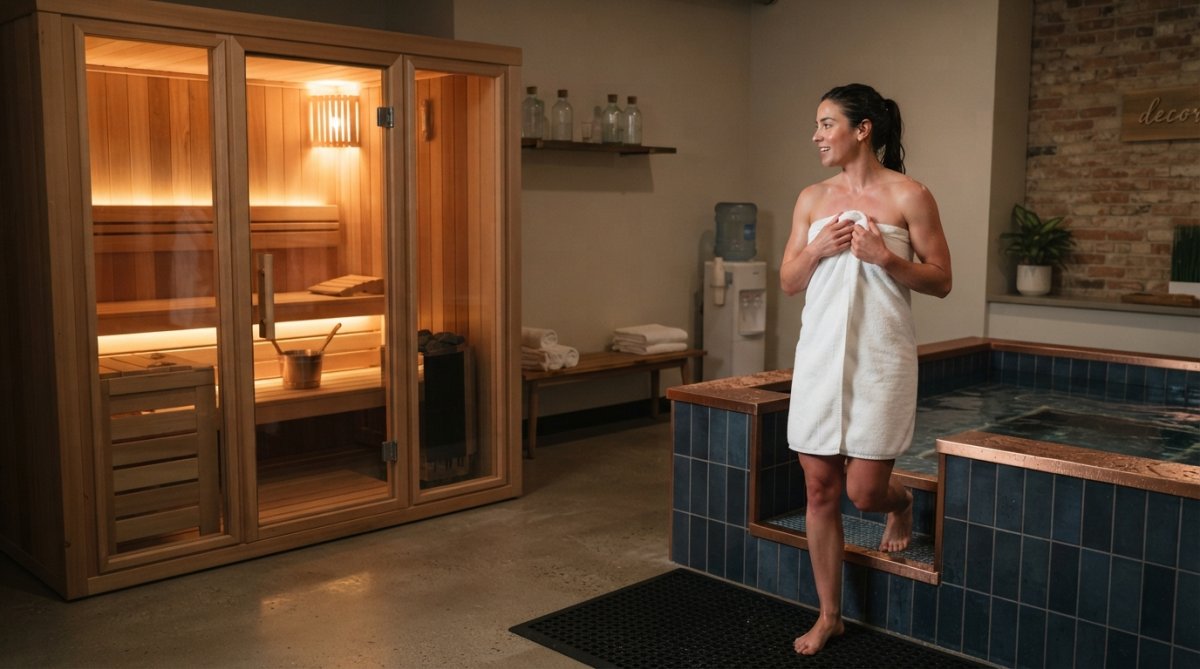
The layout should separate wet and dry zones to manage humidity and prevent corrosion. Ventilation must handle moisture from steam and plunge areas, routing exhaust through an energy recovery ventilator so heat and humidity are captured before leaving the building.
For existing facilities, a retrofit requires mapping current chiller and boiler locations and calculating whether the heat exchange loop can tie into the existing domestic water system. New builds can design the recovery room adjacent to the mechanical core, minimizing pipe runs and heat loss.
Calculating the ROI of Wellness Services in Fitness Centers
The ROI of wellness services in fitness centers comes down to three variables: incremental membership revenue, use rates, and operating costs. Recovery amenities justify higher membership tiers and attract new clients seeking cold plunge and sauna offerings.
To model the return, estimate the number of members upgrading to a recovery-inclusive tier and the monthly premium, multiply by your expected retention period, then subtract the energy costs of operating chillers and heaters.
A Working Payback Model for Gym Owners
Most gym owners need a concrete number to justify the capital expenditure. The following framework uses typical ranges observed across mid-sized U.S. fitness facilities; your figures will vary, but the structure gives a defensible starting point.
Step 1: Establish your baseline energy cost.
Pull 12 months of utility bills and isolate the load attributable to domestic hot water and cold plunge chilling. A common pattern is that a 40,000-square-foot facility with 2,000 members and a 4-tub cold plunge suite spends between $1,200 and $2,500 per month on combined water heating and chilling. If you lack sub-metering, a licensed HVAC contractor can estimate the split.
Step 2: Estimate the recovery potential.
A well-designed thermal recovery system typically captures 40% to 60% of waste heat rejected by chillers and exhaust air. For a facility with a $1,800 monthly combined energy bill, a 50% recovery rate on the chiller side alone translates to roughly $300 to $500 in monthly savings, depending on chiller runtime and hot water demand.
Step 3: Calculate the payback period.
A commercial-grade heat recovery loop tied to a cold plunge chiller system typically costs between $15,000 and $45,000 installed. Using a mid-point cost of $30,000 and conservative monthly savings of $400, the simple payback period is 75 months, or just over six years.
That payback shortens considerably when you factor in the revenue side. If a recovery tier commands a $25 monthly premium and just 60 of your existing 2,000 members upgrade, that is $1,500 in new monthly recurring revenue. Combined with $400 in energy savings, the same $30,000 investment now pays back in roughly 16 months.
Key Cost Variables That Move the Payback
Local utility rates. Facilities in states with high commercial electricity rates, such as California or Hawaii, see faster payback because avoided energy cost is larger. Facilities in low-rate states like Louisiana or Oklahoma rely more heavily on membership revenue.
Chiller runtime. A cold plunge suite operating 18 hours per day rejects far more recoverable heat than one running only during staffed hours. If you plan 24/7 access, the energy savings case strengthens considerably.
Domestic hot water demand. The recovery system only saves money if there is simultaneous demand for hot water. A gym with heavy shower usage during peak hours absorbs more recovered heat than one with light shower use. If demand is low, you may need a larger storage tank to bank the recovered heat.
Existing equipment condition. If your current chiller is nearing the end of its useful life, replacing it with a heat-recovery-ready model adds minimal incremental cost. Retrofitting a recovery loop onto an aging chiller may not be cost-effective if the chiller will need replacement within a few years.
A Simple ROI Calculator Framework
To build your own model, use this structure in a spreadsheet:
| Line Item | Value | Source |
|---|---|---|
| Monthly hot water energy cost | $X | Utility bills / sub-meter |
| Monthly chilling energy cost | $X | Utility bills / sub-meter |
| Combined monthly energy cost | $X | Sum of above |
| Estimated recovery rate | 40-60% | Equipment spec / contractor estimate |
| Monthly energy savings | $X | Combined cost × recovery rate |
| Number of members upgrading to recovery tier | X | Your estimate based on waitlist or survey |
| Monthly premium per upgrading member | $X | Your pricing structure |
| Monthly incremental revenue | $X | Upgrades × premium |
| Total monthly benefit | $X | Energy savings + incremental revenue |
| Installed system cost | $X | Vendor quote |
| Simple payback period (months) | $X / Total monthly benefit | Divide cost by benefit |
Run this model for a conservative and an optimistic case. If the conservative case shows a payback under 36 months, the investment is likely sound. If it stretches beyond 60 months, consider a phased approach where you add the recovery loop when you next replace your chiller or boiler.
Retrofitting vs. New Build Integration
Retrofitting an existing gym is more complex than integrating into a new build, but it is often the more practical path for established facilities. Main considerations are mechanical room space, condition of the existing chiller and boiler, and whether plumbing can accommodate additional circulation loops.
New builds have a clear advantage: the architect can allocate space for heat recovery equipment from the start, and the mechanical design can account for occupant load and ventilation rates with recovery amenities factored in. For both scenarios, payback depends on local utility rates and usage intensity.
| Scenario | Key Considerations | Best For |
|---|---|---|
| New Build | Design mechanical core adjacent to recovery room | Facilities planning from scratch |
| Retrofit | Map existing chiller and boiler capacity | Established gyms adding amenities |
| Phased Retrofit | Add recovery room, upgrade chiller later | Facilities managing capital spend |
Balancing Fresh Air with Energy Loss: HVAC Design
Indoor air quality is non-negotiable in fitness facilities. High occupant load means your ventilation system must deliver constant fresh air to manage CO2 levels and remove odors, but every cubic foot of fresh air you bring in is air you have already paid to heat or cool.
An energy recovery ventilator solves this conflict by transferring heat between outgoing exhaust air and incoming fresh air. In winter, exhaust warms incoming air; in summer, the process reverses. This reduces the load on primary HVAC equipment while maintaining required ventilation rates.
Thermal comfort for members also depends on getting this balance right. A recovery room that feels stuffy or humid will drive members away regardless of equipment quality. CO2 monitoring can help you adjust ventilation rates dynamically based on occupancy.
The Code Compliance Case for Energy Recovery
Ventilation requirements for fitness facilities are not optional. ASHRAE Standard 62.1, which most state and local building codes adopt by reference, sets minimum ventilation rates based on occupancy and activity level (ashrae.org). For health clubs and gymnasiums, it requires a minimum of 7.5 cubic feet per minute per person for the breathing zone, plus additional ventilation based on floor area (ashrae.org).
The energy implication is significant. Bringing in 5,000 CFM of outdoor air during a winter morning in Chicago means heating that air from 20°F to a 70°F supply temperature. With an ERV, you can capture 60% to 80% of the heat from the exhaust air stream and transfer it to incoming fresh air, cutting the heating load proportionally.
ASHRAE Standard 90.1, the energy standard for buildings, requires energy recovery on ventilation systems where design supply airflow exceeds a threshold and the temperature difference between indoor and outdoor air is significant. Many jurisdictions have adopted versions of ASHRAE 90.1 that make energy recovery mandatory for large commercial ventilation systems. Your mechanical engineer should verify whether your local code requires an ERV before finalizing the design.
How ERVs Interact with Thermal Recovery Loops
The ERV handles the air side of your heat recovery strategy, while the thermal recovery loop handles the water side. They are complementary, not competing. A complete gym design uses both: the ERV captures heat from exhaust air to precondition fresh air, and the heat recovery loop captures waste heat from chillers to preheat domestic hot water.
The interaction matters in the mechanical room. An ERV is typically located in the air handling unit or as a standalone unit connected to ductwork. The thermal recovery loop requires a heat exchanger, circulation pumps, and a storage tank near the chiller and boiler. Both systems need maintenance access, so coordinate the layout early to avoid cramped service clearances.
Sizing an ERV for a Recovery Room Environment
A recovery room with saunas, steam rooms, and cold plunges presents a unique ventilation challenge. The moisture load from steam and heat load from saunas are far higher than in the main workout area. A standard gym ERV sized for the weight floor will be undersized for the recovery suite.
The key design parameter is the latent heat load, not just the sensible heat load. Latent heat is the energy contained in moisture, and removing it requires dehumidification capacity that a standard ERV may not provide. In a recovery room, you often need a dedicated dehumidifier or a desiccant wheel ERV that can transfer moisture as well as heat.
Most practitioners find the recovery room should be treated as a separate ventilation zone with its own ERV and humidity controls. This maintains higher ventilation rates and lower humidity levels for member comfort without over-ventilating the rest of the gym. The exhaust air from the recovery room is also a prime candidate for heat recovery, since it is both warm and humid.
CO2-Based Demand Control Ventilation
A fixed ventilation rate that satisfies peak occupancy will over-ventilate during slow hours, wasting energy. CO2-based demand control ventilation solves this by modulating fresh air intake based on real-time occupancy, with sensors in the return air duct measuring CO2 concentration.
For a gym with predictable peak hours, this strategy can cut ventilation energy consumption by 20% to 30% compared to a constant-volume system. Savings come from reducing the amount of outdoor air that needs conditioning during low-occupancy periods.
When you combine CO2-based demand control with an ERV and a thermal recovery loop on the chiller, you have a fully integrated approach to energy management. Each system addresses a different waste stream, and together they reduce the facility's energy footprint while maintaining the indoor air quality members expect.
Maintenance and Lifecycle Costs to Plan For
Thermal recovery equipment is durable but not maintenance-free. Heat exchangers need periodic cleaning to prevent scale buildup, especially in areas with hard water. Circulation pumps and valves should be inspected regularly, and the refrigerant charge in chillers needs annual checks.
A common mistake is treating the recovery system as a set-and-forget installation. A dirty heat exchanger can lose a significant portion of its efficiency within a year, silently increasing energy consumption. Budget for an annual service contract that includes cleaning, refrigerant checks, and control system calibration.
The lifecycle cost of the system should factor into your payback calculation. Quality components from reputable manufacturers last longer and perform more reliably than budget alternatives, and the difference in energy savings over a decade typically justifies the higher upfront investment.
Why Thermal Recovery is a Smart Investment
The case for thermal recovery systems rests on a simple business principle: they turn a fixed cost into a savings mechanism. Every gym pays for hot water, and every gym with cold plunge amenities pays for cooling. A recovery system ensures those two costs partially cancel each other out.
The strategic benefit goes beyond the utility bill. Wellness amenities are now a deciding factor for prospective members choosing between gyms. Facilities offering cold plunge, sauna, and contrast therapy position themselves as premium destinations rather than commodity workout spaces, supporting higher pricing and stronger retention.
For gym owners evaluating this investment, the decision framework is clear. Measure your current energy consumption for hot water and cooling, estimate the recovery potential based on your usage patterns, and model the membership revenue from a recovery tier. Eternall Wellness helps facilities work through this analysis, offering thermal recovery equipment and financing options that preserve capital while the system generates returns.
Adding thermal recovery systems is a significant capital decision, but the facilities that act now will define the standard for premium fitness experiences. Eternall Wellness provides commercial-grade thermal recovery systems, cold plunge equipment, and the business analysis to help you evaluate use, pricing, and ROI before you commit. Get started with Eternall Wellness and turn your recovery amenities into a profit center.
Frequently Asked Questions
Is a heat recovery system worth it for a gym?
Yes. A thermal recovery system captures waste heat from cooling equipment like chillers and uses it to pre-heat water for showers, saunas, or the pool. This directly cuts the utility bills that come with high hot water demand. For facilities adding recovery amenities, the system also helps maintain consistent water temperatures, which improves the member experience and supports retention.
How do thermal recovery systems impact gym member retention rates?
Recovery amenities like saunas and cold plunges are a differentiator that keeps members coming back. A thermal recovery system makes these amenities more cost-effective to operate, allowing you to offer them as part of a premium membership tier. This creates a tangible wellness benefit that members value, increasing their commitment to your facility and reducing churn.
What is the difference between active and passive thermal recovery?
Passive recovery refers to the body's own cooling and healing processes, such as rest or sleep. Active recovery involves deliberate practices like stretching or low-intensity exercise. In facility design, thermal recovery refers to the technology that captures waste heat. A system actively transfers heat from one part of your building to another, using heat exchange to improve overall HVAC efficiency.