 how-to
Gym Recovery Equipment ROI Calculator 2026
Table of Contents
- Understanding Total Cost of Ownership for Recovery Equipment
- How to Add Recovery Services to Gym Operations
- Calculating Payback Period and Break-Even Point
- Gym Member Retention Strategies 2026 Using Recovery Services
- Commercial Recovery Equipment Cost Analysis
- Projecting 5-Year Financial Returns and Asset Use
- Building Your ROI Calculator Model
- Conclusion
- Frequently Asked Questions
Last Updated: September 2, 2026

Understanding Total Cost of Ownership for Recovery Equipment
When evaluating recovery equipment, the purchase price is only the beginning. Total cost of ownership (TCO) encompasses every dollar spent over the equipment's lifespan, from installation and training to maintenance, staffing, compliance, and replacement. Understanding TCO reveals the true investment required and helps you model realistic payback timelines.
At Eternall Wellness, we help gym owners and wellness facility managers think beyond the sticker price. The real question isn't "What does this equipment cost?" but rather "What will this equipment cost me to own, operate, and eventually retire?"
Capital Expenditure and Equipment Lifecycle
Your capital expenditure (CapEx) is the upfront purchase and installation cost, typically including hardware, delivery, site preparation, electrical or plumbing work, and initial setup. Recovery equipment depreciation varies dramatically by modality. A hyperbaric chamber has a longer useful life than a treadmill but requires more specialized maintenance. Building these costs into your model prevents cash flow surprises and ensures ROI projections remain realistic.
Staffing and Maintenance Overhead
Recovery equipment requires trained staff to operate safely and effectively. Staffing costs include wages and training, your team needs certification or specialized training to operate equipment safely and compliantly. Budget for initial training and ongoing refresher certifications, as regulatory requirements in some modalities demand annual recertification.
Maintenance overhead extends beyond routine cleaning. Commercial recovery equipment needs preventive maintenance to avoid downtime. Service calls from specialized technicians are expensive, and some equipment requires annual inspections or certifications. Small facilities often contract maintenance rather than hire in-house expertise, though contract costs are typically higher than routine maintenance.
Recovery-Specific Depreciation Schedules
Recovery modalities depreciate differently than traditional fitness equipment. Hyperbaric chambers, classified as medical devices in many contexts, affect your tax depreciation. Red light therapy systems depreciate faster than thermal recovery equipment because technology evolves more rapidly. Understanding your depreciation schedule matters for tax liability and replacement timing. Factoring in when you'll want to upgrade, not just when equipment fails, gives you a realistic TCO picture.
How to Add Recovery Services to Gym Operations
Adding recovery services requires assessing whether your space accommodates it, how it integrates with your membership structure, and what pricing strategy will be profitable.
Assessing Space and Integration Requirements
Before selecting equipment, audit your available space. Recovery services need dedicated areas; you can't squeeze a hyperbaric chamber into a corner. Consider foot traffic patterns, electrical capacity, ventilation, and necessary renovations. Some recovery modalities require specific environmental conditions (humidity, temperature control) that add integration costs.
Integration with your existing membership tiers is equally important. Will recovery services be available only to premium members, or offered à la carte? Some facilities create separate revenue streams by charging per session; others bundle recovery into higher-tier memberships. Your integration strategy affects pricing, marketing, and member communication.
Pricing Strategy and Revenue Modeling
Recovery services support multiple revenue models: session-based pricing, membership add-ons, or unlimited packages. Session pricing typically ranges by modality and market, but the key is understanding your target member's willingness to pay. Your pricing should reflect both perceived value and your operation's cost structure.
Recurring revenue models (subscriptions or membership add-ons) create predictable cash flow, improving ROI projections. A member paying $50 monthly for unlimited recovery access generates $600 annually, far more reliable than sporadic bookings. Build your financial model around realistic adoption rates, not optimistic assumptions.
Calculating Payback Period and Break-Even Point
Your payback period is how long it takes for equipment to generate enough profit to recover its initial investment. Your break-even point is when cumulative revenue equals cumulative costs. Both metrics are essential for evaluating recovery equipment viability.
Step-by-Step Payback Calculation
To calculate payback period, you need three numbers: total initial investment (CapEx plus installation), monthly profit from recovery services, and monthly operating costs.
Start by determining total initial investment, including equipment cost, installation, renovations, staff training, and initial marketing. Don't underestimate installation; electrical work, plumbing, or HVAC modifications can double equipment cost.
Next, project monthly revenue. Estimate how many sessions you'll sell monthly and at what price. If you project 100 sessions monthly at $50 per session, that's $5,000 in monthly revenue. Subtract monthly operating costs: staff wages (including benefits), maintenance, utilities, supplies, and licensing fees. If monthly operating costs are $2,000 and monthly revenue is $5,000, your monthly profit is $3,000. Divide your total initial investment by monthly profit to get your payback period. A $60,000 investment with $3,000 monthly profit pays back in 20 months.
Modeling Monthly Cash Flow
Monthly cash flow modeling is more realistic than payback period alone. Create a 24-36 month cash flow projection. Month 1 includes your full CapEx investment (negative cash flow). Months 2-12 show revenue minus operating costs as member adoption builds. By month 12-15, you should see positive cumulative cash flow. By month 20-24, cumulative cash flow should equal your initial investment.
Cash flow modeling also reveals when you'll need working capital. If you invest $80,000 in equipment but only generate $3,000 monthly profit, you need financial reserves to cover the gap until break-even.
Gym Member Retention Strategies 2026 Using Recovery Services
Recovery services are retention tools. Members who use recovery services show higher engagement and lower churn. The financial impact of improved retention often exceeds direct revenue from recovery sessions.
Quantifying Retention Impact on Revenue
A member who stays 12 months longer generates significant additional lifetime value. If your average member pays $60 monthly and stays 18 months before leaving, they're worth $1,080. If recovery services extend that to 24 months, the incremental value is $360 per member.
The retention impact compounds across your membership base. If you have 200 members and recovery services reduce monthly churn by just 2%, that's 4 fewer cancellations monthly. Over a year, that's 48 members retained. At $360 incremental value each, that's $17,280 in additional revenue without selling a single recovery session.
Upsell Potential and Incremental Revenue Streams
Recovery services create upsell opportunities beyond the service itself. Members using recovery equipment are primed to upgrade memberships, purchase supplements, book personal training, or try other premium services. A member discovering red light therapy might upgrade to a premium membership to access it more frequently, generating $20-30 monthly in additional revenue.
Incremental revenue streams also include corporate partnerships and group bookings. Businesses increasingly offer recovery services as employee wellness benefits. A local sports team might book recovery sessions for athletes. These bulk bookings drive use during off-peak hours and improve equipment ROI.
Commercial Recovery Equipment Cost Analysis
Understanding the cost structure of different recovery modalities helps you choose equipment aligned with your financial goals and member base.
Direct Costs: Equipment, Installation, and Licensing
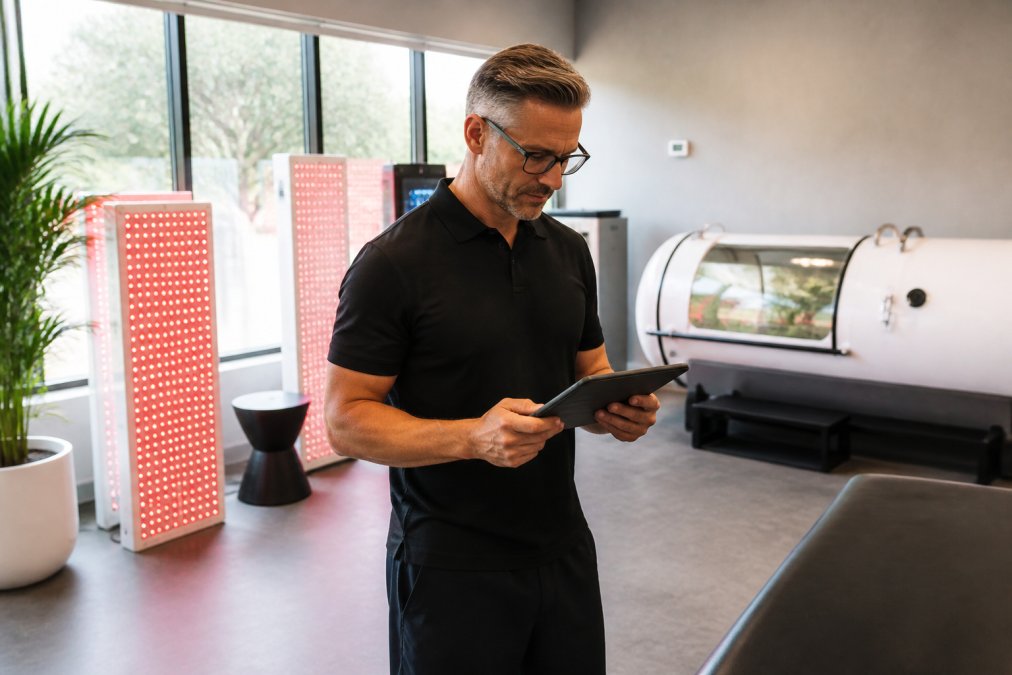
Equipment cost varies dramatically by modality. A red light therapy panel costs $5,000-15,000. A hyperbaric chamber ranges from $30,000-100,000+ depending on specifications. Thermal recovery systems range from $10,000-50,000.
Installation costs depend on your facility's infrastructure. A red light therapy panel needs electrical work and mounting, often $2,000-5,000. A hyperbaric chamber requires electrical, plumbing, and potentially structural modifications, often $5,000-15,000. Thermal systems might need dedicated ventilation, water lines, and drainage, often $10,000-25,000.
Licensing and certification fees apply to certain modalities. Hyperbaric chambers may require facility certifications or operator licenses depending on your state. Budget $1,000-5,000 for licensing, permits, and initial compliance setup.
Indirect Costs: Training, Compliance, and Insurance
Staff training for equipment operation, safety protocols, and member education typically costs $500-2,000 per staff member. Compliance costs include documentation, record-keeping, and regulatory filings. Insurance is critical, general liability coverage may not extend to recovery services. You'll likely need specialized coverage for equipment-specific risks, typically adding $1,000-3,000 annually to operating expenses.
Projecting 5-Year Financial Returns and Asset Use
Five-year projections help you evaluate long-term viability and identify when your equipment becomes truly profitable.
Service Volume Forecasting and Use Rate Targets
Use rate is the percentage of available service slots that are booked. If your hyperbaric chamber operates 8 hours daily (16 one-hour sessions) and averages 10 bookings daily, your use rate is 62.5%. Healthy use rates vary by modality and market. Red light therapy might target 60-70% use. Hyperbaric chambers might target 40-50% use. Thermal recovery services often achieve 50-60% use.
Service volume forecasting starts with realistic use assumptions. Year 1 might see 30-40% use as the service builds awareness. Years 2-3 might reach 50-60% as word spreads. Years 4-5 stabilize at your target rate. Conservative forecasting protects your financial model.
Net Profit Margin and Annualized Return Scenarios
Net profit margin is the percentage of revenue that becomes profit after all costs. If monthly revenue is $5,000 and monthly costs are $2,000, your net profit is $3,000 (60% margin). More realistic margins range from 30-50% depending on modality and scale.
Annualized return shows how much profit the equipment generates yearly. If monthly net profit is $2,500, your annualized return is $30,000. Over five years, that's $150,000 in cumulative profit (before accounting for maintenance costs that increase over time). Scenario modeling helps you understand different outcomes. Build your financial model around the realistic scenario, then stress-test against conservative assumptions.
Building Your ROI Calculator Model
Creating your own ROI calculator ensures you're evaluating equipment based on your specific situation.
Setting Business Model Assumptions
Your calculator starts with assumptions about your facility: current membership size, average member lifetime value, current churn rate, and available space. These baseline metrics determine whether recovery services make sense.
Next, define recovery service assumptions: equipment cost, installation cost, monthly operating costs, projected monthly revenue, and use ramp-up timeline. Each assumption should be defensible and based on research specific to your market and member base. Document your assumptions clearly so you can adjust them if conditions change.
Include sensitivity analysis assumptions: how much would revenue need to drop before the equipment doesn't pay for itself? How much would operating costs need to increase? These thresholds help you understand your financial risk.
Stress Testing and Sensitivity Analysis
Stress testing means asking "what if" questions. What if use is 20% lower than projected? What if operating costs increase 30%? What if member adoption takes twice as long as expected?
Run your calculator under these stressed conditions. If the equipment still achieves positive ROI under stress, it's a solid investment. Sensitivity analysis identifies which variables matter most. Understanding which variables drive your results helps you focus operational efforts on the highest-impact levers.
Conclusion
Evaluating gym recovery equipment ROI requires moving beyond equipment cost to understand total cost of ownership, realistic use rates, and member retention impact. The most profitable recovery installations align with your facility's member base, operational capacity, and financial structure.
Eternall Wellness helps gym owners and wellness facility managers build financial models tailored to their specific situation. Our approach focuses on the business as much as the technology, helping you evaluate potential ROI, understand use drivers, develop pricing strategies, and integrate recovery services into your existing operations. With financing options available, you can preserve capital while testing whether recovery services work for your facility. Get started with Eternall Wellness and discover how recovery services can become your facility's most profitable revenue stream.
| Metric | Conservative | Realistic | Optimistic |
|---|---|---|---|
| Year 1 use | 30% | 45% | 60% |
| Monthly Revenue (Year 1) | $2,250 | $3,375 | $4,500 |
| Payback Period | 28 months | 20 months | 14 months |
| Year 5 Net Profit | $45,000 | $90,000 | $135,000 |
U.S. Small Business Administration guidance on capital equipment depreciation
Harvard Business Review research on customer retention economics
OSHA guidelines for workplace safety and equipment operation
Frequently Asked Questions
Q: How do you calculate the ROI of gym recovery equipment?
A: Start by totaling capital costs (equipment, installation, licensing) and annual operating expenses (staff, maintenance, utilities). Project monthly service revenue based on utilization rate and pricing. Divide total costs by monthly net profit to find payback period in months. ROI percentage equals (annual net profit divided by total investment) times 100. When properly integrated with existing membership tiers and priced strategically, many recovery equipment installations show positive cash flow within a reasonable timeframe.
Q: What recovery equipment has the highest ROI for fitness facilities?
A: Equipment ROI depends on your facility size, member demographics, and existing service gaps. Red light therapy and thermal recovery systems can offer faster payback due to potentially lower operating costs and higher daily utilization. Hyperbaric chambers can command premium pricing but may require more staff training and compliance overhead. The highest ROI often comes from equipment that fills service gaps in your market and complements your current offerings, rather than solely from the highest-priced modality.
Q: How does recovery equipment impact member retention rates?
A: Recovery services can create differentiation that reduces churn, especially among performance-focused and older members. Members with access to premium recovery modalities may show higher lifetime value through longer tenure and increased monthly spending. The retention benefit can compound over time, as each retained member generates additional recurring revenue. Integration with existing membership tiers helps ensure recovery services enhance rather than cannibalize existing revenue.
Q: What are the operational costs of commercial recovery equipment?
A: Monthly operational costs typically include staff labor (training, certification, operation), maintenance contracts, utilities (especially for thermal and hyperbaric systems), and compliance/licensing fees. Fixed costs can vary depending on equipment type and facility size. Variable costs depend on utilization: consumables, replacement parts, and insurance scale with service volume. Staffing overhead is a significant controllable cost; facilities that cross-train existing staff may see lower labor expenses than those hiring dedicated operators.
This article was written using GrandRanker