 listicle
Best Commercial Thermal Recovery Equipment 2026
Table of Contents
- Key Features of High-Performance Thermal Recovery Units
- Types of Thermal Recovery Systems for Commercial Facilities
- Commercial Sauna and Cold Plunge Packages
- Thermal Recovery Equipment Financing Options
- Best Practices for Thermal Therapy Facility Management
- ROI of Wellness Recovery Equipment for Your Business
- Maintenance and Reliability Standards for Commercial Systems
- Selecting the Right Equipment for Your Facility's Needs
Last Updated: August 26, 2026
Key Features of High-Performance Thermal Recovery Units
High-performance thermal recovery units combine precise temperature control, rapid cycle times, and durable construction for high-frequency use. Focus on systems that maintain consistency across dozens of daily sessions without degradation. (Source: Occupational Safety and Health Administration (OSHA) guidelines)
Multi-zone temperature regulation allows operators to maintain exact conditions simultaneously. A sauna that holds 180°F precisely builds loyalty, while one fluctuating between 170°F and 185°F generates complaints and cancellations.
Look for stainless steel construction, reinforced insulation, and sealed electrical components. These materials extend equipment lifespan and reduce maintenance costs significantly over five years of operation.
Energy efficiency matters too. Modern thermal recovery equipment uses variable speed drives and smart controls to reduce power consumption during off-peak hours, lowering utility bills when equipment runs 12-16 hours daily.
The best units include redundant safety systems, automatic temperature monitoring, and alert notifications if conditions drift outside target ranges. This prevents member injuries and protects your facility from liability exposure.
At Eternall Wellness, we evaluate technical specifications as business factors. A unit with 95% uptime is worth more than a cheaper system with 85% reliability because downtime directly impacts revenue.
Types of Thermal Recovery Systems for Commercial Facilities
Commercial thermal recovery systems fall into distinct categories, each suited to different facility types and member bases.
Traditional sauna systems use dry heat, typically ranging from 160°F to 210°F. These are the most common choice for gyms and wellness clinics because they're straightforward to operate, require minimal maintenance, and members understand the experience.
Steam rooms operate at lower temperatures (110°F-120°F) with high humidity levels. They appeal to members seeking respiratory benefits and skin hydration but require more sophisticated moisture management and drainage infrastructure than dry saunas.
Infrared thermal recovery units use radiant heat technology to warm the body directly rather than heating the surrounding air. These systems operate at lower ambient temperatures (120°F-140°F) while delivering similar therapeutic effects, and many members find them more comfortable for extended sessions.
Cold plunge systems provide controlled immersion in water temperatures between 45°F and 60°F. These work best paired with sauna or infrared systems as part of contrast therapy protocols and require strong refrigeration, filtration, and chemical management systems.
Hybrid thermal recovery equipment combines multiple modalities in a single installation, maximizing space efficiency and allowing members to experience full thermal contrast protocols without moving between rooms.
The choice depends on your facility size, member demographics, available space, and operational capacity. Smaller gyms typically start with a single sauna or infrared system, while larger facilities integrate multiple modalities to justify premium pricing.
Commercial Sauna and Cold Plunge Packages
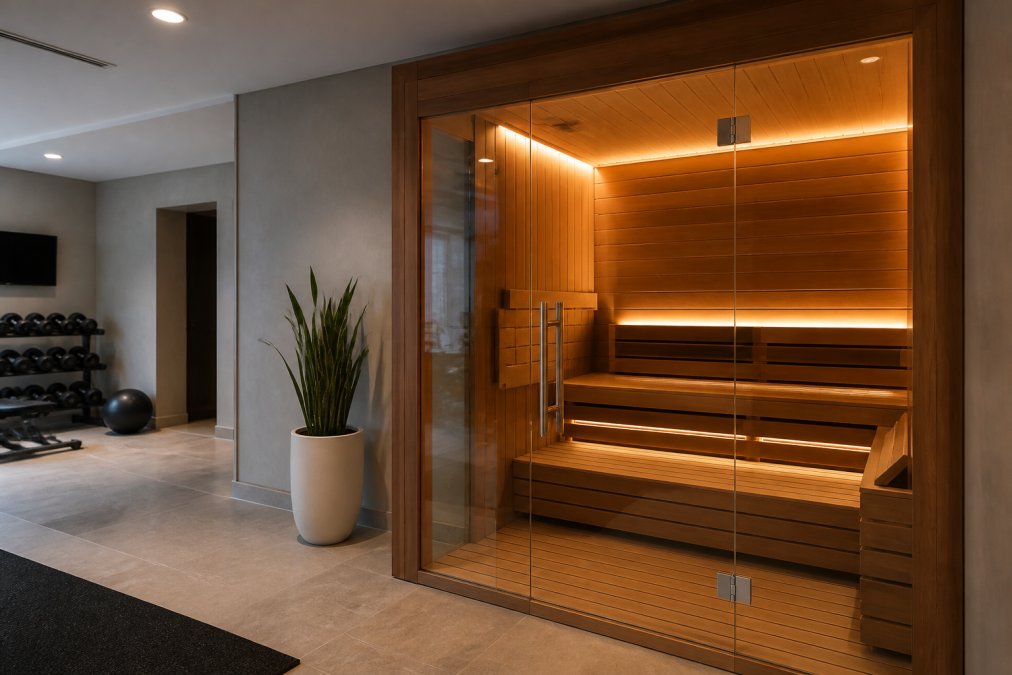
Sauna and cold plunge packages represent the most popular thermal recovery equipment configuration for commercial wellness facilities, creating contrast therapy protocols that position your facility as a serious recovery destination.
A typical package includes a commercial sauna unit (capacity 4-8 people), a dedicated cold plunge tank (capacity 2-4 people), and integrated circulation systems. The sauna heats to operational temperature in 30-45 minutes, while the cold plunge maintains 50°F-55°F year-round using commercial-grade refrigeration.
Members spend 15-20 minutes in the sauna, then 2-3 minutes in the cold plunge, repeating the cycle. This thermal contrast stimulates circulation, reduces muscle soreness, and delivers the recovery benefits members increasingly expect from premium facilities.
Installation requires proper ventilation, drainage, electrical infrastructure, and often structural reinforcement. Most facilities allocate 200-300 square feet for a functional sauna and cold plunge setup with 8-10 feet minimum ceiling height.
Operational management is straightforward once installed. Daily tasks include temperature verification, water quality testing, and surface cleaning. Weekly maintenance involves filter changes and system inspections. Most staff can learn proper protocols within a few training sessions.
Member use typically runs 40-60% of facility capacity during peak hours. A facility with 200 members will see 80-120 member visits per week to thermal recovery services, representing consistent, recurring revenue if priced appropriately.
Thermal Recovery Equipment Financing Options
The upfront cost of commercial thermal recovery equipment can range significantly based on system type and capacity. Financing allows facility operators to preserve capital while expanding service offerings.
Financing structures typically work as lease-to-own or equipment loans. With lease-to-own arrangements, your facility makes monthly payments over 3-7 years, with ownership transferring at the end. Equipment loans function like traditional business loans, with ownership immediate and repayment over time with interest.
The business case is straightforward: if thermal recovery equipment generates significant monthly incremental member fees and ancillary revenue, then monthly financing payments can create positive cash flow from month one.
Eternall Wellness offers financing options specifically designed for wellness facilities. We help you evaluate revenue potential first, making data-informed decisions about ROI before committing capital.
Data from similar facilities shows that thermal recovery equipment, when properly integrated into member experience, achieves strong use. The key is positioning it correctly as part of your facility's core recovery offering, not as an optional add-on.
Financing also preserves your credit line for other operational needs rather than depleting cash reserves.
Best Practices for Thermal Therapy Facility Management
Operating commercial thermal recovery equipment successfully requires consistent protocols, staff training, and preventive maintenance.
Daily operational protocols should be documented and followed precisely. This includes pre-opening temperature checks (sauna should reach target temperature 30 minutes before member access), water quality testing in cold plunges (pH, chlorine, temperature), and visual inspections for cracks, corrosion, or electrical issues.
Member safety procedures must be clearly communicated. Post signage indicating temperature, recommended session duration (typically 15-20 minutes maximum for sauna), and contraindications. Train staff to recognize heat exhaustion symptoms and enforce session time limits for new members.
Cleaning and sanitation prevent bacterial growth and member illness. Daily cleaning includes wiping down sauna benches and cold plunge surfaces with hospital-grade disinfectant. Weekly deep cleaning involves draining and refilling cold plunge systems, cleaning filters, and sanitizing all contact surfaces.
Equipment maintenance schedules extend system lifespan. Sauna systems need annual professional inspection, including thermostat calibration and heating element testing. Cold plunge refrigeration systems require quarterly filter replacement and annual professional servicing. Document all maintenance to track patterns and plan replacements before failures occur.
Staff training is non-negotiable. Every staff member who operates or supervises thermal recovery equipment should complete formal training on temperature control, safety protocols, emergency procedures, and basic troubleshooting.
Member communication shapes experience and use. Send new members orientation videos showing proper sauna and cold plunge use. Explain the contrast therapy protocol and why alternating between heat and cold amplifies recovery benefits. Members who understand the "why" use systems more consistently and report higher satisfaction.
ROI of Wellness Recovery Equipment for Your Business
Return on investment depends on three factors: initial cost, monthly revenue generated, and operational expenses.
Revenue generation comes from membership tier increases (charging more for memberships that include thermal recovery access), thermal recovery packages (selling sauna and cold plunge sessions separately), and ancillary services (massage, stretching, recovery coaching paired with thermal sessions).
A facility with 200 members that adds thermal recovery equipment might increase membership pricing by $15-$30 monthly for members who want recovery access. If 60% of members upgrade (120 members), that's $1,800-$3,600 in incremental monthly revenue. Add another $800-$1,200 from non-member sessions and package purchases, and total monthly revenue can be significant.
Operational expenses include utilities, water, maintenance supplies, and staff time. Most facilities report monthly operational costs between $400-$700.
If a facility generates significant monthly thermal recovery revenue with typical operational costs, and equipment financing costs are manageable, the facility can achieve positive cash flow from the first month.
Payback timelines vary significantly. A small gym adding a single sauna might reach payback in 18-24 months. A larger facility integrating multiple modalities might achieve payback in 12-18 months with strong member adoption.
The less obvious ROI benefit is member retention. Facilities that add premium recovery services typically see improved member retention rates. Retained members generate far more lifetime value than new member acquisition.
| Facility Size | Estimated Monthly Revenue | Estimated Monthly Costs | Net Monthly Contribution | Payback Timeline |
|---|---|---|---|---|
| Small gym (150 members) | Varies | Varies | Varies | Varies |
| Medium gym (250 members) | Varies | Varies | Varies | Varies |
| Large facility (500+ members) | Varies | Varies | Varies | Varies |
| Med spa (50-100 members) | Varies | Varies | Varies | Varies |
Maintenance and Reliability Standards for Commercial Systems
Commercial thermal recovery equipment operates in demanding environments with daily use, high temperatures, humidity, and constant member traffic. Equipment meeting professional maintenance and reliability standards survives this stress; equipment that doesn't fails prematurely.
Reliability standards for commercial sauna systems typically include thermostat accuracy within ±5°F, heating elements that maintain consistent temperature even with door openings, safety cutoffs that prevent overheating, and humidity control that maintains target levels within ±10%.
Cold plunge systems should maintain water temperature within ±2°F of target, with automatic refrigeration cycling that prevents temperature drift. Filtration systems should cycle water completely every 2-4 hours.
Maintenance intervals follow predictable patterns. Sauna systems need annual professional inspection, including thermostat calibration and heating element testing. Cold plunge systems require quarterly filter replacement, monthly water chemistry testing, and annual refrigeration system servicing. Infrared systems need annual bulb replacement.
Facilities that follow manufacturer maintenance schedules see equipment lasting 10-15 years. Facilities that defer maintenance see failures within 5-7 years and face expensive emergency repairs.
Documentation is critical. Keep detailed logs of every maintenance action to create a historical record that helps predict when major components will fail, allowing you to plan replacements before they break.
Supplier reliability matters as much as equipment reliability. Choose manufacturers or distributors that maintain local service capacity. Before purchasing, confirm that service technicians are available within 50 miles of your facility.
Selecting the Right Equipment for Your Facility's Needs
Choosing the best commercial thermal recovery equipment requires honest assessment of your facility's space, budget, member demographics, and operational capacity.
Space assessment comes first. Measure available square footage and ceiling height. A sauna needs 100-150 square feet with 8-10 feet of ceiling height. Cold plunge systems need 50-75 square feet. Steam rooms need 80-120 square feet. Infrared systems can fit into smaller spaces (as small as 60 square feet for a single-person unit).
Infrastructure evaluation is critical. Have a licensed electrician assess your facility's electrical capacity. Commercial sauna systems draw 30-50 amps at 240V (nfpa.org). Cold plunge refrigeration systems draw 15-25 amps. Check water pressure and drainage capacity as well.
Member demographics should guide your selection. A facility serving primarily athletes benefits from sauna and cold plunge combinations. A med spa might prioritize infrared thermal recovery equipment. A wellness clinic serving older members might emphasize traditional sauna and steam options.
Budget reality matters. If your facility can allocate a certain budget, you can install a quality sauna and cold plunge system. If your budget is lower, you're limited to a single sauna or infrared system. If your budget is higher, you can integrate multiple modalities.
Operational capacity determines what systems you can realistically manage. A single sauna requires minimal staff training and maintenance. A system combining sauna, cold plunge, and infrared requires more sophisticated operational protocols.
At Eternall Wellness, we help facility operators work through this selection process systematically. We evaluate your specific situation, space, budget, member base, staff capacity, and business goals to ensure the thermal recovery equipment you select generates strong ROI.
Many facility owners choose equipment based on manufacturer specifications rather than real-world fit. Better to choose equipment that's slightly less advanced but perfectly aligned with your operational reality.
Selecting the right commercial thermal recovery equipment requires balancing technical specifications, space constraints, member demand, and operational realities. The best choice is the one that fits your facility, appeals to your members, and your team can operate reliably.
Eternall Wellness specializes in helping facilities evaluate thermal recovery equipment as revenue-generating services. With financing options available, you can expand your service offerings while preserving capital. Learn more about wellness equipment ROI calculations to understand how thermal recovery systems generate consistent, recurring revenue for facilities like yours.
Frequently Asked Questions
What features should I look for in commercial thermal recovery equipment?
Prioritize thermal efficiency, flow rate capacity, and system integration with your existing building management systems. Look for variable speed drive technology to optimize energy use, durable heat exchangers rated for high-capacity operations, and pressure testing certification. Equipment should also support operational reliability through multi-stage design and include surveillance monitoring capabilities. Verify that the system meets environmental compliance standards and can handle your facility's daily utilization demands without performance degradation.
How does thermal recovery equipment improve client retention in wellness centers?
Thermal recovery systems create differentiated service offerings that attract members seeking premium wellness experiences. By adding sauna, cold plunge, or infrared therapy modalities, you increase reasons for members to visit and extend their time on-site. These services support post-workout recovery and injury management, which complements existing offerings like fitness and chiropractic care. Members using recovery equipment report higher satisfaction and are more likely to maintain active memberships, directly improving retention metrics.
What are the maintenance requirements for commercial-grade thermal recovery systems?
Commercial thermal recovery equipment requires regular maintenance protocols including filter drier replacement, pressure testing, refrigerant recovery checks, and heat exchanger cleaning. Most systems need quarterly inspections to ensure consistent thermal management and prevent carbon footprint-related inefficiencies. Establish a preventive maintenance schedule with your equipment provider, document all service activities, and train staff on daily operational checks. Proper maintenance extends equipment lifespan, maintains energy reclamation efficiency, and ensures compliance with safety standards.
Is a thermal recovery system worth the investment for a smaller gym?
Yes, thermal recovery equipment scales effectively for facilities of all sizes. Smaller gyms with 150+ members can generate recurring revenue through pay-per-use or membership add-on pricing models. Equipment typically pays for itself through utilization within 18-36 months, depending on pricing strategy and member adoption. Financing options preserve capital while you build the revenue stream. Start with a single high-capacity unit or a sauna-cold plunge package, then expand based on demand and performance metrics.
Are there specific safety standards for thermal recovery equipment in med spas?
Yes. Commercial thermal recovery equipment must comply with ASME (American Society of Mechanical Engineers) standards for pressure vessels and heat exchangers. Hyperbaric and sauna systems require FDA compliance for medical-grade installations. Check state and local building codes for ventilation, electrical, and plumbing requirements specific to your facility type. Work with your equipment provider to ensure all systems pass pressure testing, environmental compliance audits, and liability insurance requirements before operation. Professional installation and commissioning are essential for regulatory adherence.
This article was written using GrandRanker