 blog
blog
Best Wellness Recovery Equipment for Spas
Table of Contents
- Quick Comparison: Top Wellness Recovery Equipment for Spas
- Red Light Therapy and Photobiomodulation Systems
- Compression Therapy, Cryotherapy, and Percussion Massage
- Hyperbaric Oxygen Chamber for Sale: What Spa Owners Need to Know
- Wellness Equipment Financing Options
- ROI of Wellness Recovery Services: Space, Staff, and Safety
- How to Choose the Right Wellness Recovery Equipment for Your Spa
- Conclusion
- Frequently Asked Questions
Last Updated: September 16, 2026
Quick Comparison: Top Wellness Recovery Equipment for Spas
Choosing the best wellness recovery equipment for spas comes down to matching each modality to your space, your staffing model, and the clients you already serve. At Eternall Wellness, we evaluate these systems as revenue-generating services rather than one-time purchases, because that framing changes which technologies make sense for a given facility. Red light therapy, compression therapy, cryotherapy, and percussion devices each solve a different problem, and most successful spas run two or three together rather than betting everything on one unit. Below, we break down the categories side by side, then dig into the operational math that decides whether a system pays for itself. (Source: photobiomodulation research)
| Equipment Category | Primary Benefit | Space Needed | Staffing Demand | Best For |
|---|---|---|---|---|
| Red light therapy | Skin and tissue recovery | Low | Low | Med spas, wellness clinics |
| Compression therapy | Circulation and lymphatic drainage | Low | Low | Gyms, recovery studios |
| Cryotherapy / cold plunge | Inflammation reduction | Medium | Medium | Performance-focused facilities |
| Percussion massage | Muscle recovery | Very low | Low | Any facility |
| Infrared sauna | Heat therapy, relaxation | Medium | Low | Luxury spas |
| Hydrotherapy | Rehabilitation, body composition | High | High | Clinical settings |
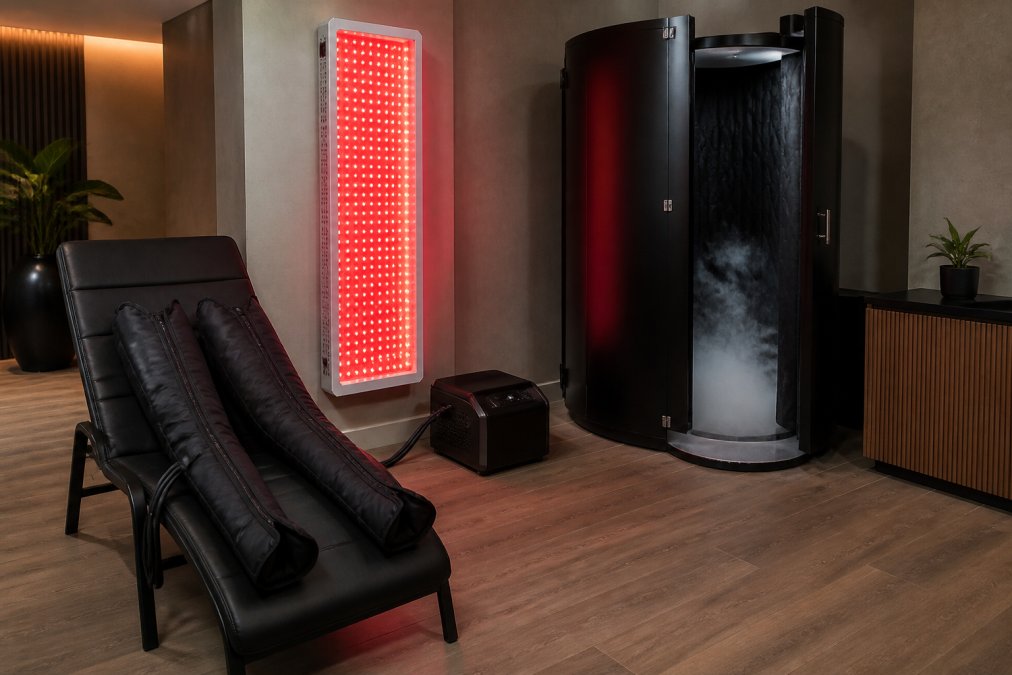
A common mistake is buying equipment before mapping the floor plan. Measure your available square footage first, then match modalities to it.
Red Light Therapy and Photobiomodulation Systems
Photobiomodulation is the clinical term for how red and near-infrared light interacts with cells to support tissue repair and reduce inflammation. Red light therapy systems deliver specific therapeutic wavelengths that penetrate the skin without heat, making them comfortable for most clients and simple for staff to operate.
Unlike equipment that requires a trained technician in the room, most red light panels and beds run on preset programs.
Compression Therapy, Cryotherapy, and Percussion Massage
These three modalities anchor most recovery floors, and each one solves a different problem. Treating them as interchangeable is the fastest way to buy the wrong unit.
Compression Therapy
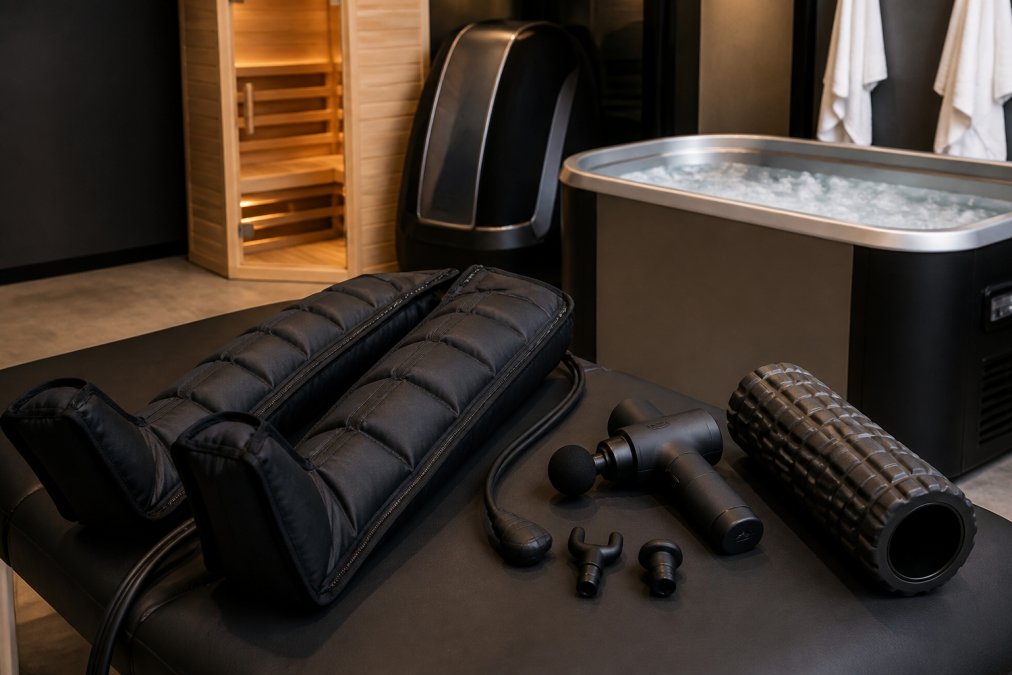
Compression therapy uses pneumatic boots and sleeves that inflate in sequenced chambers to support circulation and lymphatic drainage. A typical session runs 20 to 45 minutes, the client stays fully clothed, and one attendant can oversee several stations at once.
Cryotherapy and Cold Plunge
Cold exposure targets inflammation reduction and post-exertion recovery. Two formats dominate: whole-body cryotherapy chambers, which use chilled air for two to four minutes, and cold plunge tanks, which immerse the client in water held at a controlled low temperature for a longer interval.
Percussion Massage and Vibration Therapy
Percussion devices deliver rapid, targeted pulses to a specific muscle group. Vibration therapy, including whole-body vibration plates and vibrating rollers, applies a broader, lower-intensity stimulus. Both are low-cost, low-space additions that work best as self-service stations or as add-ons to a longer service rather than as standalone bookings.
How the Three Fit Together
A common pattern is to run all three as a single recovery circuit: a client starts with percussion to warm tissue, moves to compression for circulation, and finishes with a short cold plunge. That sequence raises average ticket value, gives the client a reason to book a longer appointment, and spreads the cost of the cold plunge across more sessions.
Hyperbaric Oxygen Chamber for Sale: What Spa Owners Need to Know
A hyperbaric oxygen chamber for sale represents one of the larger investments in the recovery category, and it demands more planning than a compression boot. These systems require dedicated space, careful client screening, and staff who understand operating protocols.
Wellness Equipment Financing Options
Wellness equipment financing options let facilities preserve working capital while adding new services. Rather than paying the full cost upfront, you spread the investment across monthly payments that ideally sit below the revenue the equipment generates. (Source: infrared sauna market trends)
ROI of Wellness Recovery Services: Space, Staff, and Safety
Most articles on recovery equipment stop at the product list. The section that actually decides whether a modality belongs in your facility is the operational math, and that math comes down to three variables: revenue per square foot, labor cost per session, and the cost of safety compliance.
Revenue Per Square Foot
Start by measuring the usable footprint of each modality, including the clearance a client and attendant need to move around it. Then divide the monthly revenue you realistically expect from that service by the square footage it occupies.
Labor Cost Per Session
Labor is the largest recurring cost in most recovery offerings, and it is the variable most buyers ignore. Sort each modality into one of three buckets:
- Unattended: the client runs the session with preset programs and minimal oversight. Labor cost per session is near zero.
- Supervised: a staff member sets up the client, monitors the session, and resets the equipment. Labor cost per session is moderate.
- Attended: a trained technician stays with the client for the duration. Labor cost per session is high and scales directly with booking volume.
Safety Compliance as a Cost Line
Contraindication screening, staff training, and documented protocols are not overhead you can skip, they are the cost of operating advanced recovery technology responsibly. Budget for them explicitly:
- Written screening forms for every client before their first session on cold exposure, heat therapy, or hyperbaric systems
- Documented staff training with a refresher cadence
- A written emergency protocol posted at each station
- A maintenance log for every unit, since manufacturers tie warranty coverage to documented service
Putting the Numbers Together
| ROI Factor | What to Measure | Why It Matters |
|---|---|---|
| Space efficiency | Monthly revenue ÷ usable square feet | Justifies or disqualifies large systems |
| Staffing hours | Labor cost per session | Protects margin on attended services |
| Safety compliance | Screening, training, and maintenance records | Reduces liability and preserves warranty |
| Use rate | Sessions booked vs. sessions available | Drives payback speed |
Model all four before you sign. A modality that looks strong on space efficiency can still fail if its use rate never reaches the level your payback math assumed.
How to Choose the Right Wellness Recovery Equipment for Your Spa
Match the equipment to your clients, not to a trend. The best wellness recovery equipment for spas is the system your existing clientele will actually book, at a price point they will pay, in a space you already have.
Work through this sequence:
- List the services your clients already request most often
- Measure available square footage and note power and ventilation needs
- Estimate realistic use, not best-case
- Confirm staffing capacity and training requirements
- Model monthly payment against projected monthly revenue
- Verify contraindication screening and safety protocols are in place
- Pilot one modality before committing to a full circuit
The facilities that succeed treat recovery equipment as a service line with its own pricing, staffing, and marketing plan, not as a piece of equipment parked in a spare room.
Conclusion
Adding recovery services is a capital decision, and the pressure to get it right is real. Eternall Wellness helps gyms, spas, med spas, and wellness clinics evaluate premium, multi-modality systems as revenue-generating services, with financing available to preserve capital while you expand. Our portfolio includes red light therapy systems, thermal recovery equipment, and hyperbaric chambers built for commercial environments. Get started with Eternall Wellness and build a recovery offering that pays for itself.
Frequently Asked Questions
What is the best device for muscle recovery in a spa setting?
The best device depends on your clients and space. Compression therapy and percussion massage are popular for post-workout recovery, while red light therapy and infrared sauna support circulation and inflammation reduction. For a spa, a mix of modalities often works best because it serves different needs. Consider your client base and available square footage before deciding. Many facilities start with one or two systems and expand based on demand.
How do I choose the right wellness recovery equipment for my spa?
Start by assessing your space, budget, and client demand. Look for commercial-grade equipment built for frequent use, and check training and support requirements. Consider a hybrid recovery circuit that combines multiple modalities to maximize space and revenue. Financing options can help preserve capital. Always request a demo or trial period, and review safety protocols and staff certification needs before committing.
What are the benefits of adding hyperbaric oxygen therapy to a spa?
Hyperbaric oxygen therapy can support tissue repair and inflammation reduction, making it attractive for recovery-focused clients. It adds a premium service that can differentiate your spa and attract high-end clientele. However, it requires significant space, staff training, and safety compliance. Evaluate client demand and operational capacity before investing. Financing and ROI analysis can help determine if it fits your business model.
Are there specific regulations for operating wellness recovery equipment in spas?
Regulations vary by state and modality. Some equipment, like hyperbaric chambers, may be subject to FDA clearance and state health department rules. Always check with local authorities and consult a legal professional. Ensure staff are properly trained and that you have liability insurance. Compliance is your responsibility, so verify requirements before purchase and operation.