 blog
blog
Best Thermal Recovery Systems 2026: Buyer's Guide
Table of Contents
- How to Compare Thermal Recovery Systems in 2026
- Comparing Commercial Sauna and Cold Plunge Packages
- Thermal Recovery Equipment ROI for Gyms and Clinics
- Best Practices for Wellness Facility Recovery Zones
- Thermal Therapy Equipment Maintenance Standards
- Regulatory Compliance for Thermal Recovery Systems
- Frequently Asked Questions
Last Updated: September 12, 2026
How to Compare Thermal Recovery Systems in 2026
Comparing thermal recovery systems in 2026 starts with one question: what will the equipment actually do for your facility's revenue and retention? At Eternall Wellness, we've watched gym owners, med spa directors, and clinic managers wrestle with the same problem. The equipment matters, but the business case matters more. This buyer's guide breaks down the specs, the ROI math, and the compliance questions that separate a smart purchase from an expensive mistake. Below, we'll show you exactly how to evaluate thermal recovery systems before you sign anything.
Residential vs. Commercial: What Changes
Commercial thermal recovery systems are built for continuous, multi-user operation, while residential units assume one or two users with long gaps between sessions. That difference drives everything: duty cycle, warranty terms, service intervals, and how the unit handles back-to-back bookings during peak hours.
For a gym or clinic, the practical implications are:
- Duty cycle: Commercial equipment is rated for repeated daily cycles; residential units typically are not.
- Warranty coverage: Commercial warranties usually assume professional maintenance schedules.
- Throughput: Session capacity per hour directly determines your revenue ceiling.
A common mistake is buying residential-grade equipment to save on upfront cost, then discovering it can't handle 30 sessions a day. The savings evaporate the first time a unit goes down during peak hours.
The Specs That Actually Matter
The specs that decide whether a system performs are heat recovery efficiency, airflow capacity, and how the unit manages moisture and frost. Everything else is secondary.
Two definitions worth locking in:
Sensible heat is the energy that changes air temperature without changing moisture content. Latent heat is the energy tied to moisture, released or absorbed when water vapor condenses or evaporates. Systems that recover both move far more total energy than temperature-only designs.
Also check:
- Heat transfer coefficient and thermal conductivity of the core material
- Ventilation rate at your expected occupancy
- Frost protection strategy for your climate
Comparing Commercial Sauna and Cold Plunge Packages
Commercial sauna and cold plunge packages are best compared on three axes: session throughput, installation requirements, and how well the two modalities pair in one recovery zone. A sauna that seats four and a plunge that holds two creates a bottleneck; match capacities or you'll frustrate members.
| Package Type | Best For | Key Consideration | Maintenance Load |
|---|---|---|---|
| Traditional sauna + plunge | High-traffic gyms | Ventilation and drainage | Moderate |
| Infrared sauna + plunge | Med spas, clinics | Electrical load | Lower |
| Hybrid multi-modality zone | Recovery studios | Floor space and layout | Higher |
| Compact single-unit | Small gyms under 200 members | Throughput limits | Low |
Smaller facilities often assume these systems aren't for them. In practice, a single well-placed sauna and plunge pair can anchor a premium membership tier even in a 150-member gym, provided you price and schedule it correctly.
Thermal Recovery Equipment ROI for Gyms and Clinics
Thermal recovery equipment ROI for gyms and clinics comes down to use, pricing, and how many members upgrade to access it. The equipment doesn't pay for itself; the service model does. What separates a defensible projection from a hopeful one is whether you model the full cost stack and the realistic ramp, not just the sticker price.
The Four Cost Buckets
Most operators underwrite only the equipment line. A complete model has four:
- Capital cost, equipment, delivery, and installation. Installation is frequently underestimated because it includes electrical work, drainage, ventilation modifications, and any structural reinforcement for filled plunge tubs.
- Operating cost, energy to heat and chill, water treatment chemicals, filter media, and the staff time to run and monitor the zone.
- Maintenance and lifecycle cost, scheduled service, replacement parts, and the eventual major-component replacement. Heat exchangers, pumps, and control boards are the components most likely to drive a mid-life capital event.
- Financing cost, if you spread the purchase across monthly payments, the interest is a real line item, not a rounding error.
A Payback Framework You Can Run Yourself
You don't need a spreadsheet wizard to get a defensible number. Build it in four steps:
- Step 1, Revenue per session. Take your session price or the monthly premium members pay for recovery access, and divide the premium by the number of sessions a typical member uses per month to get an effective per-session value.
- Step 2, Realistic sessions per day. Use a ramp, not a peak. A common pattern is 30-40% of capacity in the first months, climbing as the service is marketed and members adopt it.
- Step 3, Monthly operating cost. Add energy, chemicals, filter media, and allocated staff time. This is the number that quietly kills optimistic models.
- Step 4, Payback period. Divide the net capital cost (after any financing down payment) by monthly net contribution (revenue minus operating cost). The result is your months-to-payback.
Run the same math at 40%, 60%, and 80% utilization. If payback only works at 80%, you don't have a business case yet, you have a best-case scenario.
Lifecycle Costs Nobody Puts in the Brochure
The hidden costs of thermal recovery are concentrated in three places:
- Filter and media replacement. Plunge filtration media and sauna air filters are consumables. Over a multi-year horizon, these add up faster than most buyers expect.
- Water treatment. Skipped or sloppy water chemistry is the single most common cause of premature component failure in plunge systems. The chemical cost is small; the repair cost is not.
- Component degradation. Heating elements, pumps, and heat exchangers degrade with cycling. A unit rated for continuous commercial duty will outlast a residential-grade unit in the same role, which is why the cheaper upfront option often has the higher lifecycle cost.
Financing vs. Paying Upfront
Financing changes the picture in two ways. It preserves working capital for marketing and staffing, the things that actually drive utilization, and it matches outflows to the revenue the service generates. The trade-off is interest cost and, in some cases, equipment liens. Compare the total cost of financing against the opportunity cost of tying up capital, and pick the option that keeps your cash position healthy through the ramp period.
A Simple Sensitivity Check
Before you commit, stress-test three variables: session price, utilization, and operating cost. If a 10% drop in price or a 20% rise in operating cost breaks the model, the margin is too thin. The facilities that get this right build in a cushion and revisit the model quarterly against actuals.
Best Practices for Wellness Facility Recovery Zones
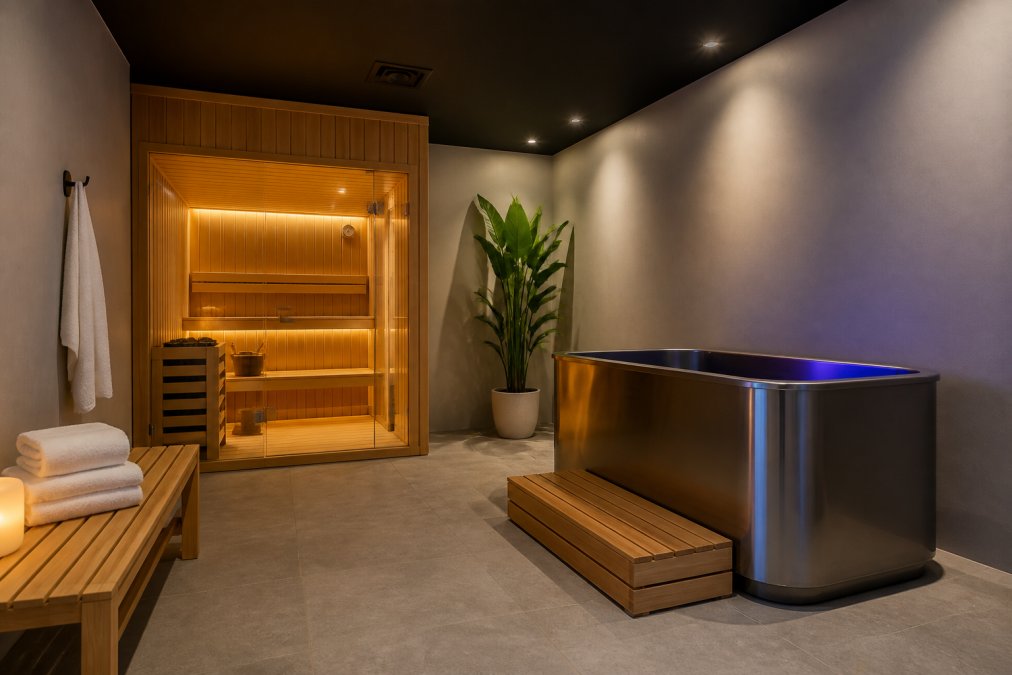
Wellness facility recovery zones work best when they're designed around flow, not just equipment. Members move between heat and cold, so layout, privacy, and proximity matter as much as the machines themselves.
Design principles that hold up:
- Cluster heat and cold together so members don't walk across the building between modalities
- Control the environment with proper ventilation and humidity management
- Build in rest space between stations
- Keep sightlines and staff access clear for safety monitoring
Indoor air quality in a recovery zone is not optional. Saunas, plunge areas, and steam produce moisture and heat loads that a standard HVAC system wasn't sized for. Plan the exhaust air stream and fresh air intake deliberately.
Thermal Therapy Equipment Maintenance Standards
Thermal therapy equipment maintenance standards exist for a reason: heat, moisture, and continuous cycling wear components faster than most facility managers expect. A maintenance schedule protects both uptime and warranty coverage.
A practical baseline schedule:
- Daily: inspect water chemistry, filters, and surface condition
- Weekly: check seals, drains, and heating elements
- Monthly: service ventilation and heat exchanger components
- Quarterly: professional inspection of electrical and control systems
- Annually: full system audit and parts replacement review
The thing nobody tells you about thermal equipment is that most failures trace back to skipped water treatment or clogged filtration, not to the heating system itself. Cheap prevention, expensive neglect.
For guidance on workplace safety and equipment standards, the Occupational Safety and Health Administration publishes general workplace safety resources that apply to commercial facilities.
Regulatory Compliance for Thermal Recovery Systems
Regulatory compliance for thermal recovery systems depends on your facility type, your state, and the specific modality. There is no single national rule that covers every thermal recovery installation, which is exactly why operators get surprised. The practical approach is to work through the layers in order, energy code, electrical code, plumbing and mechanical code, accessibility, and health-department rules, and document each one before you order equipment.
Energy Code: The 2026 Baseline
Commercial buildings are governed by state-adopted energy codes, most of which are based on the ASHRAE 90.1 standard or the International Energy Conservation Code (IECC) (energy.gov). These codes set requirements for ventilation, exhaust, and HVAC efficiency that directly affect how a recovery zone must be designed. A sauna, steam room, or plunge area adds moisture and heat loads that a standard HVAC design may not accommodate, so the ventilation strategy has to be engineered, not assumed.
What to verify:
- Ventilation rates for the recovery zone at expected occupancy
- Exhaust requirements for moisture-laden air streams
- HVAC efficiency targets that apply to any added equipment
- Economizer and heat recovery provisions that may apply to your exhaust air
Electrical Code
Equipment installation must comply with the National Electrical Code (NEC), as adopted and amended by your state or local jurisdiction. The items that most often trip up recovery installations are:
- Circuit capacity, saunas and plunge chillers draw significant amperage, and existing panels may not have headroom
- Ground-fault protection, required in wet locations, including plunge areas
- Disconnect and emergency shutoff, location and labeling requirements
- Bonding and grounding, especially for metallic tubs and equipment in wet environments
Plumbing and Mechanical Code
Plunge systems and steam rooms fall under plumbing and mechanical code requirements for water supply, drainage, backflow prevention, and venting. Verify:
- Backflow prevention on any potable water connection to a plunge or steam system
- Drainage capacity for the volume of water involved in draining and refilling
- Ventilation and exhaust for steam and moisture
- Floor loading and waterproofing for filled tubs
Accessibility
The Americans with Disabilities Act (ADA) applies to places of public accommodation, which includes gyms, spas, and clinics. Recovery zones should be evaluated for accessible routes, clear floor space, and transfer options where applicable. Accessibility is easiest and cheapest to design in before construction, not after.
Health Department Rules
If you operate a medical or spa facility, state and local health departments may impose additional requirements on water quality, sanitation, and record-keeping. These rules vary widely by jurisdiction and by modality, so confirm them directly with your local authority before installation.
Manufacturer Certifications and Documentation
Ask vendors for documentation of the certifications that apply to their equipment, for example, listings from a nationally recognized testing laboratory. Keep the documentation on file. Inspectors and insurers may ask for it, and it protects you if a warranty dispute arises.
A Compliance Checklist
- Confirm the energy code edition adopted in your jurisdiction
- Verify electrical capacity and NEC compliance with a licensed electrician
- Confirm plumbing and mechanical code requirements for water and drainage
- Evaluate ADA accessibility for the recovery zone
- Check state and local health department rules for your facility type
- Collect and file manufacturer certifications
- Document staff training on operation and safety
Compliance is not a one-time checkbox. Inspections, documentation, and staff training all factor into staying compliant over the life of the equipment. Confirm requirements with your local authorities and a qualified professional before you buy.
For guidance on workplace safety and equipment standards, the Occupational Safety and Health Administration publishes general workplace safety resources that apply to commercial facilities.
Frequently Asked Questions
What are the benefits of thermal recovery systems for wellness clinics?
Thermal recovery systems help wellness clinics attract clients seeking recovery and relaxation services. They can increase member retention by offering premium amenities like saunas and cold plunges. These systems also create opportunities for recurring revenue through day passes or memberships, complementing existing services like massage or chiropractic care.
How do I choose the right thermal recovery equipment for a commercial space?
Start by assessing your available space, power supply, and ventilation. Consider your target clients: gyms may prioritize durability and quick recovery cycles, while med spas might focus on comfort and aesthetics. Evaluate energy efficiency, maintenance requirements, and whether the equipment can be integrated with your existing HVAC. Always request a site assessment from the vendor.
What is the expected ROI for installing thermal recovery systems in 2026?
ROI depends on utilization, pricing, and operational costs. To estimate, calculate potential revenue from additional memberships or service fees, then subtract equipment cost, installation, and ongoing maintenance. Financing options can help preserve capital while you build revenue.
Are there specific safety regulations for thermal recovery systems in wellness centers?
Regulations vary by state and municipality. Most require compliance with local building codes, electrical standards, and health department rules for public pools or spas. For saunas and cold plunges, ensure proper drainage, non-slip surfaces, and temperature controls. Consult your local health department and a qualified installer to meet all requirements.