 Comparison
How to Compare New vs Refurbished Med Spa Devices in 2026
Last Updated: November 7, 2026
Quick Summary
Comparing new vs refurbished med spa devices comes down to total cost of ownership, not sticker price. Build a five-year ownership model covering acquisition, financing, training, consumables, maintenance, repair reserve, downtime, and resale value, then compare both options against your actual booking volume. Refurbished units only save money if documented service history, parts availability, and warranty transfer check out.
- Ask refurbished sellers for the service log, hours of operation, and reason the unit was retired.
- Verify the serial number against the manufacturer and confirm the device is not stolen or subject to a lien.
- Hold back part of payment until an on-site acceptance test passes.
- Compare loan, lease, and manufacturer financing on total cost over the term, not monthly payment.
- Map current bookings and empty rooms before shopping so the device fills existing demand.
Table of Contents
- New vs Refurbished Med Spa Devices: The Real Trade-Offs
- New vs Refurbished Equipment: Key Differences at a Glance
- What Refurbished Med Spa Equipment Actually Means
- Refurbished Aesthetic Equipment Warranty and Service Access
- Your Used Cosmetic Laser Buying Checklist
- Med Spa Equipment Financing and Total Cost of Ownership
- Matching the Purchase to Treatment Demand and Room Use
- Building Your Equipment Shortlist with Eternall Wellness
- Frequently Asked Questions
New vs Refurbished Med Spa Devices: The Real Trade-Offs
Comparing new vs refurbished med spa devices comes down to one question most buyers never ask out loud: what is this machine actually going to earn? A device that costs less upfront but sits idle in a back room is more expensive than a pricier unit that runs all day.
The used aesthetic equipment market has matured. Refurbished equipment can come with documented service histories and transferable support, depending on the seller. That does not make them automatically safe. It makes them worth a closer look, provided you know what to verify. Below, we break down the trade-offs, the contract fine print, and the ownership costs that separate a smart purchase from a costly lesson.
New vs Refurbished Equipment: Key Differences at a Glance
| Factor | New Equipment | Refurbished Equipment |
|---|---|---|
| Upfront cost | Highest | Lower, varies by condition |
| Warranty | Full manufacturer term | Limited or third-party |
| Software | Current version | May need updates |
| Device history | None, factory fresh | Must be documented |
| Lead time | Weeks to months | Often faster |
| Support access | Direct from manufacturer | Depends on the refurbisher |
Upfront Cost and Potential Savings
The purchase price gap is the headline reason buyers look at refurbished med spa equipment. A pre-owned device can cost meaningfully less than its new counterpart, and that difference lands directly in your clinic budget. What most guides miss is that the savings are only real if the device is serviceable for years, not months. A cheap unit with no parts availability is a write-off waiting to happen.
Condition, Device History, and Prior Use
Device history is where refurbished deals are won or lost. Ask for the service log, the hours of operation, and the reason the unit was retired. A device pulled from a high-volume clinic after years of daily use is a different risk than one returned after a short lease. Prior use tells you what wear to expect on handpieces, capacitors, and cooling systems.
What Refurbished Med Spa Equipment Actually Means
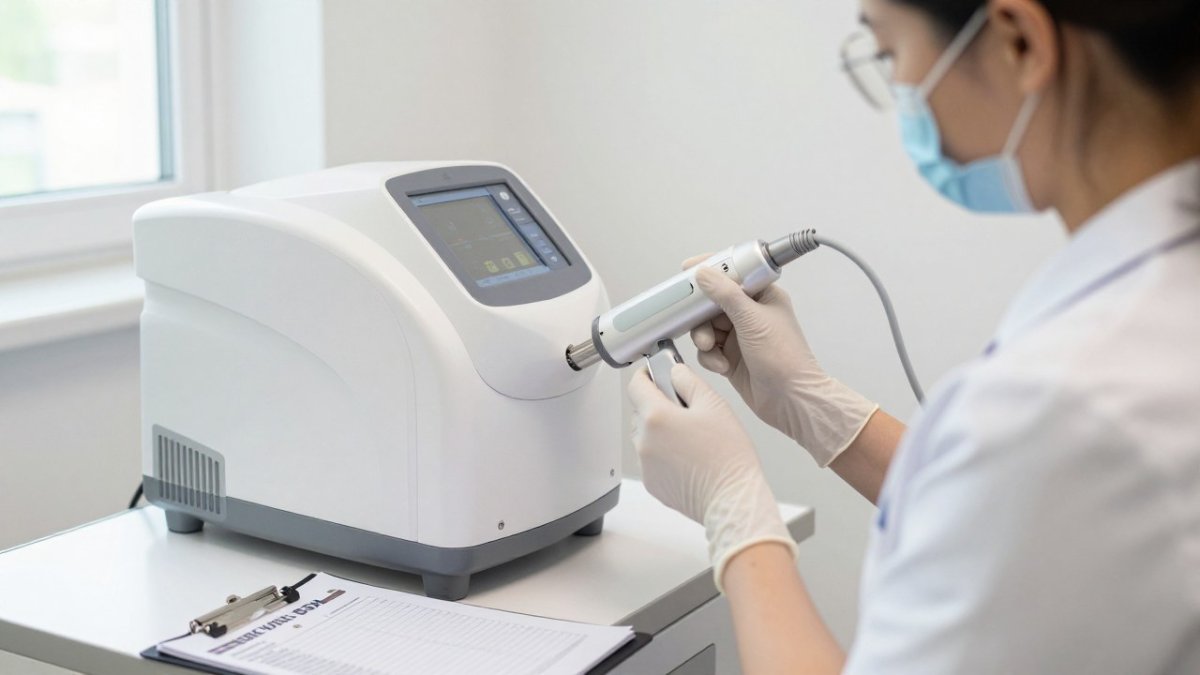
The difference matters because aesthetic lasers and energy devices degrade in specific ways. Output can drift, cooling lines can clog, and software can fall out of step with current treatment protocols. A proper refurbishment process addresses all three. Ask any seller to describe their inspection steps in writing before you commit.
Refurbished Aesthetic Equipment Warranty and Service Access
- What parts are covered, and for how long
- Whether labor and on-site travel are included
- Response time commitments for technical support
- Whether replacement parts are OEM or aftermarket
- What voids coverage, such as using third-party technicians
Maintenance obligations often sit with the buyer. If your team cannot handle routine upkeep, price a service agreement into the deal. Our guide to essential maintenance tips for med spa devices covers what ongoing upkeep actually involves.
Your Used Cosmetic Laser Buying Checklist
A used cosmetic laser buying checklist keeps emotion out of a purchase that should be pure diligence. The generic version, service history, warranty terms, parts availability, is table stakes. What separates a good refurbished purchase from an expensive lesson is verifying the device by technology category, confirming the regulatory and ownership paperwork transfers cleanly, and running an acceptance test before the check clears.
Verify by device category, not as one lump
Refurbishment risk and useful life vary substantially by technology. Ask category-specific questions:
- Lasers (fractional, vascular, pigment, hair removal). Ask for output energy verification against spec, pulse count or shot count where the platform tracks it, and the condition of the flashlamp, fiber, and handpiece optics. Optical components and fibers degrade and are among the most expensive replacements. Confirm the specific wavelengths and spot sizes you need are supported by the installed software, not just the hardware.
- Radiofrequency platforms. Ask about handpiece and electrode condition, calibration records, and whether the unit's temperature and impedance feedback has been tested. RF handpieces are consumable-adjacent and often the largest recurring cost.
- Ultrasound (focused and microfocused). Ask for transducer condition and calibration, treatment count, and whether the transducer is original or replaced. Transducers are frequently the limiting component.
- Body-contouring and cryolipolysis systems. Ask about applicator cup condition and count, vacuum and cooling performance test results, and whether applicators are single-patient or reusable. Applicator replacement can rival the purchase price if several are near end of life.
- Light therapy and recovery devices. Ask for LED or panel output testing, hours of use, and whether replacement panels or lamps are still manufactured.
Verify regulatory status and ownership transfer
This is the step most buyers skip, and it is where a deal can quietly fall apart.
- Confirm the device's regulatory status for its intended use and that the clearance or listing matches the model and intended treatment. Ask the seller for the model number and any FDA clearance or registration information they hold, and verify it independently rather than accepting a screenshot.
- Verify the serial number against the manufacturer's records, and confirm the device is not reported stolen or subject to a lien. Ask for a bill of sale with a clear title representation.
- Confirm whether the manufacturer's warranty or service contract transfers to a new owner, and get that in writing from the manufacturer or refurbisher, not just the seller.
- Confirm software licensing. Some platforms require a license transfer or re-registration; some restrict service to the original owner. Ask whether software updates are still available for the installed version and whether the operating system is still supported.
- Confirm cybersecurity and data handling. If the device stores patient data or connects to a network, ask how data is wiped before transfer and whether the device can receive security updates.
Run an acceptance test before final payment
Do not accept a device on the seller's inspection report alone. Structure the deal so a portion of payment is held until acceptance testing passes.
- Written service history with hours of operation or treatment count
- Inspection report covering output, cooling, and software version
- Serial number verified against the manufacturer
- Regulatory status and clearance verified independently
- Clear title, bill of sale, and lien check completed
- Warranty or service contract transfer confirmed in writing
- Software license transfer and update path documented
- Parts availability confirmed for the next several years
- Category-specific component condition verified (fiber, handpiece, transducer, applicator, lamp)
- On-site acceptance test: power-up, self-test, output verification, cooling performance, and a test treatment on a qualified volunteer or phantom per the seller's protocol
- Installation, delivery, and staff training included or priced
- Insurance and liability coverage confirmed before delivery
That last item catches more buyers than any other. Our breakdown of med spa equipment insurance and liability coverage explains what to confirm before a used device enters your treatment room. And if the seller resists an acceptance test or a held-back payment, treat that as the answer to your question about the device's condition.
Med Spa Equipment Financing and Total Cost of Ownership
Total cost of ownership is the number that decides the deal, and it is never just the sticker price.
A workable model has seven lines. Fill each one for the new unit and the refurbished candidate before you negotiate:
- Acquisition cost. Purchase price plus sales tax, freight, rigging, and any build-out the device requires (dedicated circuits, plumbing, room shielding).
- Financing cost. Total interest and fees over the term, not the monthly payment. A longer term lowers the payment and raises the total.
- Installation and training. Manufacturer or refurbisher installation, plus staff training hours at your loaded labor rate. Confirm in writing whether training is included.
- Consumables. Per-treatment cost multiplied by expected annual treatments. Some platforms use proprietary tips, gels, or handpiece components that only the OEM sells; others have broader aftermarket supply.
- Maintenance and service contract. Annual preventive maintenance plus any service agreement. New devices typically carry a manufacturer service contract; refurbished devices may require a third-party agreement or a per-visit rate.
- Repair reserve and downtime. Set aside a realistic annual reserve for out-of-warranty repairs, and assign a dollar value to treatment days lost while a unit is down. Downtime cost is highest for a device that is your only unit for a high-demand service.
- Resale value. Estimate what the device is worth at the end of the hold period. New equipment generally depreciates steeply in the first two years; a well-supported refurbished unit may hold a flatter curve, but only if parts and service remain available.
Run the model against utilization, not against hope, and check the result against your actual booking volume.
Financing itself is a cash-flow tool, not a discount. Before you sign, review financing options for wellness equipment and understand how to qualify for med spa equipment loans so the terms fit your budget rather than stretch it.
Matching the Purchase to Treatment Demand and Room Use
Treatment demand decides whether a device pays for itself. An idle treatment room is a fixed cost with no offsetting revenue, so the smartest purchase is often the one that fills existing capacity rather than adding new overhead. Map your current bookings before you shop.
Start with the services clients already ask for and the rooms sitting empty during peak hours. A device that fits an existing demand curve beats a flashier unit that requires building a new client base from scratch. If you are planning to grow, our guide on scaling med spa operations with new tech walks through matching equipment to demand and room use.
Building Your Equipment Shortlist with Eternall Wellness
Eternall Wellness supplies premium wellness and recovery systems for commercial facilities, including red light therapy, thermal recovery, and hyperbaric chambers. We help clients evaluate each system as a revenue-generating service, with financing available to preserve capital while you expand. For current pricing or a quote, visit the Eternall Wellness website.
The trade-off between new and refurbished med spa devices is not about which is cheaper. It is about which one you can verify, service, and fill with paying clients. Run the checklist, read the warranty fine print, and model the total cost before you commit.
Frequently Asked Questions
Is it better to buy refurbished or brand-new med spa equipment?
It depends on your budget, treatment mix, and tolerance for downtime. New med spa devices give you the latest features, a full manufacturer warranty, and predictable service access, but the upfront cost is highest. Refurbished med spa equipment can cut the purchase price significantly and still deliver proven technology, provided you verify the refurbishment process, inspection records, and warranty terms in writing. Buy new when a specific new feature drives bookings; buy refurbished when a well-documented, proven device covers demand.
What should you check before buying a refurbished aesthetic device?
Ask for the device history, including age, prior use, and hours of operation.
Do refurbished med spa devices come with a warranty?
Many do, but coverage varies widely. Some refurbished aesthetic equipment warranty plans cover parts and labor for a set period, while others cover parts only or exclude consumables and handpieces. Before you sign, read the fine print on what voids coverage, whether service is performed on site, and how long replacement parts remain available. A short, clearly written warranty from a supplier with a service network is worth more than a long warranty with slow response times.
How much can a med spa save by buying refurbished equipment?
Compare total cost of ownership, including purchase price, financing, installation, training, maintenance and expected lifespan. For current pricing or a quote, visit the Eternall Wellness website.