 how-to
Financing Options for Wellness Equipment: A 2026 Guide
Table of Contents
- How Equipment Financing Works for Wellness Businesses
- Leasing vs. Loans: The Two Main Financing Paths
- Commercial Wellness Equipment Leasing: Flexible Terms and Upgrades
- Business Equipment Loan Requirements: What Lenders Look For
- The Section 179 Tax Deduction for Equipment: A Key Advantage
- Total Cost of Ownership and Credit Impact for Wellness Equipment
- A Checklist for First-Time Buyers
- Frequently Asked Questions
Last Updated: September 22, 2026
How Equipment Financing Works for Wellness Businesses
Financing options for wellness equipment is a lending arrangement that lets a facility acquire recovery systems, therapy devices, or fitness equipment and pay for them over time rather than in one upfront payment. The lender or leasing company retains a security interest in the equipment until the balance is settled.
Here's why this matters for a gym, med spa, or recovery studio right now. Premium modalities like red light therapy panels, thermal recovery systems, and hyperbaric chambers carry meaningful upfront costs. Paying cash for all of them at once drains the working capital you need for staffing, marketing, and day-to-day operations. Financing spreads that cost across the revenue the equipment generates.
At Eternall Wellness, we help facilities think through exactly this trade-off: not just what the equipment costs, but what it can earn once it's running and how financing shapes the payback timeline.
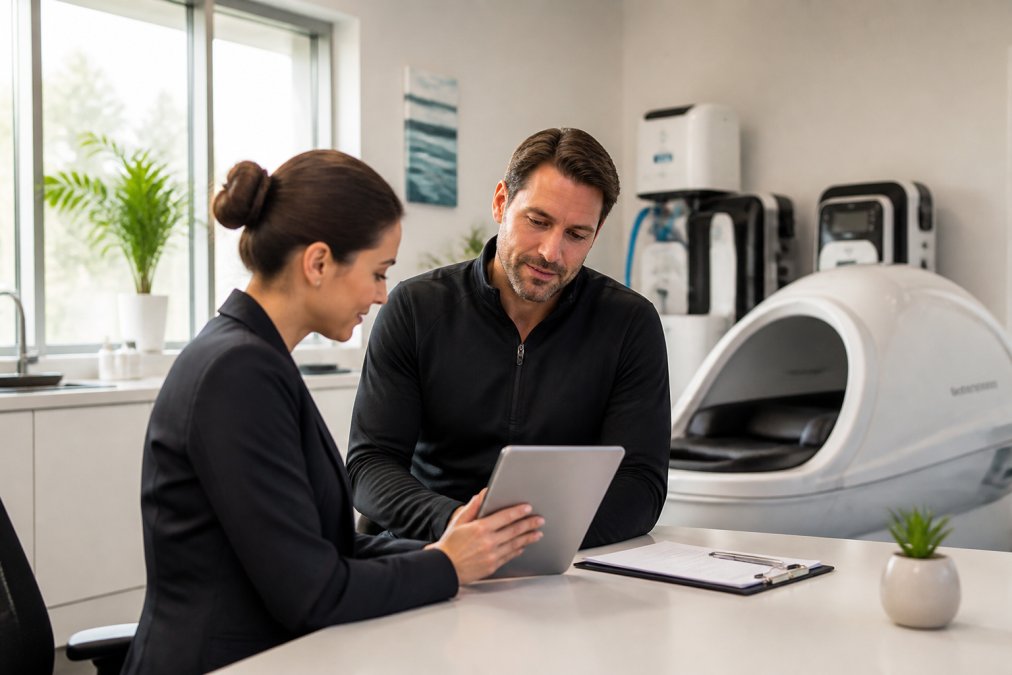
Most arrangements follow one of two structures:
- Secured financing: The equipment itself serves as hard collateral, which typically lowers the interest rate.
- Unsecured or application-only financing: Approval leans on your business credit profile instead of a specific asset, which speeds things up but often costs more.
The structure you choose affects your monthly payments, your approval speed, and how much of your own capital stays in the business. That last point is the one most owners underestimate.
Leasing vs. Loans: The Two Main Financing Paths
A loan gives you ownership from day one; a lease gives you use of the equipment for a set term, usually with an option to buy at the end. That's the core difference, and it drives everything else.
With a business equipment loan, you borrow a fixed amount, repay it with fixed interest over a set loan term, and own the asset outright. You can depreciate it, and if you finance the purchase, you may qualify for the Section 179 tax deduction. Monthly payments tend to be higher because you're paying down the full purchase price.
With commercial wellness equipment leasing, you make lower monthly payments because you're covering the equipment's use during the term, not its full value. At the end of the lease, you typically have options: return it, renew, or purchase it at a set price. For facilities that want to upgrade equipment every few years, this flexibility is the whole point.
| Factor | Equipment Loan | Equipment Lease |
|---|---|---|
| Ownership | Yours immediately | Option to buy at term end |
| Monthly payment | Higher | Lower |
| Down payment | Often required | Sometimes $0 down |
| Upgrade flexibility | Sell or trade in | Swap at lease end |
| Tax treatment | Depreciation + possible Section 179 | Payments may be deductible |
Neither path is automatically better. A med spa planning to keep a hyperbaric chamber for a decade usually comes out ahead with a loan. A gym that wants to refresh its recovery lineup every three years often prefers a lease.
Commercial Wellness Equipment Leasing: Flexible Terms and Upgrades
Leasing tends to win when technology moves faster than your depreciation schedule. Recovery equipment evolves, and a lease lets you adopt new modalities without being stuck with aging systems.
The practical advantages of a lease-to-own or straight lease structure:
- Lower down payment keeps more business capital available for launch marketing and staffing.
- Predictable monthly payments make cash flow management simpler.
- End-of-term flexibility lets you upgrade to newer equipment instead of reselling old units yourself.
- Preserved credit lines leave room for other financing needs.
The trade-off is total cost. Over a long horizon, leasing usually costs more than buying outright because you're paying for flexibility. If you know you'll keep the equipment for its full useful life, a loan is often the cheaper route.
Business Equipment Loan Requirements: What Lenders Look For
Lenders evaluate three things: your credit profile, your time in business, and the equipment itself. Understanding business equipment loan requirements before you apply saves weeks of back-and-forth.
Most lenders weigh these factors:
- Business credit and personal credit scores. Stronger scores unlock better interest rates and larger funding limits.
- Time in business. Established operations get more favorable terms than startups.
- Revenue and cash flow. Lenders want to see that monthly payments fit comfortably within your income.
- Collateral. Equipment serves as hard collateral; other business assets may serve as soft collateral.
- Down payment. A larger down payment reduces the lender's risk and can lower your rate.
Approval speed varies widely. Application-only financing can move quickly for qualified customers, while larger secured loans involve more documentation. For a fuller picture of how lenders assess applications, the U.S. Small Business Administration's loan guidance outlines what underwriters typically review.
The Section 179 Tax Deduction for Equipment: A Key Advantage
The Section 179 tax deduction for equipment lets qualifying businesses deduct the full purchase price of eligible equipment in the year it's placed in service, rather than depreciating it over many years. For a wellness facility buying recovery systems, that can meaningfully reduce taxable income for the year.
Two conditions matter most:
- The equipment must be used in your business and placed in service before year-end.
- You must finance or purchase the equipment; leased equipment generally doesn't qualify the same way.
This is where financing and tax strategy connect. If you finance a purchase, you may still claim the deduction while spreading the payments over time. That combination, a deduction now and manageable payments later, is why many owners choose a loan over a lease for equipment they intend to keep.
Deduction limits, phase-outs, and eligibility rules change, and they depend on your entity type and income. The IRS guidance on Section 179 is the authoritative source for current thresholds, and a tax advisor should confirm how they apply to you.
Total Cost of Ownership and Credit Impact for Wellness Equipment
Total cost of ownership (TCO) is the full cost of an asset over its life: purchase price, financing charges, installation, maintenance, training, and eventual resale or disposal. TCO is the number that actually tells you whether a modality is worth adding, not the sticker price.
Most owners compare only the upfront cost. That's a mistake.
Here's a simple framework for comparing two options:
- Add the purchase price and total financing charges over the term.
- Add installation, training, and projected annual maintenance.
- Subtract the estimated resale or trade-in value at the end of your holding period.
- Divide by the number of months you'll operate it to get a true monthly cost.
For facilities weighing whether to buy now or wait, the Federal Reserve's resources on small business credit offers context on how credit conditions shift over time.
A Checklist for First-Time Buyers
Before you sign anything, work through this list. It's the difference between a modality that pays for itself and one that becomes a monthly burden.
- Confirm the equipment's projected monthly revenue at realistic use, not best-case.
- Calculate TCO over your intended holding period, including maintenance and resale.
- Get pre-qualified with at least two lenders to compare rates and terms.
- Check whether a loan or lease fits your upgrade plans.
- Confirm Section 179 eligibility with a tax professional.
- Review any personal guarantee requirements before signing.
- Verify training and ongoing support are included with the purchase.
- Build a cash flow buffer for the ramp-up period.
Frequently Asked Questions
What are the primary differences between equipment leasing and equipment loans?
A loan gives you ownership of the wellness equipment immediately, with the asset serving as collateral and payments building equity. Leasing is essentially a long-term rental; you make monthly payments for use of the equipment but do not own it at the end unless you choose a lease-to-own option. Leases often have lower monthly payments and flexible upgrade paths, while loans typically result in a lower total cost over the asset's life.
What credit score is typically required for commercial wellness equipment financing?
Requirements vary by lender and the amount financed. Many application-only financing programs look for a FICO score of 600 or higher, while larger loans or those with better fixed interest rates may require 680 or above. Lenders also weigh time in business, revenue, and the equipment's resale value. A strong down payment can offset a lower score, so it is worth discussing options with several funding partners before committing.
How does the Section 179 tax deduction apply to wellness equipment?
Section 179 of the Internal Revenue Code allows businesses to deduct the full purchase price of qualifying equipment in the year it is placed in service, rather than depreciating it over several years. To qualify, the equipment must be used more than 50% for business purposes. For wellness equipment like recovery systems or hyperbaric chambers, this can substantially reduce the net cost of financing. Consult a tax professional about your specific situation.
Can I finance multi-modality wellness systems for my clinic?
Yes. Lenders and vendor financing programs routinely fund bundled purchases that include multiple modalities such as red light therapy, thermal recovery, and hyperbaric systems. Packaging equipment into a single financing agreement can simplify payments and may improve approval odds because the total collateral value is higher. It also lets you launch several revenue streams at once rather than phasing them in over years.