 How-to
8 Steps to Scaling Med Spa Operations with New Tech
Last Updated: November 4, 2026
Quick Summary
Scaling med spa operations with new technology starts with an operational stress test before you buy anything, then moves through automation software, tech-stack mapping, ROI calculation, standardized SOPs, change management, HIPAA compliance, and margin protection. The clinics that grow well stress-test first, standardize early, and treat every purchase as a revenue decision.
- Run a stress test covering room use, booking friction, staff load, and revenue mix before buying technology.
- Build your own ROI model in three scenarios and judge payback period, not just the ratio.
- Write one SOP per service and a fixed intake and consent script to standardize locations.
- Train two super users per shift first and measure readiness signals, not training attendance.
- Track labor per treatment, equipment use, and service mix monthly to protect margins.
Table of Contents
- Step 1: Run an Operational Stress Test Before You Buy Anything
- Step 2: Choose Med Spa Automation Software That Fits Your Clinical Workflows
- Step 3: Map Your Tech-Stack Before Adding Another System
- Step 4: Calculate the ROI of Med Spa Technology Upgrades Before You Commit
- Step 5: Apply Med Spa Operational Efficiency Strategies That Scale Past One Location
- Step 6: Build a Change Management Plan for Staff Before Launch Day
- Step 7: Lock Down HIPAA Compliance and Cybersecurity at Scale
- Step 8: Protect Profit Margins While You Grow
- Frequently Asked Questions
Step 1: Run an Operational Stress Test Before You Buy Anything
Scaling med spa operations with new technology fails when owners buy first and diagnose later, and that is exactly where med spa operations planning should start. A common pattern is a clinic that adds a hyperbaric chamber or red light suite before checking whether the front desk, the rooms, and the staff can absorb the volume. Run the stress test first.
A practical stress test covers four checks:
- Room use: how many treatment hours sit empty each week?
- Booking friction: how many calls does it take to fill one appointment?
- Staff load: where does the team manually re-enter the same data?
- Revenue mix: how much income depends on one or two services?
Write down the answers. Any weak spot is where technology should go next, not wherever the latest equipment pitch points. The Agency for Healthcare Research and Quality's workflow assessment guidance offers a structured way to map process steps before you change them.
Step 2: Choose Med Spa Automation Software That Fits Your Clinical Workflows
Med spa automation software is the scheduling, intake, and follow-up layer that runs your clinic without manual effort. The right system matches how your providers actually work, not the other way around.
Where Automated Booking Actually Saves Hours
Automated booking can reduce the phone tag that takes up front-desk time. A client may book online, receive a confirmation, and get reminders without staff involvement.
Before you commit, map three workflows: new-client intake, provider handoffs, and no-show recovery. If a system forces your team to change all three, walk away. For a practical walkthrough of setting this up, see our guide on how to set up automated booking for a wellness clinic.
Step 3: Map Your Tech-Stack Before Adding Another System
Interoperability is the hidden cost of growth. Most clinics end up with five or six disconnected tools: scheduling, EMR, payments, marketing, inventory, and now recovery equipment. Each new system adds a data gap.
Build a simple map before you buy:
| Layer | What It Does | Integration Question |
|---|---|---|
| Scheduling | Books appointments | Does it sync with the EMR? |
| EMR | Stores clinical records | Can it export to billing? |
| CRM | Tracks leads and retention | Does it pull booking data? |
| Payments | Handles transactions | Does it reconcile automatically? |
| Equipment | Delivers the service | Does it log usage for ROI? |
If two layers can't talk to each other, staff become the bridge. That's where errors and burnout start.
Step 4: Calculate the ROI of Med Spa Technology Upgrades Before You Commit
The ROI of med spa technology upgrades comes down to three numbers: added service revenue, hours saved, and retention gains. Skip the vendor spreadsheet and build your own. Vendor ROI sheets can assume full utilization from day one, so building a framework you control helps show whether a purchase pays for itself.
Start by listing every cost, not just the sticker price. The total cost of ownership for a new system or modality usually includes:
- Acquisition: equipment, software licensing, and installation
- Recurring: subscription fees, consumables, and maintenance contracts
- Integration: staff hours to configure, test, and reconcile data between systems
- Training: paid time for super users and the rollout period when throughput dips
- Financing: interest and fees if you fund the purchase rather than pay cash
Then build the return side in three buckets:
- Added service revenue. Estimate incremental slots filled per week × average ticket, then discount it. Many operators assume a new service runs below full capacity in its first few months and reaches steady state later. If the math only works at 100% utilization, the purchase is too risky.
- Labor hours saved. Multiply hours removed from scheduling, intake, and follow-up by the fully loaded hourly cost of the staff who did that work, wages plus payroll taxes and benefits, not just the hourly rate. Only count hours you will actually redeploy or cut; saved minutes that get absorbed by other tasks are not real savings.
- Retention and lifetime value. Estimate how many at-risk clients the new follow-up or membership workflow keeps, multiplied by average annual spend. Be conservative: retention gains are the easiest number to overstate.
A workable monthly formula:
Monthly ROI = (added service revenue + labor hours saved × fully loaded hourly cost + retained-client revenue) ÷ total monthly cost of ownership
Run it three ways, pessimistic, base, and optimistic, and look at the payback period, not just the ratio. A modality that returns 1.4x but takes 30 months to pay back ties up capital that a faster-returning upgrade could use. Track actual utilization monthly after launch and compare it to the base case; if the gap is wide, reprice, bundle, or cut before the equipment becomes a fixed cost you cannot shed.
Watch out: counting gross revenue from a new service without subtracting the provider's time, room hours, and consumables can make a break-even modality look profitable on paper while cash flow falls.
Most owners fund upgrades from cash flow. If that's tight, our guide on how to qualify for wellness equipment financing walks through the qualification steps.
Step 5: Apply Med Spa Operational Efficiency Strategies That Scale Past One Location
Operational efficiency strategies that work in one room often break in five. The difference is standardization. When every location runs the same way, training, quality, and reporting all get simpler.
Standard Operating Procedures as the Backbone
Standard operating procedures are written, repeatable instructions for every recurring task. They turn tribal knowledge into a system any new hire can follow.
Book a 30-Minute Facility Review →
- One SOP per service, from setup to cleanup
- A checklist for equipment start-up and shutdown
- A fixed script for intake and consent
- A weekly routine for room turnover
Multi-location management lives or dies on these documents. For concrete tactics, read our breakdown of how to reduce treatment room turnover time.
Step 6: Build a Change Management Plan for Staff Before Launch Day
Staff resistance sinks more rollouts than bad software does. A change management plan names who learns what, when, and how you'll measure readiness, and it starts weeks before launch day, not the week of.
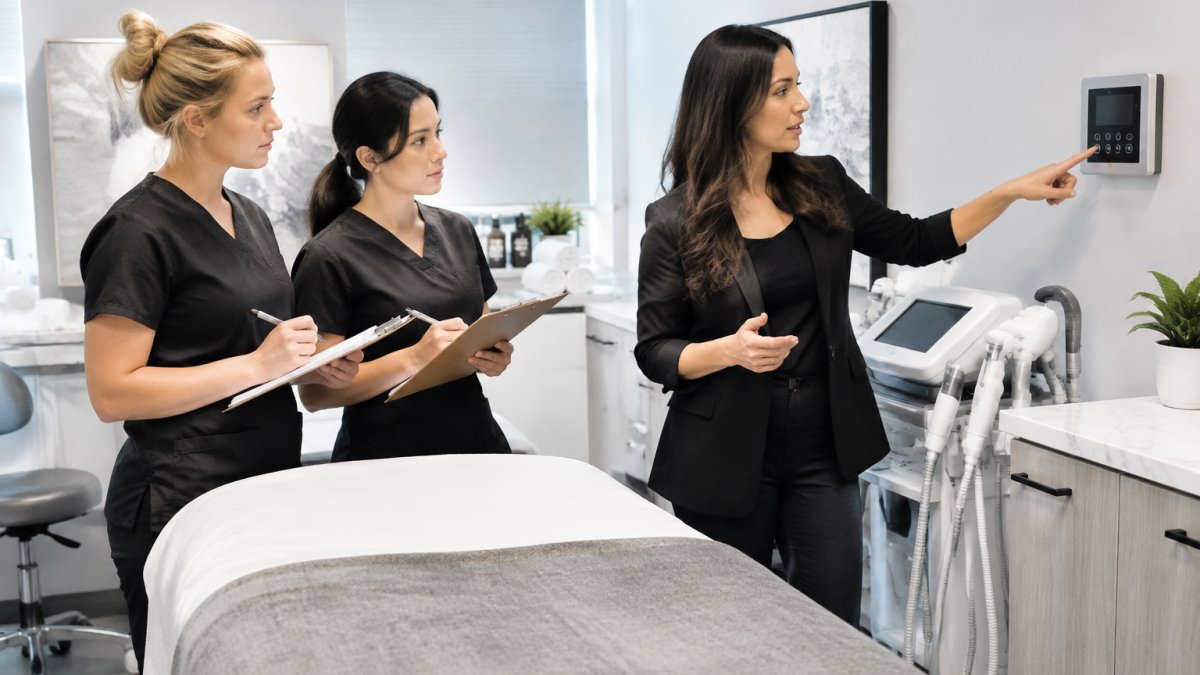
Build the plan in four phases:
1. Name the change and the reason. Write one sentence staff can repeat: what is changing, why, and what it fixes for them, fewer double entries, fewer no-shows, faster room turnover. Change that arrives without a stated reason gets treated as extra work.
2. Map who is affected and how. List each role, front desk, providers, estheticians, managers, and the specific workflows that change for each.
3. Sequence the rollout. Pick two super users per shift and train them first. Let them run the new workflow in live conditions for a week or two before the rest of the team switches.
4. Measure readiness, not attendance. Training completion is not readiness. Define concrete signals: a super user can complete the full workflow unaided, the error rate on new intake drops below an agreed threshold, and staff can name who to ask when something breaks.
Run a feedback loop for the first month. When staff flag a workflow problem, fix it fast and tell them it was fixed, visible response is what earns buy-in.
Watch out: training everyone at once the week before launch feels efficient but concentrates every mistake into the busiest possible window, when staff have no experienced peer to ask and no time to absorb the change.
Change management is also where multi-location rollouts diverge. A single-location clinic can absorb a rough launch with overtime and goodwill; five locations cannot.
Step 7: Lock Down HIPAA Compliance and Cybersecurity at Scale
Every new system that touches client data expands your risk surface. HIPAA compliance is not a one-time setup; it's an ongoing practice, and the stakes rise with each location and each connected device.
Cover the basics first:
- Role-based access so staff see only what they need
- Encrypted data in transit and at rest
- A written incident response plan
- Regular access reviews when people leave
The HHS Security Risk Assessment Tool gives small practices a free way to audit their safeguards. Equipment that logs client usage also needs a data policy. Before you expand your tech footprint, review our med spa equipment insurance and liability coverage facts.
Step 8: Protect Profit Margins While You Grow
Growth quietly eats margins when overhead costs rise faster than revenue. Watch three levers: labor per treatment, equipment use, and service mix.
Track key performance indicators monthly. If a new modality sits idle, either reprice it, bundle it, or cut it. Recurring revenue models, like memberships that include recovery sessions, smooth out cash flow and boost patient retention.
Adding new services brings legal questions. Check our guide on legal considerations for adding medical wellness services before you commit. And when you're ready to evaluate equipment as a revenue line rather than a cost, Eternall Wellness can help you model use, pricing, and ROI before you buy.
Scaling a med spa is a systems problem, not an equipment problem. The clinics that grow well stress-test first, standardize early, and treat every purchase as a revenue decision. Eternall Wellness builds premium recovery systems, including red light therapy, thermal recovery, and hyperbaric chambers, designed for commercial facilities. We offer financing to preserve capital and help you evaluate ROI, use, and demand before you commit. Get started with Eternall Wellness and turn your next upgrade into a service line that pays for itself.
Frequently Asked Questions
What are the most effective technologies for scaling med spa operations?
The systems that move the needle most are automated booking and scheduling, EMR and CRM integration, and business intelligence dashboards that track key performance indicators like utilization and patient retention. Add service-line technology such as red light therapy, thermal recovery, or hyperbaric chambers when you want new recurring revenue without adding treatment rooms. The common thread is that each system removes manual work or fills idle capacity, which is what makes med spa operations scale instead of just getting busier.
How does automation impact med spa client retention?
Automation keeps patients on schedule. Automated reminders, rebooking prompts, and follow-up sequences reduce no-shows and catch patients who drift past their usual treatment interval. Because retention depends on consistent visit cadence, med spa automation software that triggers a rebooking message at the right moment does more for retention than most loyalty programs. Track rebooking rate and visit frequency before and after launch so you can see the effect in your own numbers rather than assuming it worked.
What operational metrics should med spa owners track when scaling?
Watch room utilization, average revenue per patient, rebooking rate, no-show rate, cost per acquisition, and staff hours per treatment. These six cover capacity, revenue, retention, and overhead costs in one view. Review them monthly during a rollout and quarterly once stable. If utilization climbs but margins fall, your overhead costs or discounting are eating the gain. If rebooking rate drops after a software change, that is a change management problem, not a technology problem.
How do you integrate new wellness modalities without disrupting current workflows?
Pilot in one room with one trained staff member before rolling out facility-wide. Map the new service into your existing appointment scheduling so it appears in the same booking flow, then write a standard operating procedure covering setup, session timing, cleaning, and documentation. Run the pilot for a set period, measure utilization and patient feedback, and only then train the wider team. This staged approach keeps clinical workflows intact and gives staff a reference point when questions come up.