 how-to
How to Set Up Red Light Therapy Protocols in Med Spas
Table of Contents
- What You'll Need to Set Up a Red Light Therapy Protocol
- Step 1: Prepare the Treatment Room and Device Placement
- Step 2: Establish Red Light Therapy Clinical Dosage Guidelines
- Step 3: Create Red Light Therapy Patient Intake Forms
- Step 4: Screen for Red Light Therapy Contraindications for Clinics
- Step 5: Set Up Billing and Insurance Codes for Light Therapy
- Step 6: Train Staff and Write Standard Operating Procedures
- Common Mistakes to Avoid When Setting Up Red Light Therapy Protocols
- Frequently Asked Questions
Last Updated: September 26, 2026
What You'll Need to Set Up a Red Light Therapy Protocol
Setting up red light therapy in a med spa takes more than buying a panel and plugging it in. You need a written protocol that covers dosage, screening, billing, and staff training. This guide from Eternall Wellness walks through the six steps that separate a compliant, profitable service from an expensive room decoration.
Here is what you need before your first client:
- A dedicated or shared treatment room with proper layout
- A professional-grade LED panel or light therapy bed
- Written clinical protocols for dosage and session frequency
- Patient intake and consent forms
- A screening process for contraindications
- Billing codes and a pricing model
- Trained staff and standard operating procedures
Step 1: Prepare the Treatment Room and Device Placement
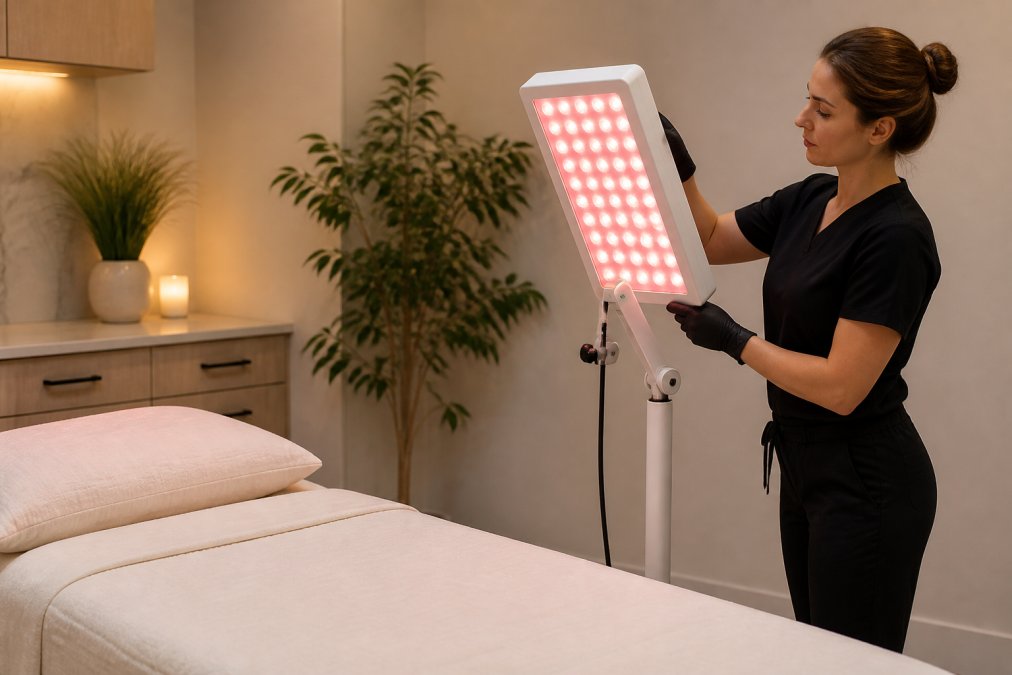
The treatment room is where most new operators cut corners, and it shows. A well-planned room protects patient safety and lets staff work efficiently.
Start with these basics:
- Keep the treatment bed at least 3 feet from the panel to allow for distance adjustments
- Mark the floor with tape so staff can repeat the same distance every session
- Position the panel so it can be angled toward the face, torso, or a targeted area
- Use adjustable stands or wall mounts rated for the panel's weight
- Add a timer or wall clock visible from the treatment bed
Step 2: Establish Red Light Therapy Clinical Dosage Guidelines
Red light therapy clinical dosage guidelines define how much light energy reaches the skin and for how long. Get this wrong and you either waste sessions or risk overexposure.
Three numbers drive every session:
- Wavelength: Most clinical panels use red light around 630-660 nanometers and near-infrared around 810-850 nanometers.
- Irradiance: Measured in mW/cm², this is the power delivered per unit of area. It varies with distance.
- Therapeutic dose: Measured in joules per square centimeter (J/cm²), this is irradiance multiplied by exposure time.
Step 3: Create Red Light Therapy Patient Intake Forms
Red light therapy patient intake forms capture the health history and consent details your staff need before the first session. A good form does three jobs: it screens, it informs, and it documents.
Your intake form should include:
- Current medications, especially anything that increases light sensitivity
- Pregnancy status
- History of skin cancer or active lesions in the treatment area
- Recent cosmetic procedures or injectables
- Known photosensitivity conditions
- Consent language explaining expected sensations and limits
Step 4: Screen for Red Light Therapy Contraindications for Clinics
Red light therapy contraindications for clinics are the conditions and situations where you should pause, adjust, or decline treatment. Screening is not optional, and it is not a one-time event.
Common areas of caution include:
- Photosensitizing medications, such as certain antibiotics and acne treatments
- Active skin infections or open wounds in the treatment area
- Pregnancy, where many clinics choose to defer treatment as a precaution
- A history of skin cancer, which calls for medical clearance first
- Recent use of retinoids or strong exfoliants
Step 5: Set Up Billing and Insurance Codes for Light Therapy
Billing and insurance codes for light therapy vary by how you position the service. Most med spas offer red light therapy as a self-pay wellness service rather than a billed medical treatment.
A practical approach:
- Decide up front whether the service is medical or wellness
- If medical, confirm current coding with your billing partner
- If wellness, build packages and memberships instead of single sessions
- Track use per room and per provider
Step 6: Train Staff and Write Standard Operating Procedures
Standard operating procedures are what turn a good setup into a repeatable service. Without them, every staff member runs the session differently, and quality drifts. But an SOP binder nobody reads is not training. The clinics that run red light therapy well treat staff competency as a documented, verifiable milestone, not a one-time walkthrough.
Tier the training by role
Not everyone on your team needs the same depth. A workable structure:
- Front desk / intake: Screening questions, stop-list triggers, consent form collection, and when to escalate to a clinician. No device operation.
- Technician / esthetician: Room setup, panel positioning, distance verification, session timing, eye protection, and post-session documentation.
- Clinician / medical director: Contraindication clearance, dosage adjustments, adverse event response, and protocol sign-off.
Build a competency checklist, not a lecture
Hands-on verification beats a slide deck. A common pattern is a three-part check for each technician:
- Observe a full session run by a trained staff member.
- Perform a full session under direct supervision, including room setup, distance check, timing, and documentation.
- Demonstrate the stop criteria, when to pause a session, when to call a clinician, and how to document what happened.
Write the SOP so it survives turnover
Your SOP should cover:
- Room setup and panel positioning, including the marked floor distance
- Recommended session duration and exposure time by treatment area
- Cleaning and sanitization between clients (see the hygiene section below)
- Eye protection rules for staff and clients
- When to stop a session and who to notify
- How to document each visit in the practice management system
- How to log device maintenance and any panel replacement
Connect training records to liability and insurance
This is where staff training stops being an HR task and becomes a risk-management tool. Check with your insurer that your policy covers light-based services, and confirm your consent forms and training documentation match what your carrier expects. If a question ever arises about a session, a signed training record and a completed session log are the difference between a documented process and an undocumented one.
Common Mistakes to Avoid When Setting Up Red Light Therapy Protocols
The costliest mistakes in red light therapy setup are operational, not technical. Here are the ones that come up most.
| Mistake | Why It Hurts | Fix |
|---|---|---|
| No written protocol | Inconsistent sessions, training gaps | Document dosage, distance, and duration |
| Skipping screening | Safety and liability exposure | Use intake forms and a stop list |
| Ignoring device clearance | Using equipment outside its cleared use | Confirm clearance with the maker |
| No staff training record | Weak defense if a question arises | Keep signed training logs |
| No device hygiene protocol | Health inspection and liability exposure | Build a between-client cleaning SOP |
| Treating it as a one-off sale | Low use, weak revenue | Build packages and memberships |
Mistake 1: No sanitization protocol for shared devices
This is the gap almost every guide skips, and it is the one that matters most for a med spa. A red light panel is a shared device that sits close to bare skin, and clients notice whether it looks clean. More importantly, your local health department and your liability carrier care whether you can show a written cleaning routine.
A practical between-client routine:
- Wipe the panel housing and any contact surfaces with a manufacturer-approved disinfectant. Check the panel maker's cleaning guidance first, some finishes and coatings are damaged by harsh solvents.
- Disinfect the treatment bed, headrest, and any positioning straps or bolsters between every client.
- Replace or launder any linens, eye protection straps, or reusable covers that touch the client.
- Clean eye protection lenses and frames with an appropriate wipe, and store them in a covered bin, not loose on a counter.
- Log the cleaning step in the session record so the routine is documented, not just performed.
Mistake 2: No ROI tracking
Plenty of clinics never measure whether the room is paying for itself. Track three numbers per month: sessions delivered, revenue per session (or per package), and room utilization. If the panel sits idle between bookings, the fix is usually bundling, pairing red light therapy with an existing service or membership rather than selling it as a standalone add-on.
Mistake 3: No adverse-event or incident log
Even low-risk services occasionally produce an unexpected reaction, a client reports warmth, redness, or discomfort. A simple incident log (date, what happened, what staff did, who was notified) gives you a pattern to review and a record if a question ever arises. It also feeds back into your protocol: if the same complaint repeats, your dosage or screening needs a second look.
Mistake 4: Skipping device maintenance
LED panels degrade gradually. Output can drop over time, which quietly changes the dose your clients receive. Follow the maker's maintenance schedule, keep a log of any output checks or panel replacements, and revisit your exposure times whenever a panel is swapped out.
Frequently Asked Questions
What is the typical protocol for red light treatment in a med spa?
A standard red light therapy protocol covers device distance, session length, frequency, and documentation. Clinicians typically position the panel 6 to 12 inches from the skin, run sessions for 10 to 20 minutes depending on the device's irradiance in mW/cm², and schedule treatments 2 to 3 times per week. Every session should be logged with wavelength, exposure time, and the patient's response so you can adjust the therapeutic dose over time. Written standard operating procedures keep delivery consistent across staff.
What are the standard safety protocols for professional red light therapy?
Professional safety protocols include eye protection for patients and staff, a completed intake form that screens for contraindications, and cleaning the device and treatment room between clients. Staff should be trained on device clearance, panel power output, and how to recognize an adverse reaction. Document each session with the wavelength, session duration, and any skin response. Check the FDA clearance status of your device and follow the manufacturer's instructions for use, since those define the cleared indications and safe operating parameters.
How do med spas document red light therapy sessions for compliance?
Documentation should capture the date, device used, wavelength, irradiance setting, exposure time, distance from skin, and the areas treated. Record the patient's consent, intake form responses, and any reported side effects. Keep these records in the patient chart alongside your standard operating procedures. If you bill insurance, the session note must support the codes submitted. Retention periods vary by state, so confirm the requirement with your state health department or a healthcare attorney rather than assuming a single national rule.
How should red light therapy be integrated into existing med spa service menus?
Start by deciding whether red light therapy stands alone or supports services you already offer, such as skin rejuvenation or post-treatment recovery. Bundle it with existing appointments to fill idle treatment rooms, then price it as an add-on or a package. Train front desk staff to explain the benefits and the session frequency. Track utilization and revenue per room for the first 90 days so you can adjust pricing and staffing based on actual demand rather than projections.