 How-to
How Do You Maintain a Commercial Cryotherapy Chamber?
Last Updated: October 31, 2026
Quick Summary
Maintain a commercial cryotherapy chamber with a written checklist split by frequency and component: daily operator checks of temperature, ventilation, door seals and alarms, weekly cleaning and seal inspections, monthly technician checks of refrigeration and sensors, and annual full refrigeration service. Match the service schedule to your technology, since electric and liquid nitrogen chambers have different needs.
- Daily operator checks take 5 to 10 minutes and include temperature verification and a session log.
- Never let an operator open refrigeration panels or LN2 line fittings; those are technician-only tasks.
- Dry the chamber interior between clients, because leftover moisture can freeze and stress components.
- Brief every client on session duration and the exit signal before they enter the chamber.
- Document each issue in a maintenance log with the date, problem and fix to speed up repairs.
Table of Contents
- Why a Maintenance Plan Decides Your Chamber's Lifespan
- Your Cryotherapy Chamber Maintenance Checklist for Daily, Weekly, and Monthly Tasks
- Commercial Cryotherapy Chamber Cleaning Between Clients
- Cryotherapy Chamber Safety Checks Before Every Session
- Building a Cryotherapy Chamber Service Schedule Around Your Technology
- Troubleshooting, Downtime Planning, and Maintenance Records
- Setting Up Maintenance Support for Your New Chamber
- Frequently Asked Questions
Why a Maintenance Plan Decides Your Chamber's Lifespan
A commercial cryotherapy chamber is a major piece of equipment, and how you care for it decides whether it runs for a decade or breaks down in year two. Before committing to a plan, it helps to understand commercial hyperbaric chamber maintenance costs.
The stakes are higher than a repair bill. A whole-body cryotherapy chamber relies on precise temperature control and a working cooling system. The FDA guidance on medical device reporting is a useful reference for how seriously equipment failures should be documented.
Here is the core idea that runs through this guide: maintenance is not a chore you do after setup. It is part of the service you sell. Get it right, and your chamber becomes a reliable revenue source.
Your Cryotherapy Chamber Maintenance Checklist for Daily, Weekly, and Monthly Tasks
The best way to protect a commercial cryotherapy chamber is a cryotherapy chamber maintenance checklist split by frequency and by component. Daily checks catch small issues fast. Weekly and monthly tasks stop wear from building into failure. Annual tasks catch what calendars miss.
What most checklists leave out is who performs each task. Some checks are operator-safe; others require a trained technician. Mixing the two is how facilities void warranties or create safety hazards. Use the split below as a starting framework, then adapt it to your manufacturer's service manual.
Daily operator checks (5-10 minutes)
- Temperature verification: Compare the displayed reading against the set point. A drift of more than a degree or two is a flag, not a rounding error.
- Ventilation and room air: Confirm exhaust is running and the room feels dry and clear. Stale or humid air is an early sign of a ventilation problem.
- Door and seal visual: Look for frost buildup, condensation, or visible gaps around the door seal.
- Emergency stop and alarm indicator: Confirm the stop button is unobstructed and the alarm panel shows no active faults.
- Session log: Record session count, any client complaints, and anything that looked or sounded different.
Weekly operator checks (15-30 minutes)
- Door seals and hinges: Wipe seals, check for cracking or compression, and confirm the door closes flush without force.
- Platform and floor: Inspect for moisture, ice, or debris; dry and clean as needed.
- Interior surfaces: Wipe down high-touch areas with a cleaner approved for your chamber's materials.
- Filters (where accessible): Check pre-filters for dust loading; replace or clean per the manufacturer's schedule.
- Controls and displays: Confirm buttons, touchscreens, and indicators respond correctly.
Monthly operator and technician checks
- Refrigeration components (technician): Inspect compressor area, check for unusual noise or vibration, and verify refrigerant pressures against spec.
- Alarms and safety systems (technician): Test alarms, oxygen monitoring (for LN2 systems), and emergency stop circuits end to end.
- Sensors and calibration (technician): Verify temperature sensors read accurately against a reference; recalibrate if drift is outside tolerance.
- Seals and gaskets (operator-assisted): Deep-clean and inspect for wear; schedule replacement before failure.
- Maintenance log review (operator): Update the log, flag recurring issues, and confirm the next service visit is booked.
Annual and semi-annual tasks
- Full refrigeration service (technician): Compressor inspection, refrigerant charge check, and electrical connection torque check.
- LN2 tank and delivery system inspection (technician): Pressure test, relief valve check, and line inspection for LN2 systems.
- Warranty and service-plan review (operator): Confirm coverage is current and that all scheduled service has been documented.
Keep the checklist posted near the chamber, not buried in a binder. The best checklist is the one an operator can actually complete between clients.
Commercial Cryotherapy Chamber Cleaning Between Clients
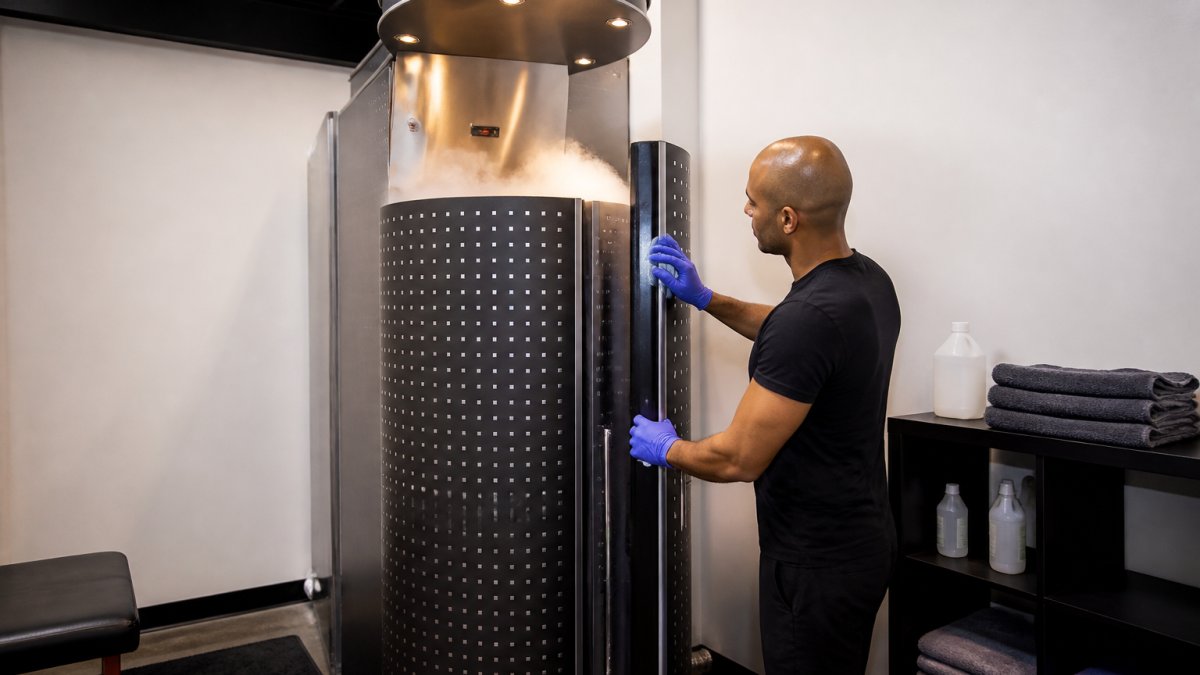
Commercial cryotherapy chamber cleaning is the task most operators underestimate. Clients enter in minimal clothing, often after sweating, so hygiene matters for both safety and reputation.
The routine is straightforward. Ask clients to arrive with clean, dry skin and to remove jewelry before entry. Between sessions, wipe down contact surfaces with a cleaner approved for your equipment. Never use harsh chemicals that could damage seals or coatings.
Here is what a between-client clean looks like:
- Wipe the entry area and handrails
- Check the platform for moisture and dry it
- Replace disposable covers where used
- Confirm the chamber is dry before the next client
What most guides miss is the drying step. Moisture left inside a chamber can freeze and stress components. A dry chamber is a safe chamber. Build the dry-down into your turnover routine, not as an afterthought.
Cryotherapy Chamber Safety Checks Before Every Session
Cryotherapy chamber safety checks are non-negotiable, and they take less than a minute. The operator confirms the chamber is at the correct temperature, the ventilation is working, and the emergency stop is reachable before any client steps in.
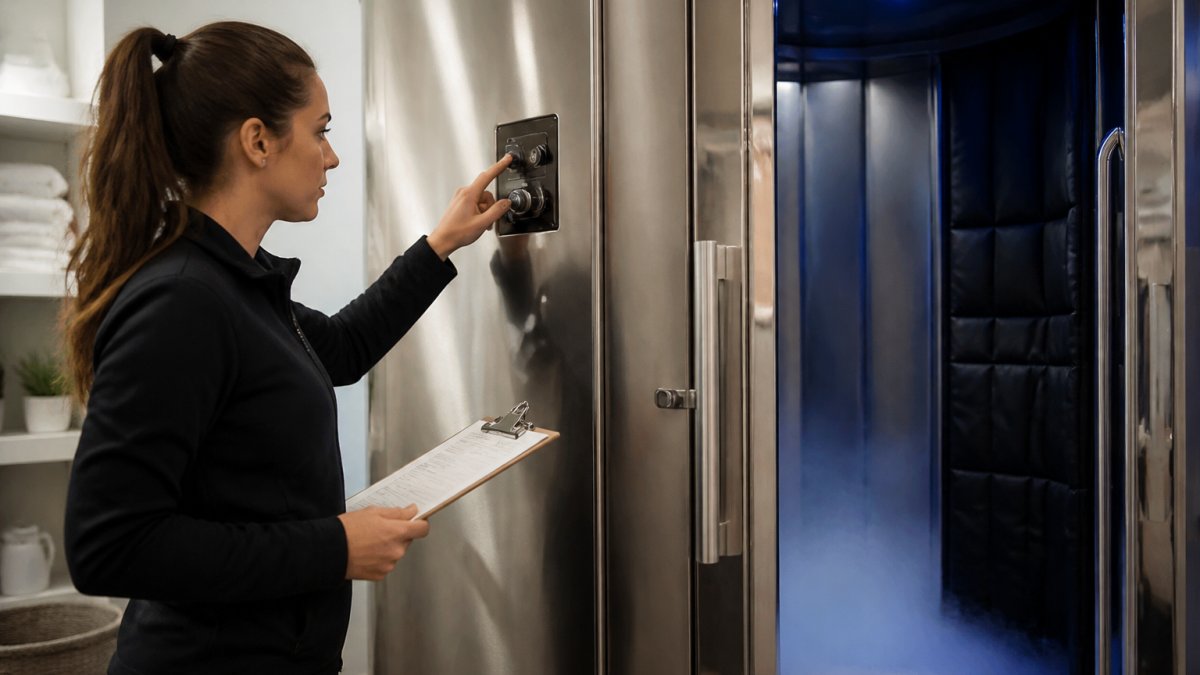
Run through this list before each session:
- Confirm the temperature set point and actual reading
- Check that oxygen monitoring and ventilation are active
- Verify the emergency stop and alarms work
- Confirm the client has removed jewelry and is dry
- Brief the client on session duration and the exit signal
Watch out: skipping the client briefing is the most common safety gap. For broader equipment safety context, the OSHA workplace safety resources offer useful general guidance on operator training.
Building a Cryotherapy Chamber Service Schedule Around Your Technology
Your cryotherapy chamber service schedule should match the technology inside the unit. An electric chamber and a liquid nitrogen system have different service needs, so a one-size schedule will not work. Treating them as interchangeable is one of the most common maintenance mistakes in the category.
Book a 30-Minute Facility Review →
Electric (compressor-based) chambers
Electric chambers rely on a refrigeration circuit and compressors. The service focus is mechanical and electrical:
- Compressor and refrigeration checks (monthly, technician): Listen for unusual noise, check vibration, and verify refrigerant pressures against the manufacturer's spec. Compressors are the highest-cost component to replace, so early detection matters.
- Filter replacement (per schedule, operator): Dust-loaded filters force the system to work harder and can cause temperature instability. Follow the manufacturer's interval rather than a generic calendar.
- Condenser and coil cleaning (quarterly, technician): Dust and lint on coils reduce cooling efficiency. This is a technician task because it involves opening panels.
- Electrical connections (semi-annual, technician): Torque checks on connections prevent intermittent faults and overheating.
Liquid nitrogen (LN2) chambers
LN2 systems depend on delivery, storage, and ventilation. The service focus is supply-chain and safety:
- LN2 delivery and tank inspection (per delivery cycle, technician): Confirm tank pressure, inspect lines for frost or damage, and verify the relief valve is functioning.
- Ventilation and oxygen monitoring (daily, operator): LN2 displaces oxygen when it evaporates. Confirm exhaust is running and oxygen monitors are active before every session.
- Line and valve inspection (monthly, technician): Check for icing, leaks, and valve wear. Icing on lines is a warning sign, not normal operation.
- Refill timing planning (operator): Build refill scheduling around session volume so you never run low during a booked day.
Side-by-side service focus
| Chamber Type | Key Service Focus | Typical Frequency | Who Performs It |
|---|---|---|---|
| Electric | Compressor and refrigeration checks | Monthly | Technician |
| Electric | Filter replacement | Per manufacturer schedule | Operator |
| Electric | Condenser and coil cleaning | Quarterly | Technician |
| LN2 | LN2 delivery and tank inspection | Per delivery cycle | Technician |
| LN2 | Ventilation and oxygen monitoring | Daily | Operator |
| LN2 | Line and valve inspection | Monthly | Technician |
The point is to match service intervals to the actual cooling technology, not to a generic calendar.
Troubleshooting, Downtime Planning, and Maintenance Records
Every chamber will have a bad day. The question is whether you have a plan. Troubleshooting starts with a clear escalation path: what the operator can fix, and what needs a trained technician.
Use this simple rule set:
- Operator-level: temperature drift, door seal issues, surface cleaning
- Technician-level: cooling system faults, electrical problems, alarm failures
- Stop use immediately: any oxygen or ventilation concern
Downtime planning matters as much as repair. Detailed hyperbaric chamber maintenance and safety protocols can help you build your records and downtime procedures around a proven framework.
Good records do two things: they speed up repairs and they prove you ran a safe operation. Watch out for logs kept in someone's head. If it is not written down, it did not happen.
Setting Up Maintenance Support for Your New Chamber
The smartest time to set up maintenance support is before the chamber arrives. For practical facility planning guidance on launching and supporting a new recovery service, see how to build a wellness service that earns its place. A new unit comes with a warranty and a service plan, and knowing who to call saves days of downtime later.
When you buy, confirm three things:
- What the warranty covers and for how long
- Who performs scheduled service
- How fast support responds when something fails
Eternall Wellness helps businesses evaluate cryotherapy and other recovery equipment as potential revenue-generating services, and financing options are available to help preserve capital.
Frequently Asked Questions
How often should a commercial cryotherapy chamber be serviced?
Manufacturers typically publish a service schedule for their equipment, and high-volume use may call for more frequent visits. In between, your team handles daily checks, weekly cleaning, and monthly inspections of seals, sensors, and the cooling system. Follow the service schedule in your owner's manual, since liquid nitrogen and electric chambers have different requirements. Keeping a log of every visit can help you spot recurring faults.
What daily checks should operators perform on a cryotherapy chamber?
Before the first client, check the temperature readout against the target range, confirm the ventilation and oxygen monitoring systems are working, inspect the door seal and platform for damage, and verify the emergency stop button. Log the results. During the day, watch for frost buildup, unusual noise from the cooling system, and any change in session temperature. If a reading falls outside the manufacturer's range, pause sessions and call your service provider rather than adjusting settings yourself.
How do you clean and disinfect a cryotherapy chamber between clients?
Wipe down high-touch surfaces such as handrails, the door handle, and the platform with a disinfectant approved for your chamber's materials, then dry them fully. Ask clients to arrive with clean, dry skin, remove jewelry, and wear the provided protective clothing. Never spray liquids directly into the cabin or near electrical panels. For commercial cryotherapy chamber cleaning, follow the manufacturer's list of approved products, since some solvents can damage seals and sensors.
Can staff perform cryotherapy chamber maintenance, or is a technician required?
Staff can handle daily checks, cleaning, and visual inspections if they are trained and the tasks are in the manual. Work on the cooling system, liquid nitrogen delivery, electrical components, and safety sensors should go to a qualified technician. Build a clear line between the two in your cryotherapy chamber maintenance checklist so no one guesses. Document who performed each task and when, and keep the technician's contact details posted near the unit.
Adding a cryotherapy chamber is a real investment, and it deserves a real maintenance plan. The facilities that protect uptime are the ones that treat service as part of the product. Eternall Wellness builds premium recovery systems for commercial facilities, with financing to preserve capital and support that helps you plan utilization from the start. Get started with Eternall Wellness and turn your recovery service into a dependable source of revenue.