 how-to
Staffing Requirements for Gym Recovery Stations
Table of Contents
- Why Gym Recovery Staffing Requirements Depend on Your Service Format
- Recovery Room Staff Training: Roles, Competencies, and Onboarding
- Gym Recovery Equipment Safety Procedures and Risk-Based Supervision
- Recovery Services Scheduling for Gyms: Matching Staff to Peak Usage
- Recovery Station Member Onboarding: Reducing Staff Burden Long-Term
- Cleaning, Sanitation, and Turnover Workload by Station
- Frequently Asked Questions
Last Updated: October 15, 2026
Why Gym Recovery Staffing Requirements Depend on Your Service Format
Staffing requirements for gym recovery stations start with one question: who runs the equipment when a member walks in?
The answer changes based on your setup. A self-service stretching corner needs almost no oversight.
Most gyms get this backwards. They buy equipment first, then guess at staffing.
Recovery zone is the umbrella term for any dedicated space offering post-workout services. That includes foam rollers, massage guns, compression therapy boots, infrared sauna, and cryotherapy.
Each one carries a different supervision burden. That difference is the whole ballgame.
Self-Service vs. Staff-Assisted Recovery Stations
Self-service recovery stations let members use equipment on their own after a quick orientation. Staff-assisted service means a recovery specialist guides the session.
The two formats sit at opposite ends of a spectrum:
- Self-service: Low labor cost, high member independence, needs clear signage and equipment instructions
- Staff-assisted: Higher labor cost, better member experience, needs trained and qualified staff
- Hybrid: Staff present during peak hours only, self-service off-peak
Most gyms land on hybrid. It balances cost against member experience without overstaffing quiet hours.
The format you pick drives every staffing number that follows.
How Member Needs and Recovery Goals Shape Coverage
Coverage follows member needs, not the clock. Two gyms with the same square footage can need very different staff levels.
Ask three questions:
- What are members' recovery goals? General mobility, injury recovery, or performance?
- What are their usage patterns? Morning rush, evening peak, or all-day traffic?
- Which membership tiers get access? Premium membership perks need more support.
Higher-tier members expect more attention. That expectation is part of what they pay for.
Recovery Room Staff Training: Roles, Competencies, and Onboarding
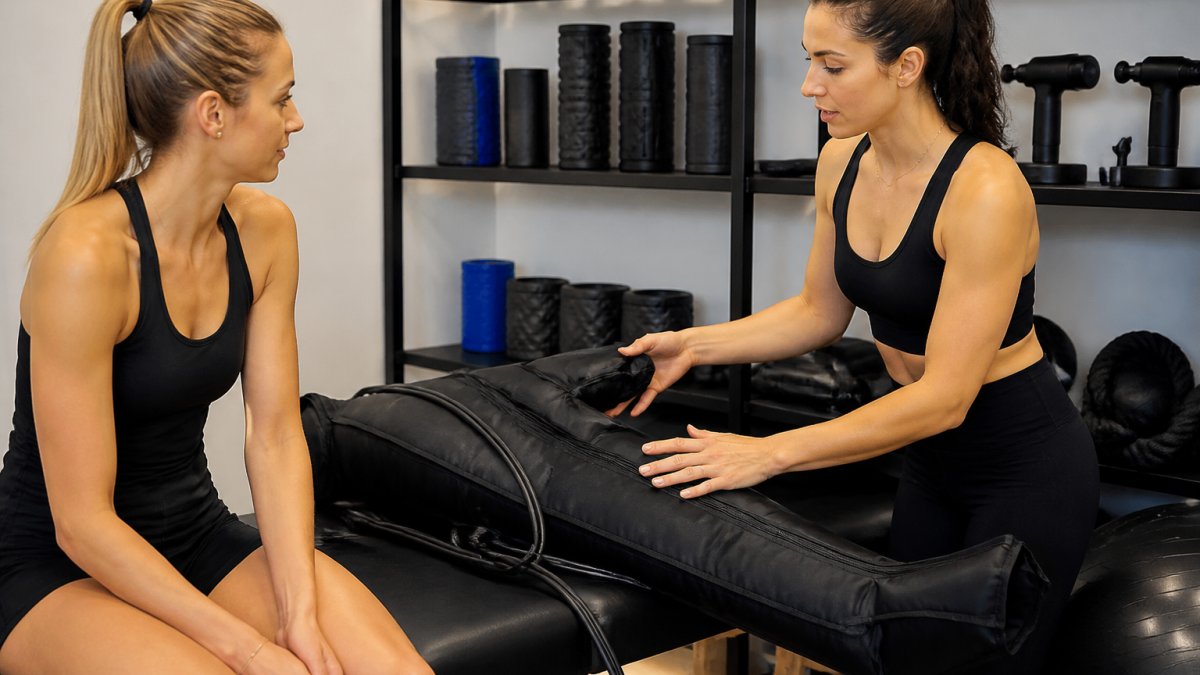
Recovery room staff training turns a general employee into a safe, confident operator. The role splits into three levels: attendant, recovery specialist, and supervisor.
Role definitions and what each one owns
- Attendant: Checks members in, explains equipment instructions, resets stations, handles basic cleaning, and knows when to escalate. Does not adjust equipment settings or guide sessions.
- Recovery specialist: Guides sessions, adjusts settings, recognizes when to stop a session, knows emergency procedures, and can screen members for contraindications before a session starts.
- Supervisor: Manages schedules, handles incidents, owns safety standards and compliance, and is the named person on the incident report.
A common pattern is to staff attendants at all open hours and recovery specialists only during peak windows or on high-risk stations. Supervisors are usually shared across the facility rather than dedicated to the recovery zone.
Competency checklist by station type
Competency requirements should be written down, not assumed. A new hire should demonstrate each skill before working solo. Build a one-page checklist per station type. A workable structure:
- Low-risk stations (foam rollers, stretching area, hydration): Can explain proper use, can demonstrate two common modifications, can identify when a member should stop.
- Medium-risk stations (massage guns, compression boots): Can set correct pressure or intensity, can explain contraindications in plain language, can reset and sanitize the station to the manufacturer's protocol.
- High-risk stations (infrared sauna, cryotherapy, hyperbaric chambers): Can run the full session start-to-finish, can execute the station's emergency procedure without prompting, can document the session and any adverse event.
Onboarding timeline and training hours
Onboarding should cover equipment operation, member communication, and safety limits. Hyperbaric chambers and cryotherapy demand the most training. Foam rollers and stretching areas demand the least. A realistic onboarding sequence:
- Day 1, Facility and policy: Tour, emergency exits, incident reporting, member communication standards.
- Days 2-3, Low-risk stations: Shadow a trained attendant, then run the station with the trainer watching.
- Days 4-5, Medium-risk stations: Equipment-specific training from the manufacturer's manual, then supervised sessions.
Paid training hours are a real line item. Budget them as part of the role, not as an afterthought, see the labor-cost section below.
Escalation responsibilities
Every staff member needs to know the chain. A simple escalation ladder:
- Attendant handles routine questions, resets, and cleaning. Escalates any member complaint, injury, or equipment fault to the specialist on duty.
- Recovery specialist handles session adjustments, stops sessions when a member shows distress, and starts the emergency procedure. Escalates incidents and equipment failures to the supervisor.
- Supervisor handles incident reports, contacts emergency services if needed, and owns follow-up with the member and the equipment vendor.
Post the ladder at the recovery zone entrance. New hires should be able to recite it before their first solo shift.
Refresher training and documentation
Competency fades. A common cadence is a short refresher every quarter and a full re-demonstration annually, plus a re-check any time a new piece of equipment is installed. Keep the signed checklists on file, if an incident ever happens, the training record is the first thing an insurer will ask for.
Gym Recovery Equipment Safety Procedures and Risk-Based Supervision
Gym recovery equipment safety procedures should match supervision to risk. Not every station needs the same level of oversight.
Risk-based supervision means you watch the high-risk equipment closely and trust members with the low-risk tools.
A simple tier system works well:
- Low risk: Foam rollers, vibration rollers, stretching area, hydration station. Self-service with signage.
- Medium risk: Massage guns, compression therapy boots. Orientation required, periodic staff checks.
- High risk: Infrared sauna, cryotherapy, hyperbaric chambers. Staff present or immediately available.
This tiering keeps your labor budget sane while protecting members on the equipment that can actually hurt them. (Source: Occupational Safety and Health Administration (OSHA) guidelines for fitness facilities)
Emergency Procedures by Station Type
Every station needs a written emergency procedure. The steps differ by equipment.
For thermal systems like infrared sauna, staff should know how to help a member exit quickly and cool down.
Post the procedure at the station. Train every staff member on it. Run a practice drill at least twice a year.
Check your state and local health rules before opening any high-risk station.
Recovery Services Scheduling for Gyms: Matching Staff to Peak Usage
Recovery services scheduling for gyms works best when it follows real usage data, not guesses. Track when members actually use each station for two to four weeks before you finalize shifts. The goal is a coverage plan that matches staff to demand hour by hour, not a headcount that looks reasonable on paper.
Build a coverage model by station type and operating hours
Start with a station-level table. The ratios below are starting points that can be adjusted after the first month of tracking:
| Station Type | Coverage Model | Typical Peak Window | Staff Ratio |
|---|---|---|---|
| Stretching area | Self-service | All hours | 0 dedicated |
| Compression boots | Hybrid | Evening peak | 1 per 8-10 members |
| Massage guns | Self-service with checks | Morning and evening | Shared attendant |
| Infrared sauna | Staff-assisted | Evening peak | 1 per station block |
| Cryotherapy | Staff-assisted | Evening peak | 1 dedicated |
| Hyperbaric chamber | Staff-assisted | By appointment | 1 dedicated |
Measure utilization before you change coverage
Coverage decisions should be driven by numbers, not vibes. Track four metrics per station per hour:
- Bookings and walk-ins: How many members actually used the station.
- Wait time: How long members waited for a station or for staff help.
- Staff workload: How many minutes of staff time each session consumed (setup, guidance, reset, cleaning).
If a station runs under about a quarter of capacity across a shift for two straight weeks, consider adjusting coverage there and moving those hours to a peak window. If wait times regularly exceed a few minutes at peak, consider adding coverage or staggering bookings.
Calculating staffing costs and labor budget
Staffing cost is the number most gyms underestimate. Build it from hours, not headcount. Use this formula:
Monthly labor cost = (hours per shift × shifts per week × hourly wage) × 4.3
Worked example with placeholder wage, substitute your own local rate:
- Two evening shifts, 4 hours each, 5 days a week = 40 hours per week.
- At an hourly wage of $W, weekly labor = 40 × $W.
- Monthly labor = 40 × $W × 4.3.
Then layer in the costs the formula misses:
- Training hours: Paid, one-time plus quarterly refreshers.
- Supervisor time: Scheduling, incident reports, vendor follow-up.
- Coverage buffer: Sick days, vacation, and turnover. A common buffer is 10-15% of scheduled hours.
Demand-based coverage in practice
Once you have two to four weeks of data, rebuild the schedule around three bands:
- Peak: Full coverage, specialists on high-risk stations, bookings staggered to respect turnover time.
- Shoulder: Attendant on duty, specialists on call, self-service stations open.
- Off-peak: Self-service only, high-risk stations closed or by appointment.
Review the plan monthly. Usage shifts with programming, seasons, and membership mix, and a coverage plan that fit last quarter may be overstaffed or understaffed this quarter.
Recovery Station Member Onboarding: Reducing Staff Burden Long-Term
Recovery station member onboarding is the highest-use investment you can make. A member who knows how to use a station safely needs less staff time forever.
Build onboarding into the membership signup. A short orientation covers:
- Which stations are self-service and which need a specialist
- How to adjust each piece of equipment
- Session time limits and safety rules
Record a short video for each station. New members watch it once, then ask fewer questions later. Staff time drops within weeks.
Cleaning, Sanitation, and Turnover Workload by Station
Cleaning and turnover workload varies sharply by station. Plan staff time around it or your recovery room will fall behind.
High-touch surfaces need cleaning between every use. Shared equipment needs a full reset. Here's the rough workload by station:
- Foam rollers and mobility tools: Wipe down after each use, deep clean daily
- Compression therapy boots: Wipe liners between members, replace or sanitize per manufacturer guidance
- Massage guns: Sanitize handles and heads between users
Turnover time matters for scheduling. If a station takes ten minutes to reset, you can't book members back-to-back every five minutes.
Build turnover into your booking system. It protects your equipment and keeps your cleaning protocols honest.
For equipment-specific cleaning steps, follow the manufacturer's manual and your local health rules.
Frequently Asked Questions
Do gym recovery stations need to be staffed?
It depends on your service format. Self-service stations with foam rollers, massage guns, and stretching areas typically need only periodic staff checks, while staff-assisted services like compression therapy or infrared sauna sessions usually require a trained attendant on site. Higher-risk equipment such as hyperbaric chambers calls for direct supervision. Many gyms use a hybrid model: staffed during peak hours, self-service with clear signage and emergency contacts during off-peak times.
How many staff members are needed for a gym recovery area?
A single recovery specialist can often manage 4 to 8 members across multiple stations during normal demand. For a recovery zone with 6 to 10 stations, one dedicated attendant per shift is a potential starting point. During peak hours, adding a second staff member helps with equipment resets, cleaning, and member questions. Track usage patterns for the first 60 to 90 days and adjust coverage based on actual member flow rather than guessing upfront.
What training should employees receive before operating recovery equipment?
Staff should complete training on each piece of equipment before operating it with members. This includes setup, operation, contraindication awareness, cleaning protocols, and emergency shutdown procedures. Recovery room staff training should also cover member screening questions, how to explain benefits clearly, and when to refer a member to a qualified professional. Document all training and refresh it annually or whenever new equipment is added to the recovery zone.
How should gyms schedule staff coverage for recovery services?
Start by reviewing your gym's traffic data to identify peak hours for recovery station use. Most facilities see the heaviest demand in early morning and after-work hours. Schedule your most experienced recovery specialist during those windows and use lighter coverage during midday. Recovery services scheduling for gyms should also account for equipment turnover time, cleaning between sessions, and staff breaks. A simple shared calendar with station assignments prevents coverage gaps.
Adding recovery services means adding a staffing plan, not just equipment. The gyms that get this right treat coverage, training, and cleaning as one system. Eternall Wellness helps facilities design that system from the ground up, with multi-modality recovery solutions, financing options that preserve your capital, and support that turns equipment into a revenue-generating service. Get started with Eternall Wellness and build a recovery zone your members actually use.