 how-to
Cost Benefit Analysis of Wellness Recovery Rooms
Table of Contents
- Why Wellness Recovery Rooms Need a Cost Benefit Analysis
- Wellness Equipment Cost Analysis: Capital and Operating Expenses
- How to Estimate Revenue and Use for Recovery Services
- Wellness Equipment Break-Even Analysis: When Does the Room Pay for Itself?
- Buy vs Lease Wellness Equipment: Financing Options Compared
- Building a Recovery Room Business Plan That Lenders and Investors Trust
- Measuring ROI: Metrics to Track After Opening a Recovery Room
- Frequently Asked Questions
Last Updated: October 13, 2026
Why Wellness Recovery Rooms Need a Cost Benefit Analysis
A cost benefit analysis of wellness recovery rooms turns a hopeful purchase into a defensible business decision.
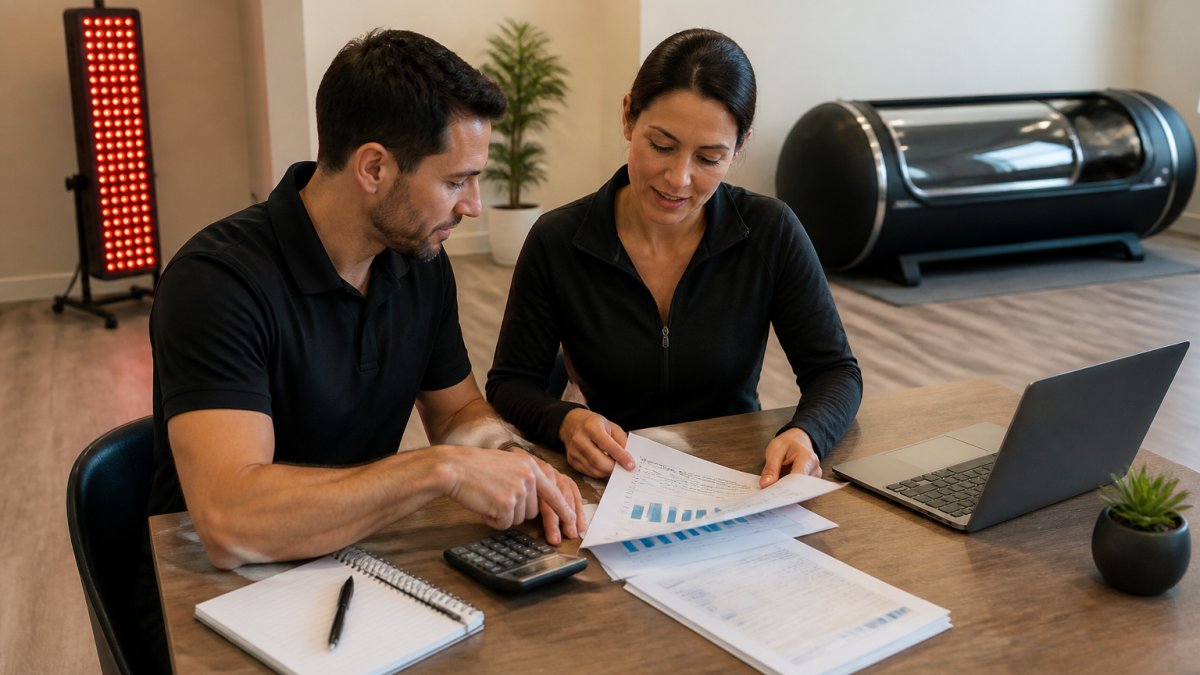
Most operators skip this step, buy on instinct, and then watch the room sit idle while the payments keep coming.
A cost benefit analysis answers three questions:
- What does the room cost to build and run each month?
- How many sessions do you need to sell to break even?
- What is the realistic return once you hit steady use?
Wellness recovery rooms are commercial spaces equipped with therapeutic technology such as red light therapy, thermal recovery systems, or hyperbaric chambers.
Below, we break down the full model: capital costs, operating costs, use assumptions, break-even math, and the metrics that tell you whether the room is working.
Wellness Equipment Cost Analysis: Capital and Operating Expenses
Wellness equipment cost analysis splits into two buckets: what you pay once, and what you pay every month. Getting both right is the difference between a profitable room and a money pit, and a recovery room has a longer cost spine than "equipment plus staffing."
Capital Costs: Equipment, Buildout, and Installation
Capital costs cover everything needed before the first client walks in, one-time expenses, though financing spreads them over time.
- Equipment: The recovery systems themselves, red light therapy panels, infrared saunas, cold plunge tubs and chillers, compression therapy sleeves, float tanks, and hyperbaric chambers. Cost scales with modality count and chamber class, not just square footage.
- Room buildout: Electrical work, dedicated circuits, ventilation and exhaust, plumbing and drains for plunge or float systems, moisture-resistant wall and floor finishes, and soundproofing.
- Installation: Delivery, assembly, water fill and balancing, calibration, and manufacturer commissioning.
- Permits and inspections: Local commercial buildout permits, electrical sign-off, and any health-department review that applies to your service mix.
- Furniture and fixtures: Treatment chairs or loungers, storage, privacy screens, lockers, and a changing area.
Buildout most often breaks the budget. A cold plunge needs drainage, a dedicated chiller circuit, and humidity control; a hyperbaric chamber may need dedicated power and ventilation a standard treatment room lacks. Get a contractor's quote against a specific address before you commit to a space.
Operating Costs: Staffing, Utilities, and Consumables
Operating costs recur monthly and determine your break-even point. The drivers are more specific than a general wellness program:
- Staffing: Trained technicians to run sessions, sanitize between clients, and manage bookings. Hyperbaric and float services typically require a trained operator on site; red light and compression sessions often run unattended after a short orientation.
- Utilities: Power for panels, saunas, and chillers; water and sewer for plunge and float; heating, cooling, and dehumidification to protect equipment and finishes. Chillers and saunas are the largest continuous draws.
- Consumables: Sanitation supplies, towels and linens, ear plugs and neck pillows for float, single-use liners, and replacement filters.
- Maintenance: Service contracts, water chemistry and filter changes, lamp or panel replacement, and chiller servicing.
- Insurance: Liability coverage sized to the services you offer, hyperbaric and float carry different exposure than red light.
- Software: Booking, scheduling, waivers, and payment systems, plus any membership management.
Staffing is usually the largest recurring line item, but utilities and maintenance are the ones operators underestimate, a plunge-and-sauna room carries meaningful water, chemical, and power costs even at low utilization.
| Cost Type | Examples | Frequency |
|---|---|---|
| Capital | Equipment, buildout, installation, contingency | One-time |
| Operating | Staffing, utilities, consumables, maintenance | Monthly |
| Compliance | Permits, insurance, inspections | Annual or one-time |
Cost Per Visit: The Number That Actually Matters
Total cost is not the decision metric, cost per visit is. Divide your total monthly operating cost by the sessions you actually deliver, then add the per-session variable cost (consumables, linens, water treatment).
Build the model in a spreadsheet with three tabs: capital, monthly operating, and per-visit. Update the per-visit tab monthly after opening, watching it move is how you catch a room that is quietly losing money.
How to Estimate Revenue and Use for Recovery Services
Revenue estimation starts with use: the share of available session slots you actually sell. This single number drives everything else.
Estimate it in four steps:
- Count available slots. Hours open per day times days per week times number of stations.
- Set a realistic use rate. New rooms often start low and climb over months.
- Set your price per session. Base this on local demand and your target client.
- Multiply. Slots times use times price equals monthly revenue.
Model three scenarios, conservative, moderate, and strong, since conservative assumptions protect you from disappointing early months.
Demand matters as much as math. A med spa with an existing client base can fill slots faster than a new studio with no list.
Wellness Equipment Break-Even Analysis: When Does the Room Pay for Itself?
A wellness equipment break-even analysis tells you the month your cumulative revenue covers your cumulative costs, the point where the room stops costing you money and starts earning. The formula is simple; the discipline is in refusing to hide behind round numbers.
Break-Even Formula and Sample Scenarios
The formula:
Break-even sessions = Total fixed costs ÷ (Price per session − Variable cost per session)
Fixed costs include financing payments, allocated rent, and base staffing; variable costs cover consumables, linens, and per-session supplies. The result is the number of sessions you must sell each month before the room contributes anything.
Rather than fill a table with words like "few" and "many," build it with your own inputs and run three columns side by side. The structure looks like this:
| Input | Conservative | Expected | Strong |
|---|---|---|---|
| Sessions sold per month | Your low case | Your base case | Your high case |
| Price per session | Your floor price | Your list price | Your package price |
| Variable cost per session | Your per-visit consumables | Same | Same |
| Monthly fixed costs | Financing + rent + base staff | Same | Same |
| Contribution per session | Price − variable | Price − variable | Price − variable |
| Break-even sessions | Fixed ÷ contribution | Fixed ÷ contribution | Fixed ÷ contribution |
| Months to payback | Cumulative revenue vs. cumulative cost | Same | Same |
The point is not the numbers you pick but seeing how far the break-even session count moves when utilization changes. If your conservative case needs more sessions than the room can physically deliver, the plan does not work.
Sensitivity Analysis: What If Use Is Lower Than Expected?
Sensitivity analysis asks the hard question: what happens if fewer people show up than you planned? Test the model against these shocks, one at a time and then in combination:
- Utilization drops below your base case. Recalculate break-even sessions. If the room cannot physically deliver that many, the plan is fragile.
- Price per session falls due to competition. A 10% price cut raises the break-even session count by more than 10% because the variable cost does not fall with it.
- Staffing costs rise. Adding a second technician to cover peak hours raises fixed costs and pushes break-even out.
- Equipment needs unexpected repairs. A chiller or chamber service call is a fixed cost spike that lands in a single month.
- Ramp-up is slower than planned. Most rooms do not fill in month one. Model the first 90 days at low utilization and confirm your cash reserves cover the gap.
A useful output is a break-even utilization rate: the percentage of available slots you must sell to cover costs. If it sits comfortably below what comparable rooms in your market achieve, the plan has a cushion; near the ceiling, you are betting on best-case demand.
Distinguishing Correlation From Causation in Projected Savings
When you model benefits beyond session revenue, reduced absenteeism, better retention, lower turnover, be honest about what you can attribute to the room. A recovery room opening alongside a new membership push will show improved retention whether or not it caused it. Track usage against those outcomes and treat savings as a range, not a fixed number; lenders trust a conservative range far more than one optimistic figure.
Buy vs Lease Wellness Equipment: Financing Options Compared
The buy vs lease wellness equipment decision comes down to cash flow and long-term cost. Buying preserves ownership. Leasing preserves capital.
Buying means a larger upfront outlay but no ongoing payments and full ownership.
| Factor | Buy | Lease |
|---|---|---|
| Upfront cost | High | Low |
| Monthly payment | None | Ongoing |
| Ownership | You own it | Provider owns it |
| Maintenance | Your responsibility | Often included |
| Cash preserved | Less | More |
For many facilities, financing offers the middle path: ownership with manageable payments. Eternall Wellness offers financing options so facilities can preserve capital while adding new services.
Building a Recovery Room Business Plan That Lenders and Investors Trust
A recovery room business plan must convince a lender or investor that you understand your costs, your demand, and your path to profit.
Include these sections:
- Market analysis: Who your clients are and why they will pay
- Cost breakdown: Capital and operating costs in detail
- Revenue model: Pricing, use, and projections
- Break-even analysis: When the room turns profitable
- Risk assessment: What happens if demand is lower than expected
- Team and operations: Who runs the room and how
Lenders want evidence, not optimism. A plan built on a cost benefit analysis of wellness recovery rooms is far more convincing than one built on hope.
Measuring ROI: Metrics to Track After Opening a Recovery Room
Tracking the right metrics after launch turns assumptions into facts.
Watch these monthly:
- Use rate: Sessions sold versus slots available
- Revenue per session: Average income per booking
- Cost per session: Total costs divided by sessions delivered
- Break-even progress: Cumulative revenue versus cumulative costs
- Retention: How many clients return and rebook
- Member impact: Whether recovery services lift overall membership retention
Facilities that track these numbers can adjust pricing, staffing, and marketing before small problems become big ones.
U.S. Small Business Administration guidance on writing a business plan
Opening a recovery room is a real financial commitment, and the difference between profit and loss comes down to the numbers you run before you buy.
Frequently Asked Questions
How do you calculate the ROI of a wellness recovery room?
Calculate ROI by subtracting total costs (equipment, buildout, staffing, utilities, marketing) from total revenue generated by the recovery room over a set period, then divide by total costs. For example, if the room costs $120,000 annually to operate and generates $200,000 in revenue, ROI is 67%. Track revenue per service, utilization rates, and member retention improvements to refine your calculation. Use a 12-month rolling window to account for seasonal fluctuations and ramp-up time.
What costs should be included in a wellness recovery room business case?
Include capital costs (equipment purchase or lease, room buildout, ventilation, plumbing, electrical), operating costs (staff training and wages, utilities, consumables, cleaning, insurance, software), and indirect costs (marketing, administrative time, space opportunity cost). Also factor in financing costs if leasing or borrowing. A complete business case lists both one-time and recurring expenses, plus a contingency of 10-15% for unexpected items like permitting or equipment repairs.
How do you calculate the break-even point for wellness equipment?
Break-even point equals total fixed costs divided by the contribution margin per service (price minus variable cost per session). For instance, if monthly fixed costs are $8,000 and each session generates $60 after variable costs, you need 134 sessions per month to break even. Divide by operating days to get daily session targets. Run sensitivity analysis with 20% lower utilization to see how break-even shifts. This helps you set realistic revenue goals and pricing.
Is it better to buy or lease wellness recovery equipment?
Buying preserves long-term capital and avoids interest, but requires significant upfront cash and assumes maintenance risk. Leasing lowers initial outlay, may include service and upgrades, and preserves capital for other investments, but costs more over time and may have end-of-term fees. Consider your cash flow, tax situation, and how long you plan to keep the equipment. Many facilities use a hybrid approach: lease high-cost items like hyperbaric chambers and buy smaller modalities outright.