 How-to
7 Legal Requirements for Hyperbaric Technician Certification
Quick Summary
No single federal law requires hyperbaric technician certification for every technician in the United States. Requirements come from state rules, facility policies, and insurer or accreditor expectations, so check your state's health department or medical board before hiring.
- Certification is issued by a private certifying body, while a license is issued by a government agency.
- A CHT credential satisfies an employer or accreditor but does not by itself satisfy a state license requirement.
- Some states define chamber duties inside nursing, respiratory therapy, or other clinical scopes of practice.
- Eligibility routes for the CHT exam are set by the certifying body, so review its current candidate handbook.
- Confirm the physician oversight arrangement and keep detailed records of supervised chamber hours.
Table of Contents
- What a Hyperbaric Technician Does and Why the Law Cares
- Is Certification Legally Required to Work as a Hyperbaric Technician?
- Do You Need a License to Operate a Hyperbaric Chamber?
- Certified Hyperbaric Technologist (CHT) Certification Requirements
- Hyperbaric Chamber Operator Training and Clinical Hours
- Hyperbaric Technician Scope of Practice: Operating Versus Clinical Care
- Your Certification and Compliance Checklist Before Hiring or Operating
- Frequently Asked Questions
What a Hyperbaric Technician Does and Why the Law Cares
Last Updated: October 30, 2026
A hyperbaric technician runs a pressurized chamber that delivers oxygen to patients at pressures above normal air, and completing hyperbaric technician certification is one way to show that training. Hyperbaric oxygen therapy, or HBOT, is used for a set of approved wound and medical conditions, and the technician watches the patient, the chamber, and the safety systems the whole time. Because a mistake inside a pressurized chamber can cause serious harm, the law pays close attention to who runs one. This guide walks through the legal requirements for hyperbaric technician certification in plain terms.
A hyperbaric technician typically handles several core jobs:
- Preparing the chamber and checking pressure, gas, and safety equipment before each session
- Monitoring the patient during treatment and responding to problems
- Keeping accurate records of each session and any incidents
- Following facility protocols and manufacturer instructions for the equipment
Watch out: Many people assume a chamber can be run by anyone once it is installed. That assumption is risky. Staffing rules depend on your state and on how your facility is structured, so confirm them before anyone operates a chamber.
Is Certification Legally Required to Work as a Hyperbaric Technician?
In most cases, no single federal law makes certification mandatory for every hyperbaric technician in the United States. Requirements come from a mix of state rules, facility policies, and the expectations of insurers and accrediting bodies.
Because the rules vary, the safest approach is to check two sources: your state's health department or medical board, and the official guidance from the Centers for Medicare & Medicaid Services, CMS hospital and facility conditions of participation, if your facility bills Medicare. Those sources show which staffing and safety standards apply to your setting.
Do You Need a License to Operate a Hyperbaric Chamber?
There is no federal hyperbaric technician license. For the operating rules that apply, see the legal requirements for operating hyperbaric chambers. The legal authority to operate a chamber comes from one of three places, and which one applies depends on your state and your facility type:
- State facility licensure. Many states license the hospital, clinic, or ambulatory surgical center rather than the individual operator. The chamber is treated as facility equipment, and the state health department surveys it under the facility's license. In that model, the technician's legal permission to operate flows from the facility's licensed status and its written policies.
- State practitioner licensure. Some states fold chamber operation into an existing clinical license, respiratory therapy, nursing, or perfusion, and define hyperbaric duties inside that scope of practice. If your state does this, an unlicensed technician may be legally barred from certain duties even with a CHT credential.
- No individual licensure. A number of states have no hyperbaric-specific operator license at all. In those states, the binding rules are the facility's accreditation standards, the physician's medical direction, and the manufacturer's operating instructions.
How to find your answer in 30 minutes:
- Search your state legislature's website for the statute that governs hospitals or outpatient facilities, and look for the section on "specialized equipment" or "therapeutic gases."
- Call your state health department's facility licensing division and ask two questions: Does operating a hyperbaric chamber require an individual license in this state? and Is a hyperbaric chamber a licensed service under our facility type?
- Check your state's respiratory care board and nursing board scope-of-practice pages, if either profession claims hyperbaric duties, that claim controls who may legally perform them.
- If you bill Medicare, cross-check the CMS Conditions of Participation for your facility type, which set staffing and supervision expectations independent of state license law.
The trap most facilities fall into: they confirm that the state has no hyperbaric operator license and conclude that anyone can run the chamber. That conclusion skips the facility license, the scope-of-practice statutes for adjacent professions, and the accreditation standards the payer requires. Any one of those can impose an operator qualification that the state license statute never mentions.
Certified Hyperbaric Technologist (CHT) Certification Requirements
The Certified Hyperbaric Technologist (CHT) is a technician-level certification in hyperbaric medicine (Certified Hyperbaric Technologist Training and Certification). It is administered by the National Board of Diving and Hyperbaric Medical Technology (NBDHMT), a private certifying body, not a government agency. That distinction matters: a CHT satisfies an employer or accreditor, but it does not by itself satisfy a state license requirement.
Eligibility pathways. Eligibility routes for the CHT exam are set by the certifying body, and the route you qualify under determines what documentation you submit. Review the current candidate handbook for the routes available to you.
- Clinical credential route. Hold a current license or certification in a recognized allied health profession (for example, respiratory therapy, nursing, emergency medical services, or another approved clinical discipline), complete an approved 40-hour introductory hyperbaric medicine course, and document supervised clinical experience in a working chamber.
- Technologist training route. Complete a formal hyperbaric technologist training program that includes both the didactic course and supervised clinical hours, with the program director attesting to your competencies.
- Experience-based route. For technicians already working in the field, documented on-the-job chamber hours under physician supervision may satisfy part of the requirement, subject to the board's current rules.
Renewal and continuing competency. Certifications of this type are generally time-limited and set by the certifying body. Verify the current renewal rules against the certifying body's handbook before you build a training budget.
Book a 30-Minute Facility Review →
CHT versus CHS and other credentials. The Certified Hyperbaric Specialist (CHS) is a distinct credential, and the two should not be treated as interchangeable in job descriptions or staffing plans. Other credentials in the field (including physician-level and nursing-level hyperbaric certifications) are scoped to those professions. Before you write a job posting, map each credential to the duties you actually need performed:
| Credential | Intended holder | Typical use |
|---|---|---|
| CHT | Hyperbaric technologist | Day-to-day chamber operation and patient monitoring under physician direction |
| CHS | Hyperbaric specialist | Advanced or supervisory hyperbaric role; verify scope with the certifying body |
| Physician/nursing hyperbaric certifications | Licensed clinicians | Medical direction and clinical decision-making |
NBDHMT CHT eligibility and application requirements
Hyperbaric Chamber Operator Training and Clinical Hours
Training usually combines classroom instruction with hands-on clinical hours. Many programs start with an introductory hyperbaric medicine course that covers chamber physics, safety procedures, and patient monitoring. Clinical hours then give the trainee supervised experience running real treatment sessions.
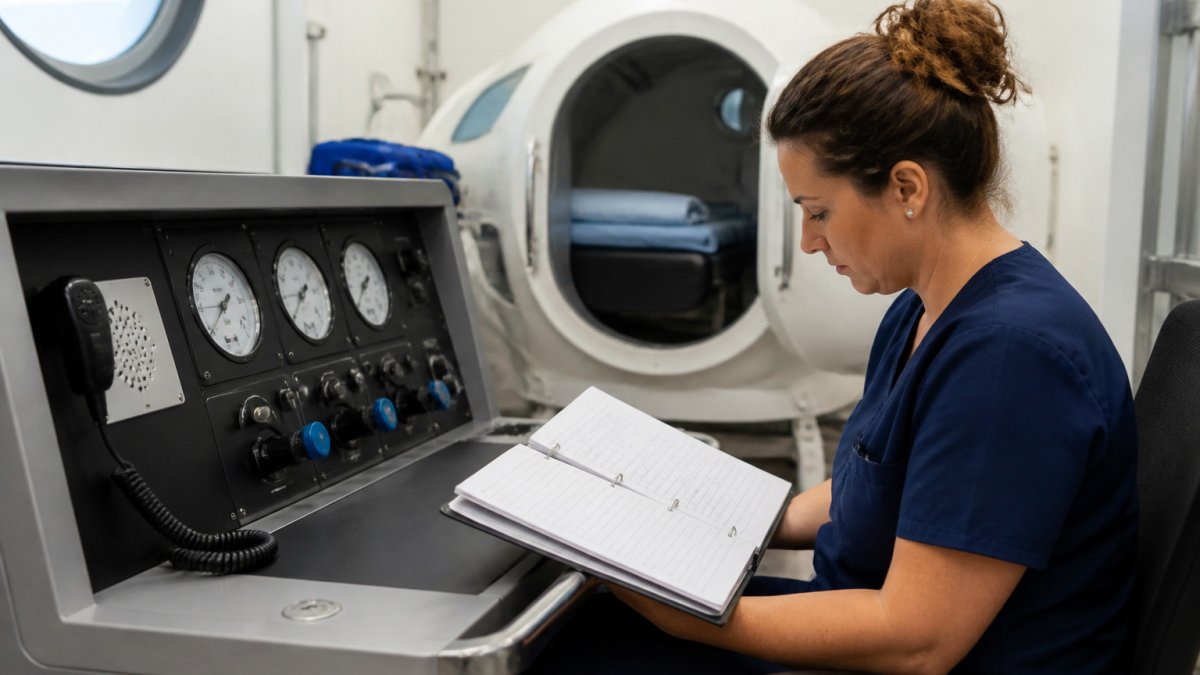
Ask any training program how many supervised chamber hours it requires and who signs off on them. Keep a detailed log, because employers and certifying boards often ask for proof.
Hyperbaric Technician Scope of Practice: Operating Versus Clinical Care
Operating a chamber and providing clinical care are not the same job. Clinical decisions about whether and how to treat a patient belong to a licensed physician or other qualified provider. Your state defines the scope of practice for each role, so write your facility's job descriptions to match those limits.
The line matters for liability. When a technician steps outside the defined role, insurance coverage and legal protection can be affected.
Your Certification and Compliance Checklist Before Hiring or Operating
Use this checklist before you hire a technician or open a chamber:
- Confirm your state's rules on chamber operation and any facility permits
- Verify which credential, if any, your state and insurer require
- Confirm the physician oversight arrangement and document it
- Check the candidate's training records and supervised clinical hours
- Review the certifying body's current eligibility and renewal rules
- Set written scope-of-practice guidelines for every role
- Keep records of each session, incident, and staff competency check
- Ask your liability insurer what documentation it expects
For more detail on the next steps, consult official state and federal sources and a qualified compliance advisor. Eternall Wellness provides information on hyperbaric equipment for commercial facilities; contact us for current product details and a quote.
Frequently Asked Questions
Is certification legally required to work as a hyperbaric technician?
In most US settings, no single federal law requires a hyperbaric technician to hold a specific certification. Requirements come from a mix of state rules, facility policies, payer and accreditation standards, and the scope of the licensed healthcare professional supervising the chamber. Employers often require a credential such as the Certified Hyperbaric Technologist (CHT) even where the law does not. Check your state health department and the facility's policies before assuming what is mandatory.
Do you need a license to operate a hyperbaric chamber?
Operating rules vary by state and by facility type. Some states regulate who may run a chamber, while clinical oversight usually rests with a physician. Hospital and clinic chambers typically operate under medical direction and institutional policy. Confirm the requirements for your state with its health department and with the physician or medical director who will supervise the chamber.
What does a Certified Hyperbaric Technologist certification require?
Certification pathways generally require a healthcare or related background, completion of hyperbaric training coursework, documented clinical experience operating chambers, and passing a certification examination. Requirements and eligibility rules are set by the certifying body and can change, so review the current candidate handbook from the certifying organization before applying.
Can a nonmedical employee operate a hyperbaric chamber?
This depends on state law, facility policy, and whether the activity is considered clinical care. Operating a chamber and providing clinical treatment decisions are separate responsibilities. Facilities usually assign chamber operation to trained staff under physician supervision. Confirm your state's rules and your insurer's and accreditor's expectations before assigning any nonmedical staff member to chamber operation.
Hiring the right technician is the first step to running a safe, compliant hyperbaric service. Eternall Wellness helps facilities evaluate equipment, training, and the business case for adding hyperbaric therapy, so you can make decisions with clear information.