 how-to
Hyperbaric Chamber Training for Staff: 2026 Guide
Table of Contents
- Who Needs Hyperbaric Chamber Training for Staff
- Hyperbaric Chamber Operational Training Duration and Course Structure
- Hyperbaric Safety Protocols for Staff: What Every Team Member Must Know
- Hyperbaric Staff Emergency Response Training
- Post-Training Competency Assessment for Your Clinic
- Cost-Benefit Analysis: Investing in Hyperbaric Chamber Training
- How to Build a Compliant Hyperbaric Training Program Step by Step
- Conclusion
Last Updated: August 18, 2026
Who Needs Hyperbaric Chamber Training for Staff
Hyperbaric chamber training for staff is the structured process of preparing clinical and non-clinical personnel to safely operate, monitor, and maintain hyperbaric oxygen therapy equipment in a commercial or medical setting. At Eternall Wellness, we work with gym owners, med spa directors, and wellness clinic managers who ask this question constantly: does everyone on my team need formal training, or just the person running the chamber?
The short answer: everyone who interacts with the chamber environment needs some level of training. The depth of that training depends on their role.
Clinical vs. Non-Clinical Roles: Different Training Tracks
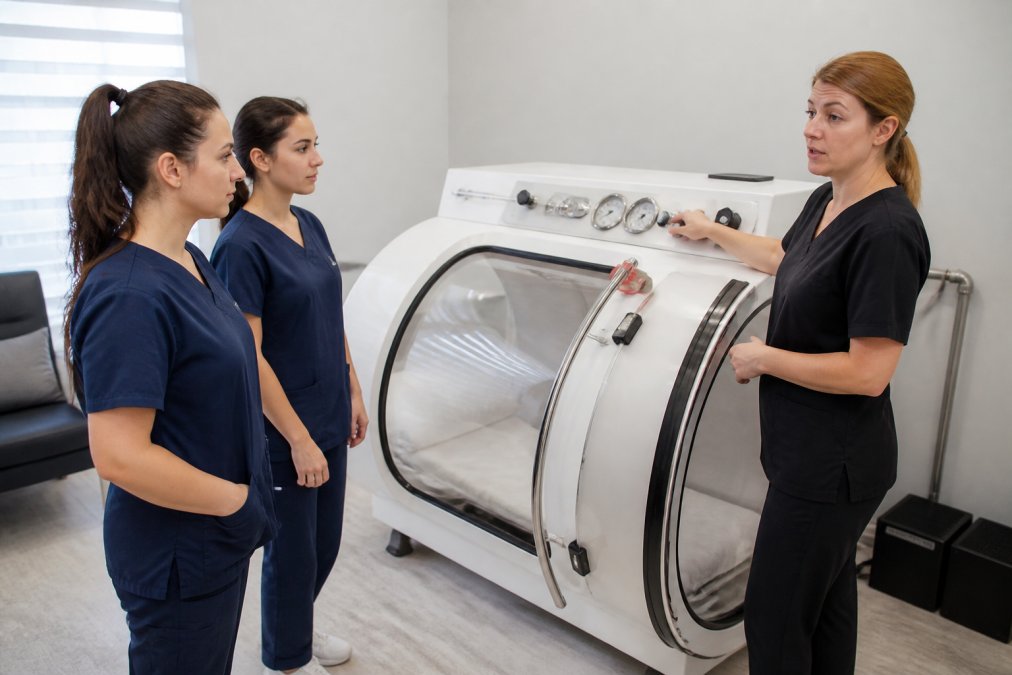
Most facilities make the mistake of treating hyperbaric chamber training as a single-tier requirement. It isn't. The Undersea and Hyperbaric Medical Society's training guidelines distinguish between operators who directly manage patient care and support staff who handle scheduling, room turnover, and equipment checks.
Clinical staff (physicians, registered nurses, respiratory therapists, physician assistants) require comprehensive hyperbaric oxygen therapy training, including patient assessment, oxygen toxicity recognition, and emergency response. Many pursue certification as a Certified Hyperbaric Technologist or Registered Hyperbaric Nurse through recognized credentialing bodies.
Non-clinical support staff (front desk coordinators, fitness coaches cross-trained in recovery, room attendants) need a different track: fire safety rules, contraindication screening protocols, and when to escalate to a clinician. This group is often overlooked in training plans, which creates real safety gaps.
| Staff Role | Training Track | Minimum Requirement |
|---|---|---|
| Physician / Medical Director | Clinical oversight | Hyperbaric medicine CME + credentialing |
| Registered Nurse / Respiratory Therapist | Primary operator | 40-hour introductory course + hands-on hours |
| Fitness or Wellness Coach | Secondary operator | Abbreviated safety + operational course |
| Front Desk / Support Staff | Awareness training | Fire safety, contraindications, escalation protocol |
| Clinic Manager | Administrative oversight | Safety officer training, regulatory standards |
Getting this matrix right before you open your hyperbaric suite is not optional. It's the foundation of a compliant, defensible program.
Hyperbaric Chamber Operational Training Duration and Course Structure
The standard entry point for anyone operating a hyperbaric chamber is a 40-hour introductory course. This is the widely accepted minimum, and it's structured to cover both didactic instruction and hands-on training within a single intensive program.
What the 40-Hour Introductory Course Covers
The 40-hour introductory course in hyperbaric chamber operational training typically spans five days and blends classroom learning with supervised chamber operation. Core modules generally include:
- Physics of hyperbaric environments, pressure principles, gas laws, and how they affect the human body at depth
- Hyperbaric oxygen therapy indications, the conditions treated, patient selection criteria, and contraindications
- Chamber operations, pressurization and depressurization procedures, equipment checks, and oxygen delivery systems
- Patient monitoring, vital sign assessment during treatment, recognizing adverse reactions, and documentation standards
- Oxygen toxicity and barotrauma prevention, recognizing early warning signs, treatment interruption protocols
- Fire safety, the unique combustion risks inside an oxygen-enriched environment and how to prevent them
- Emergency procedures, rapid decompression, medical emergencies inside the chamber, and coordination with emergency medical services
- Regulatory standards and accreditation, compliance with applicable clinical safety protocols and facility requirements
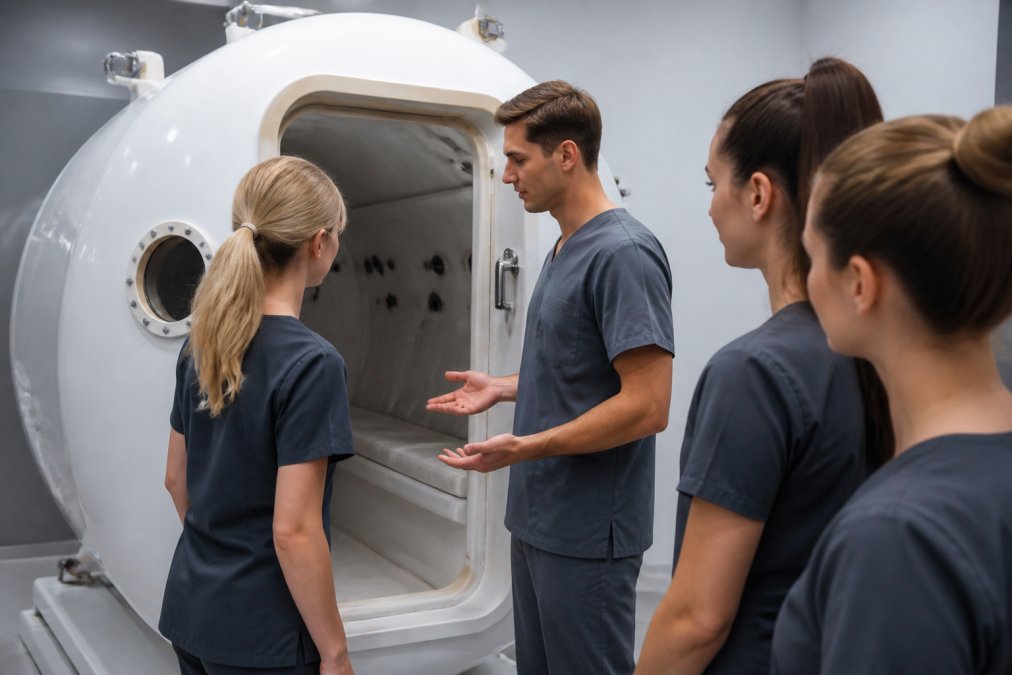
Hands-on training within this course typically involves supervised sessions on actual chamber equipment, which is where equipment-specific training nuances become critical. A monoplace chamber (single-patient, pressurized with 100% oxygen) operates differently from a multiplace chamber (multiple patients, air-pressurized with oxygen delivered by mask). Staff trained exclusively on one type should not assume competency on the other without additional instruction.
Credentialing and CME Requirements After Initial Training
Completing the 40-hour introductory course is the starting point, not the finish line. Ongoing credentialing and continuing medical education requirements apply to anyone maintaining clinical competency in hyperbaric oxygen therapy.
The National Board of Diving and Hyperbaric Medical Technology credentialing overview outlines the pathway to becoming a Certified Hyperbaric Technologist, which requires documented clinical hours, a written examination, and periodic recertification. Physicians and nurses pursuing formal hyperbaric medicine credentials through recognized bodies must also accumulate CME credits specific to hyperbaric practice.
For wellness and recovery facilities that operate mild hyperbaric chambers (below 1.5 ATA, used for wellness rather than wound care), credentialing requirements differ from hospital-based programs. Check with your state's relevant health authority and your equipment manufacturer for the applicable standards in your specific context.
Hyperbaric Safety Protocols for Staff: What Every Team Member Must Know
Safety protocols are not a checklist you review once during onboarding. They are the operational backbone of every session your team runs.
Hyperbaric safety protocols for staff cover three interlocking domains: fire prevention, physiological risk management, and patient monitoring. A gap in any one of them creates liability exposure and, more importantly, puts patients at risk.
Fire Safety, Oxygen Toxicity, and Barotrauma Prevention
Fire safety inside a hyperbaric suite deserves special attention because the risk profile is unlike anything else in a wellness facility. Oxygen-enriched environments dramatically lower the ignition threshold for materials that would not normally combust. Every staff member, clinical or not, must understand:
- No flammable materials inside or near the chamber, this includes petroleum-based lotions, certain fabrics, and electronic devices not rated for hyperbaric use
- Static electricity protocols, patients must change into approved garments; staff must follow anti-static procedures before chamber entry
- Fire suppression systems, know the location of all suppression equipment and the evacuation procedure for a pressurized chamber
Oxygen toxicity is a physiological risk for patients receiving high-concentration oxygen under pressure. Staff must recognize early symptoms: visual disturbances, ear ringing, facial twitching, and unusual anxiety. The standard response is to interrupt the session and depressurize in a controlled manner.
Barotrauma, tissue injury caused by pressure differentials, most commonly affects the ears and sinuses. Patient screening before each session should include a brief assessment of any upper respiratory congestion or recent ear issues. Staff trained in patient assessment can identify high-risk sessions before they become incidents.
Hyperbaric Staff Emergency Response Training
Emergency response in a hyperbaric setting is a specialized skill set that goes beyond standard first aid or BLS certification. The confined environment, elevated pressure, and oxygen-enriched atmosphere create conditions that standard emergency protocols were not designed for.
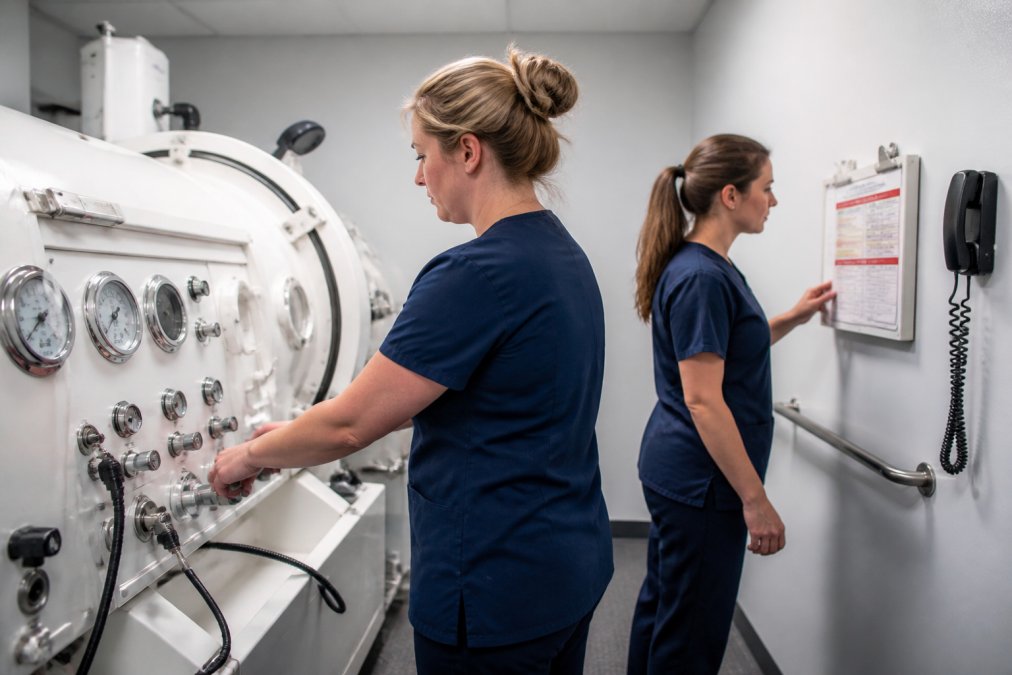
Hyperbaric staff emergency response training prepares operators to manage four primary scenarios: medical emergencies inside a pressurized chamber, unplanned rapid decompression, fire or smoke detection during a session, and equipment failure mid-treatment.
The critical difference from standard emergency medical training is that the response sequence must account for the time required to safely decompress a patient. You cannot simply open the door. Staff must be trained to:
- Assess whether the emergency requires immediate decompression or can be managed at pressure
- Communicate clearly with the patient through the intercom system while initiating the appropriate protocol
- Contact emergency medical services with accurate information about chamber type, current pressure, and patient condition
- Execute controlled decompression while monitoring the patient continuously
- Prepare the patient for handoff to emergency responders upon exit
Facilities that operate without a designated safety officer on shift during every hyperbaric session are operating outside best practice. That safety officer role does not necessarily require a physician, but it does require someone with current emergency response training and authority to make real-time decisions.
Post-Training Competency Assessment for Your Clinic
Most training programs end with a written exam. That's necessary, but it's not sufficient. Post-training competency assessment is the step most facilities skip, and it's where the gap between "trained" and "competent" becomes visible.
A structured competency assessment for hyperbaric chamber training should include three components:
1. Observed clinical performance. A qualified supervisor watches the staff member conduct a full session from patient intake through depressurization and documents specific competencies: correct equipment checks, accurate patient monitoring, appropriate response to simulated adverse events.
2. Scenario-based testing. Present staff with realistic emergency scenarios and evaluate their decision-making process, not just their final answer. Can they correctly prioritize steps under simulated pressure? Do they communicate effectively?
3. Periodic reassessment. Competency is not a one-time gate. Schedule formal reassessments at 90 days post-training and annually thereafter. This is particularly important for staff who run chambers infrequently.
Document every assessment. If a regulatory inspection or liability event occurs, your competency records are the evidence that your facility maintained clinical safety standards.
Cost-Benefit Analysis: Investing in Hyperbaric Chamber Training
Training costs are real, and clinic managers running lean operations ask the right question: what does this actually return?
The direct costs of hyperbaric chamber training include course fees for the 40-hour introductory program, travel and accommodation if training is not available locally, time off the floor for staff during training, and ongoing CME and recertification costs. For a team of two to three operators, this is a meaningful investment.
The cost of skipping or cutting corners on training is higher. Regulatory non-compliance can result in facility closure, loss of accreditation, or liability exposure that dwarfs any training budget. According to The Joint Commission's guidance on hyperbaric oxygen therapy program standards, facilities offering hyperbaric services are expected to maintain documented staff competency as part of their accreditation requirements.
Beyond compliance, well-trained staff directly affect revenue. Confident operators run more sessions with fewer cancellations, handle patient concerns more effectively, and retain clients who might otherwise drop off after a bad experience. The business case for thorough training is straightforward: it protects the asset you bought and maximizes the revenue it generates.
For facilities evaluating whether to add hyperbaric oxygen therapy services, Eternall Wellness approaches the investment as a business solution, not just an equipment purchase. That means helping clients think through staffing, training pathways, and use models before the chamber arrives, not after.
How to Build a Compliant Hyperbaric Training Program Step by Step
Building a compliant hyperbaric chamber training program from scratch requires sequencing the right steps in the right order. Here is a practical framework for clinic managers:
Step 1: Define your staff roles and training requirements. Map every role that will interact with the chamber environment. Use the clinical vs. non-clinical distinction outlined earlier. Identify which staff need the 40-hour introductory course and which need abbreviated safety training.
Step 2: Select an accredited training provider. Choose a program accredited by a recognized body in hyperbaric medicine. Confirm the course includes hands-on training on equipment comparable to what your facility operates. Verify that the curriculum covers chamber operations, patient monitoring, emergency procedures, and fire safety.
Step 3: Establish your medical oversight structure. Most hyperbaric programs, even wellness-focused ones, require a physician medical director who oversees clinical protocols. Confirm this requirement with your state health authority and your equipment manufacturer.
Step 4: Develop your facility-specific safety protocols. Generic training gives your staff the foundation. Your facility protocols adapt that foundation to your specific chamber model, physical layout, and patient population. Document everything: pre-session checklists, emergency response procedures, equipment maintenance schedules.
Step 5: Implement a post-training competency assessment process. Use the three-component model described above. Build assessment documentation into your quality management system.
Step 6: Schedule ongoing education and recertification. Map out CME requirements for clinical staff and set calendar reminders for annual competency reassessments. Assign a staff member ownership of the training calendar.
Step 7: Review and update protocols annually. Hyperbaric medicine guidance evolves. As documented by the American College of Hyperbaric Medicine's clinical practice resources, clinical safety protocols should be reviewed against current standards at least once per year.
Hyperbaric chamber training is the single most important operational investment a facility makes when adding hyperbaric oxygen therapy services. Undertrained staff create liability, lose clients, and leave revenue on the table. Eternall Wellness helps wellness businesses build the operational foundation that makes premium recovery services profitable and sustainable. Reach out to the Eternall Wellness team to discuss how hyperbaric systems fit your specific facility, staffing model, and revenue goals.
Frequently Asked Questions
What qualifications do you need to operate a hyperbaric chamber?
Requirements vary by chamber type and facility setting. In clinical settings, operators are typically licensed healthcare professionals, such as registered nurses, respiratory therapists, or physicians, who have completed a recognized hyperbaric training program. Non-clinical wellness facilities using mild hyperbaric chambers operate under different expectations, but staff should still complete a structured operational training course covering chamber mechanics, patient monitoring, and safety protocols. Always verify requirements with your state's medical board and your facility's medical director.
How long does it take to become a hyperbaric technician?
The standard entry point for hyperbaric chamber training is the 40-hour introductory course, which can be completed in about one week in an intensive format or spread across several weeks. After that, candidates typically need a defined number of clinical hours before sitting for a certification exam through bodies such as the National Board of Diving and Hyperbaric Medical Technology (NBDHMT). The full process from first course to certified hyperbaric technologist credential commonly takes several months to over a year, depending on clinical exposure.
Is specialized training required for non-medical wellness hyperbaric chambers?
Mild hyperbaric chambers used in wellness settings are not subject to the same federal clinical regulations as hospital-grade systems, but that does not mean staff can operate them without preparation. NFPA 99 sets standards for hyperbaric facilities, and any oxygen-enriched environment carries fire and pressure risks. Staff operating wellness chambers should complete equipment-specific operational training, understand basic oxygen safety and barotrauma awareness, and follow the manufacturer's protocols. Facilities should also confirm their liability coverage and consult with a qualified safety officer.
What are the OSHA and NFPA safety requirements for hyperbaric staff?
OSHA's general duty clause requires employers to provide a workplace free from recognized hazards, which applies to hyperbaric environments. NFPA 99 (Health Care Facilities Code) is the primary standard governing hyperbaric facility safety, covering chamber classification, fire prevention, electrical systems, and staff training requirements. Facilities should also follow guidance from the Undersea and Hyperbaric Medical Society (UHMS) for clinical operations. Staff training programs should address all relevant NFPA 99 requirements and document completion for compliance purposes.
This article was written using GrandRanker