 how-to
How to Market Wellness Day Passes to Local Clients
Table of Contents
- Step 1: Define Your Day Pass Offer and Ideal Local Client
- Step 2: Build Local Discovery With Geographic Targeting
- Wellness Center Marketing Ideas That Fill the Calendar
- Wellness Day Pass Promotion Ideas for First-Time Guests
- How to Promote a Wellness Center Through Partnerships and Events
- Wellness Studio Social Media Marketing and the Booking Journey
- Measure Pass Campaigns and Turn First Visits Into Repeat Revenue
- Conclusion
- Frequently Asked Questions
Last Updated: October 18, 2026
Step 1: Define Your Day Pass Offer and Ideal Local Client
A day pass is not a discount product but a low-risk trial that should lead straight into a membership or package. Get that link right and the pass pays for itself twice.
At Eternall Wellness, we help gyms, spas, med spas, and clinics treat recovery systems as revenue services rather than equipment. The first question we ask: who is the pass for?
Start With the Client, Not the Equipment
Most day-pass programs fail because they are built around what the facility owns rather than who it wants to attract. Before you set a price, write a one-sentence client profile naming four things:
- Where they live: a specific radius, not "the metro area." A pass marketed to a neighborhood three miles away converts far better than one aimed at a whole city.
- What they already do: a runner, an office worker, a new parent, a frequent traveler. The pass should slot into an existing routine, not ask them to build a new one.
- The barrier they feel: price, uncertainty about what happens inside, or scheduling. Each barrier needs a different offer.
Operators who try to serve everyone end up with a pass that appeals to no one. Pick one primary profile per campaign.
What a Strong Wellness Day Pass Includes
A pass that sells well bundles two or three services into one clear visit. Guests want a complete experience, not a single room for 20 minutes.
- One signature service, such as red light therapy or thermal recovery
- One shorter add-on to increase perceived value
- A facility tour and a short intake conversation
Keep the list short. A pass with seven inclusions confuses people and slows check-in.
Package the Pass So It Cannot Be Confused With a Membership
A day pass and a membership can look interchangeable to a first-time guest. Fix that with three structural choices:
- Time-box the pass. A pass valid for one calendar day, or for a single visit within 14 days of purchase, reads as a trial. An open-ended pass reads as a cheap membership and cannibalizes your recurring revenue.
- Cap the inclusions. Give the signature service plus one add-on. Reserve the full menu for members so the upgrade has a visible reason.
- Name the next step on the pass itself. Print or display the membership offer on the confirmation and at check-in. The guest should know before arriving what the upgrade looks like.
Pricing, Inclusions, and Conversion Economics
Price the pass to cover the cost of the visit and leave room for a membership upgrade.
A workable structure is a three-tier ladder rather than a single price:
- Entry pass: the signature service plus a tour. Priced to cover variable cost and a small margin.
- Experience pass: the signature service plus one add-on and a takeaway. Priced at roughly the value of two à la carte sessions.
- Bring-a-friend pass: two entries at a set rate. Useful for filling off-peak slots and for referral tracking.
Track three numbers for every pass sold:
| Metric | What It Tells You | Healthy Sign |
|---|---|---|
| Pass-to-membership rate | Whether the trial works | Rising month over month |
| Cost per pass booked | Whether ads pay off | Falling as word of mouth grows |
| Repeat visit rate | Whether the experience landed | Guests returning within 30 days |
Add two capacity numbers most guides skip: variable cost per visit (staff time, consumables, equipment) and available off-peak capacity.
Pricing depends on your services, room capacity, and local demand. We do not publish fixed figures, because a pass that works for a large med spa will not work for a 150-member gym.
Step 2: Build Local Discovery With Geographic Targeting
Local discovery starts with a claimed, complete business profile on Google and Apple Maps. Most first-time guests search a service plus their neighborhood, so your listing must answer that query clearly.
Fill in every field: hours, services, photos, and a booking link. Add your day pass as a named service so it appears in local search results.
Structure the Listing Around the Pass, Not Just the Facility
A complete listing is table stakes. The day-pass-specific move is to make the pass a discoverable object on its own:
- Name the pass as a service with its own short description, price range, and booking link. Guests searching for a one-time visit should land on the pass, not on a membership page.
- Use photos that show the visit, not just the equipment. A photo of a guest mid-session answers the first-timer's real question: what happens when I walk in?
- Keep hours accurate to the minute. A pass buyer is often planning a same-day or next-day visit; wrong hours are the fastest way to lose them.
Target a Radius, Not a Region
Geographic targeting saves money: a campaign aimed at a three-mile radius reaches people who can actually show up on a Tuesday evening.
Build the radius in layers:
- Core radius: the walkable or short-drive area. This is where most day-pass buyers come from, so bid most aggressively here.
- Secondary radius: a slightly wider ring for retargeting and for seasonal campaigns.
- Exclusions: exclude areas outside a realistic drive time. A pass sold to someone 40 minutes away rarely converts to a repeat visit.
Pair the radius with dayparting. Run pass ads toward the hours you are trying to fill, weekday mornings and early afternoons, rather than across the whole day.
Build a Booking Journey With No Dead Ends
Discovery only pays off if the path from search result to booked visit is short. Design the journey in five steps:
- Landing page: the pass, its inclusions, its price, and a single booking button above the fold. No menu hunting.
- Booking page: show real availability, accept same-day bookings, and collect only the information you will actually use, name, contact, and any health intake required before the visit.
- Confirmation: send arrival instructions, parking details, what to bring, and a link to reschedule. This is also where you surface the membership offer.
- Reminder: a text or email the day before cuts no-shows and gives the guest a channel to ask questions.
- Post-visit follow-up: within 48 hours, send a thank-you with the membership or package offer and a simple way to book the next visit.
Text-message marketing earns its place here. A short reminder cuts no-shows and gives guests a channel to ask questions.
Make the Pass Easy to Find in Local Search
Beyond the map listing, a few local-search basics do most of the work:
- Create a dedicated page for the day pass with the service name, neighborhood, and price range in the title and headings.
- Ask for reviews after each visit, and reply to every one. Reviews that mention the pass itself help future searchers.
- Register on local directories and neighborhood community boards.
According to Google's guidance on local business profiles, complete listings with photos and regular posts are more likely to appear in local results. That is free reach most studios ignore.
Wellness Center Marketing Ideas That Fill the Calendar
Calendar gaps are a marketing problem, not a demand problem. Weekday mornings and early afternoons sit empty at most facilities while evenings run full.
Fill them with targeted offers:
- Weekday day pass: a lower-priced pass valid before 3 p.m.
- First-visit bundle: pass plus a short consultation
- Seasonal promotion: a themed pass for a holiday or a new year reset
Each idea targets a specific gap. Run one at a time so you can measure what worked.
Book a 30-Minute Facility Review →
A pass promoted around a stress-heavy period, such as the end of a quarter or the start of a new year, tends to outperform a generic offer.
Wellness Day Pass Promotion Ideas for First-Time Guests
First-time guests need a reason to choose you over the spa down the street. A special offer works best when it removes one specific barrier: price, uncertainty, or timing.
Try these wellness day passes promotion ideas:
- Offer a first-visit rate that includes a short orientation.
- Publish a clear schedule so guests know when rooms are free.
- Send a welcome text with parking and check-in details.
- Follow up within 48 hours with a membership offer.
- Ask for a review after the second visit, not the first.
The follow-up matters most. A guest who leaves without hearing from you is a guest you paid to acquire and then lost.
How to Promote a Wellness Center Through Partnerships and Events
Partnerships put your pass in front of people who already trust someone else. That trust transfers, and it costs far less than paid advertising.
Start with businesses that share your client base but do not compete with you:
- Physical therapy and chiropractic clinics
- Personal trainers and running clubs
- Corporate HR teams and office managers
Offer a simple trade: their clients get a pass, and you mention them to yours. Track each partner with a unique promo code so you know who sends business.
Public events work the same way. An open house with free mini sessions gives neighbors a reason to walk in.
Wellness Studio Social Media Marketing and the Booking Journey
Wellness studio social media marketing should end in a booking, not a like. Every post needs a clear next step that takes two taps at most.
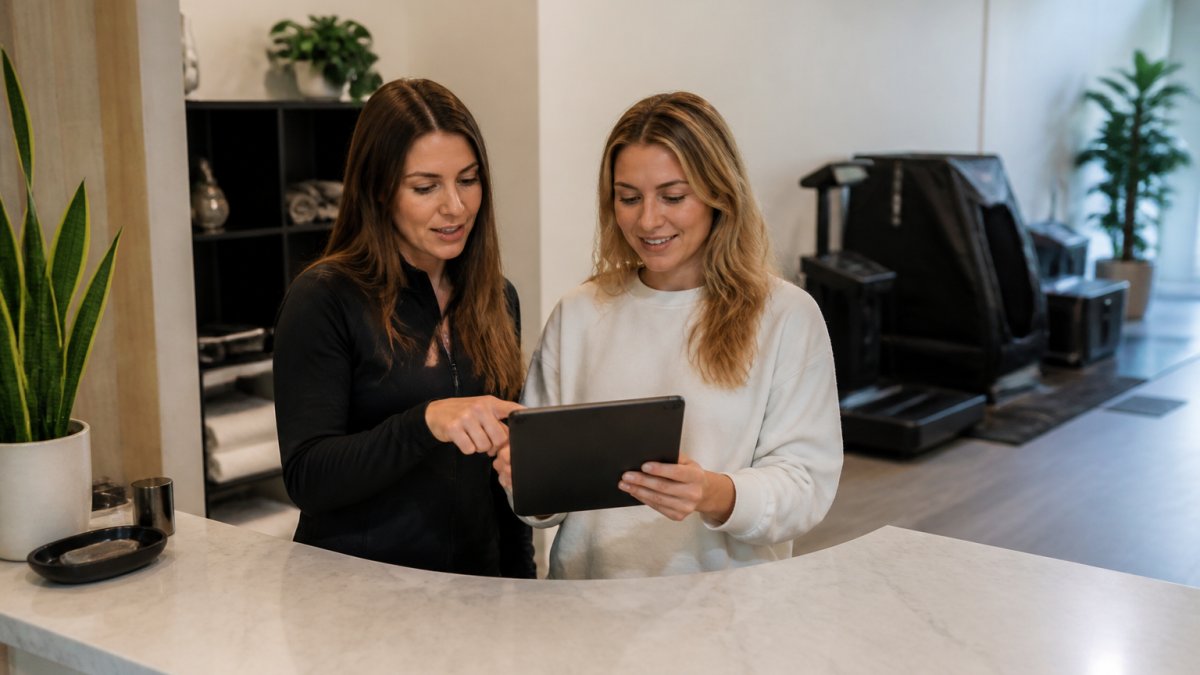
Show the space, the equipment, and real guests using it. Video performs well because it answers every first-timer's question: what actually happens when I walk in?
Then build a booking journey with no dead ends:
- Link the booking page in every profile bio
- Put the pass on the homepage, not buried in a menu
- Accept same-day bookings
Text-message marketing earns its place here. A short reminder cuts no-shows and gives guests a channel to ask questions.
Measure Pass Campaigns and Turn First Visits Into Repeat Revenue
Measurement turns a promotion into a system. Track every pass from first click to second visit to learn which channel deserves more budget.
Set these benchmarks and review them monthly:
- Cost per pass booked, by channel
- Share of pass guests who book again
- Share who upgrade to a membership or package
The last number is the one that matters. Customer lifetime value, not the pass price, tells you whether a campaign is worth repeating.
Client retention starts at check-in. Train staff to learn each guest's name, note their goals, and book the next visit before they leave.
Equipment choices shape that experience. At Eternall Wellness, we help operators match recovery systems to their space, staffing, and demand, with financing so capital stays free while new services launch. Our team works through pricing, use, and ROI before a single unit ships.
Conclusion
Filling the calendar with first-time guests is the easy part. Turning those guests into regulars is where most wellness businesses stall.
Eternall Wellness builds recovery systems that support all three. Our multi-modality equipment, financing options, and ROI planning help facilities add services that pay for themselves. Get started with Eternall Wellness and turn every day pass into a lasting client relationship.
Frequently Asked Questions
What should a wellness day pass include to attract local clients?
A day pass that converts usually bundles one signature service with access to shared amenities, such as a recovery modality plus a thermal or lounge area, and a clear time window. Keep inclusions simple enough to explain in one sentence, because local clients compare options quickly. Price the pass so it covers the cost of one staffed session and leaves room for an upgrade path. Build the pass around what your facility already does well rather than adding every modality at once, and make the booking page list exactly what is and is not included.
How can wellness day passes bring in new local clients?
Day passes work as a low-risk first step for people who are not ready for a membership. Promote them through local search, neighborhood partnerships, and social content that shows the actual experience. Track which channel produced each booking so you know where to spend more. The pass itself is not the goal: the goal is a second visit. Offer a simple next-step credit or a follow-up message within a few days, and measure repeat visits rather than pass sales alone. That shift in focus is what turns a promotion into customer acquisition.
How do I promote a wellness center on a limited budget?
Start with the channels that cost time rather than money. Claim and complete your local business listing, ask happy clients for online reviews, and post short video of the space and the experience. Partner with nearby businesses that already serve your ideal customer and cross-promote. Run one small paid campaign targeted to a tight radius around your location rather than a broad region. Track bookings per channel for four to six weeks before adding spend, so you can tell which effort actually produced clients.
How do I get first-time day pass guests to come back?
The return visit is decided during the first one. Confirm the booking clearly, greet the guest by name, and walk them through the space so they are not guessing where to go. Ask for feedback the same day and invite a second visit with a specific reason, such as a new service or a quieter time slot. Capture contact details with permission so you can follow up. Track how many first-time guests book again within 30 days; that number tells you whether your client experience is working.
Sources and further reading: U.S. Small Business Administration marketing guide, Federal Trade Commission advertising and endorsement guidance.