 how-to
How to Market Thermal Recovery Services to Clients
Table of Contents
- Why Thermal Recovery Services Are a Revenue Opportunity for Wellness Businesses
- How to Explain Thermal Recovery to Clients So They Book
- Building Thermal Recovery Service Packages That Sell
- Wellness Studio Marketing Ideas That Fill Your Schedule
- Your Wellness Service Marketing Plan: A Step-by-Step Launch Framework
- Measuring Marketing Performance and Proving ROI
- Common Mistakes to Avoid When Marketing Thermal Recovery Services
- Frequently Asked Questions
Last Updated: October 6, 2026
Why Thermal Recovery Services Are a Revenue Opportunity for Wellness Businesses
Thermal recovery is the use of controlled heat and cold exposure, delivered through infrared saunas, contrast therapy, and similar systems, to speed muscle recovery and support relaxation.
The business case starts with use. Most facilities already own the room, the front desk staff, and the client list.
That is the opportunity. The hard part is that nobody walks in asking for it by name.
U.S. Small Business Administration guidance on starting a business
How to Explain Thermal Recovery to Clients So They Book
Most clients do not know what thermal recovery is, so lead with the outcome, not the equipment. Explain it in terms of what they already want: less soreness, better sleep, a reason to come back between workouts. The mistake is opening with technology specs.
The 60-Second Explanation That Works at the Front Desk
Train staff to say something like: "It's a 30-minute session that uses controlled heat to help your muscles recover faster after training.
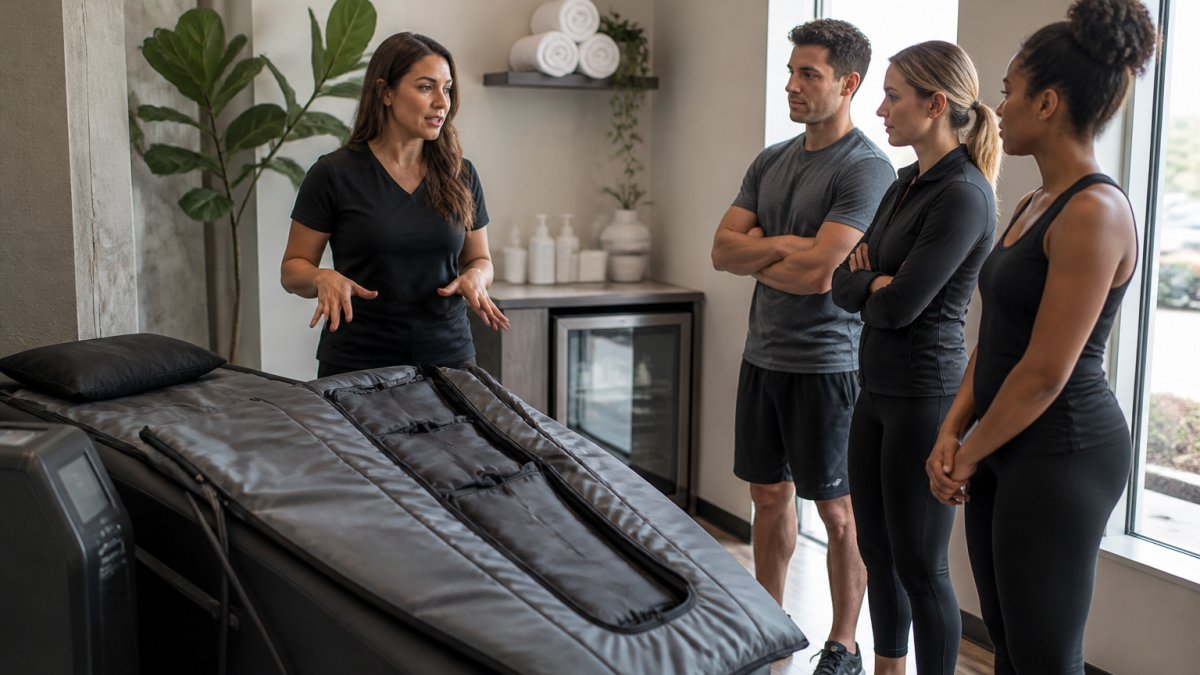
Pair the explanation with a demonstration flight. Let a prospective client sit in the room, see the equipment, and feel the space. A five-minute walkthrough converts better than any brochure.
Building Thermal Recovery Service Packages That Sell
Single sessions rarely build a habit, so package them. A one-off booking is a trial; a package is a commitment. Structure your thermal recovery service packages around frequency and duration, then price the bundle so the per-session cost drops.
| Package | Sessions | Best For | Billing |
|---|---|---|---|
| Intro Offer | 1-2 | First-time trial | One-time fee |
| Monthly Membership | 4-8 | Regular gym clients | Recurring |
| Recovery Bundle | 8-12 | Athletes, post-surgical wellness | Prepaid block |
| Add-On to Existing Service | 1 | Med spa or chiro patients | Per visit |
Package Structures That Drive Repeat Bookings
The membership model is where retention lives. A client who pays monthly has a reason to return, and recurring revenue is easier to forecast than walk-ins. Pair packages with a demo session so buyers know exactly what they are committing to.
Wellness Studio Marketing Ideas That Fill Your Schedule
The fastest wins come from the clients you already have. Before spending on ads, run these wellness studio marketing ideas: front-desk scripts, email sequences to your existing list, and a visible sign-up sheet in the recovery room. Existing clients convert at a far higher rate than cold traffic.
Local Outreach and Partnership Tactics
Build referral relationships with the businesses that already serve your target market. Physical therapists, sports medicine clinics, chiropractors, and personal trainers all have clients who need recovery. A simple partnership, where you cross-refer and offer a shared intro rate, brings in qualified leads at almost no cost.
- Drop off sample-image cards and a one-page service sheet at nearby clinics
- Offer a free demonstration flight to partner staff
- Ask for a testimonial video after every fifth happy client
- Post short video presentations of a real session to social media
- Run a local outreach email to sports teams and running clubs
Your Wellness Service Marketing Plan: A Step-by-Step Launch Framework
A wellness service marketing plan only works if it is sequenced. Launching ads, partnerships, and staff scripts in the same week makes it impossible to tell what produced a booking. Work through the phases below in order and give each one two to three weeks before judging results.
Phase 1: Pick Two Buyer Segments and Write a One-Page Profile for Each
Do not market to "everyone who wants to recover." Pick two segments and build a profile for each. Consider these four segments:
- Strength and endurance athletes. They care about training frequency, soreness between sessions, and event timelines. Proof point: a session log showing how many sessions they booked in the eight weeks before a race or meet.
- Post-rehab and chronic-tension clients referred by allied professionals. They care about comfort, consistency, and whether their physical therapist or chiropractor endorses the service. Proof point: a signed referral relationship, not a testimonial.
- Desk-bound professionals with stress and sleep complaints. They care about a 30-minute reset they can fit before or after work. Proof point: a short, honest description of what a session feels like, not clinical claims.
- Existing med spa, chiro, or gym members. They already trust you. Proof point: a member-only intro rate and a front-desk script.
For each segment, write down three things on one page: the outcome they want, the objection they will raise, and the proof you can show. That page becomes the source for every email, script, and ad you write.
Phase 2: Build the Outreach Kit Before You Contact Anyone
Build these five assets first:
- A one-page service sheet. What the service is, session length, what a client should expect to feel, and how to book. No medical claims.
- A partner referral email. Short, specific, and easy to forward. Offer a shared intro rate and a clear next step.
- A front-desk script card. One paragraph staff can read verbatim.
- A follow-up sequence. Three messages: a thank-you after the first session, a check-in at day seven, and a membership offer at day fourteen.
- A testimonial request template. Ask for a specific outcome, not a general compliment.
Phase 3: Launch to Existing Clients First
Your current list is the cheapest audience you will ever have. Send a two-email sequence: one announcing the service with the intro offer, and one seven days later with a specific use case for that client's segment. Put signage in the recovery room and a sign-up sheet at the front desk. Track how many bookings come from each source.
Phase 4: Build Local Partnerships in Person
Visit five allied businesses in person. Physical therapy clinics, sports medicine practices, chiropractors, and personal trainers are the highest-yield partners because their clients already have a recovery need. Bring the one-page service sheet, offer a free demonstration session for their staff, and propose a shared intro rate. Ask for one thing per visit: a referral relationship, not a testimonial.
Phase 5: Turn On Paid and Social Promotion
Only after phases 1 through 4 are running should you spend on ads. Target your metro area with short video showing a real session, and send traffic to a booking page that names the segment you are speaking to. Keep the creative honest: show the room, the equipment, and a client's described experience.
Phase 6: Collect Proof and Review Monthly
Ask every satisfied client for a testimonial after their fifth session, and ask specifically for the outcome they noticed. Once a month, review which phase produced the most bookings and shift budget toward it. Cut any channel that has not produced a booking in 30 days.
Federal Trade Commission guidance on advertising and endorsements
Measuring Marketing Performance and Proving ROI
Here is a short list of numbers that can help you track your marketing, with the formula for each.
The Five Numbers That Tell You Whether Marketing Is Working
- Lead-to-booking rate. Bookings divided by qualified leads. Track this by source, not as a single blended figure.
- Cost per booking. Total spend on a channel divided by bookings from that channel. Compare this against your average revenue per client, not against your session price.
- Repeat rate. Clients who book a second session divided by clients who booked a first. This is the single best predictor of whether the service will be profitable.
- Revenue per client. Total service revenue divided by unique clients over a 90-day window. This captures package upgrades and add-ons that a per-session figure hides.
- Referral share. Bookings that came from a partner or an existing client divided by total bookings. If this number is low, your partnership phase is underbuilt.
How to Build a Case Study Without Overstating What Thermal Data Shows
A case study does not need dramatic claims. It needs a clear before, a clear process, and a clear after. Use this four-part template:
- The starting situation. What the client was dealing with in their own words, with written permission to publish.
- What they booked. The package, the number of sessions, and the time frame.
- What they reported. Their described experience, quoted directly. Do not paraphrase into a medical claim.
- What you can and cannot say. State plainly that thermal recovery supports relaxation and recovery and is not a treatment for any condition. Refer medical questions to a qualified professional.
A single documented story with a real quote and a session count outperforms a page of adjectives, and it keeps you clear of advertising rules that apply to health-adjacent services.
A Simple Monthly Review
Once a month, write down the five numbers above, note which phase of your launch plan produced the most bookings, and move budget toward it. Cut any channel that has not produced a booking in 30 days. Keep the review to one page so you actually do it.
Federal Trade Commission guidance on advertising and endorsements
Common Mistakes to Avoid When Marketing Thermal Recovery Services
Lead with the benefit.
Describe typical, honest outcomes and refer medical questions to a qualified professional.
A simple follow-up message after the first session can help with retention.
Adding a recovery service is a revenue decision as much as a wellness one. At Eternall Wellness, we help gyms, spas, and clinics evaluate premium recovery systems as revenue-generating services, with financing available to preserve capital and support that focuses on ROI, use, and integration into your existing operations.
Frequently Asked Questions
How do you market thermal recovery services to new clients?
Start by identifying which local audiences will benefit most, such as athletes, chronic pain sufferers, or post-surgical patients. Create a simple explanation of what thermal recovery does and how it fits into their routine. Then use a mix of channels: social media video demonstrations, email sequences to your existing list, and partnerships with physical therapists or sports teams. Offer a discounted first session to reduce the barrier to trying it. Track which channels bring in bookings so you can double down on what works.
How can a wellness studio explain thermal recovery to clients?
Keep the explanation practical and outcome-focused. Instead of describing the technology, tell clients what they will feel and how it fits into their recovery routine. For example: 'This 20-minute session uses gentle heat to help your muscles relax and recover faster after a workout.' Avoid medical jargon. Use a simple analogy like comparing it to a warm compress that reaches deeper tissue. Have staff practice a 60-second script so every client gets the same clear message.
How do you create packages for thermal recovery services?
Structure packages around frequency and commitment. A common approach is a single session for trial, a 5-session pack for a two-week recovery cycle, and a monthly unlimited option for regular users. Price the multi-session packs at a discount to encourage prepayment. Test two or three package structures with your clients and see which one gets the highest conversion rate.
How can wellness businesses encourage repeat bookings for recovery services?
Repeat bookings come from habit and results. After each session, send a follow-up message asking how they feel and reminding them when to book next. Offer a subscription or membership that includes a set number of sessions per month. Use automated reminders via text or email. Track your repeat booking rate and adjust your follow-up timing. Focus on encouraging consistent use.