 how-to
How to Choose the Right Red Light Therapy Equipment
Table of Contents
- What You'll Need Before You Start Comparing Red Light Therapy Equipment
- Step 1: Match the Device to Your Treatment Goals
- Step 2: Decode Red Light Therapy Device Specifications
- Step 3: Calculate Your Dose (A Practical Guide)
- Step 4: Red Light Therapy Panel vs. Full-Body System
- Step 5: Verify Performance Claims Independently
- Step 6: Understand Red Light Therapy Equipment Cost and Total Cost of Ownership
- Step 7: Vetting Your Red Light Therapy Equipment Supplier
- Frequently Asked Questions
Last Updated: October 6, 2026
What You'll Need Before You Start Comparing Red Light Therapy Equipment
Learning how to choose the right red light therapy equipment starts with one question: what do you want it to do? Red light therapy uses specific wavelengths to support skin, muscle, and joint recovery. At Eternall Wellness, we help gyms, med spas, and clinics answer that before they spend a dollar.
Before you compare anything, gather these basics:
- A clear goal list: skin, joints, or whole-body recovery
- Your room size and power supply limits
- Your budget, including install and upkeep
Get those five items on paper first.
Step 1: Match the Device to Your Treatment Goals
The right device follows the goal. A facial device will not treat a shoulder, and a small panel will not cover a full body in one session. Match the format to the job before you look at specs.
Face, Joints, or Full Body: Choosing Your Target Area
Target area decides almost everything else. A facial device suits the face and neck, a mid-size panel works for joints, back, and shoulders, and a full-body system covers the whole body in one session.
Ask three questions: how many body areas need treatment, how many clients per day will use it, and whether you need hands-free operation.
A Decision Matrix: Format by Goal and Body Area
Most buyers pick a format by price or a sales rep's push. Work backward from the treatment goal and body area instead. Use the matrix below as a starting filter, then confirm specs in Step 2.
| Goal | Typical body area | Best-fit format | Why |
|---|---|---|---|
| Facial skin tone, texture, fine lines | Face and neck only | LED mask or small facial panel | Contoured coverage, short sessions, low irradiance is usually sufficient |
| Localized joint or muscle recovery | One knee, shoulder, elbow, or lower back | Mid-size panel on an adjustable stand | Concentrated output over a small area, easy to reposition |
| Multi-site recovery | Two or more joints or muscle groups per session | Large panel or two mid-size panels | Fewer repositioning steps, shorter total session time |
| Full-body recovery or wellness | Whole body, front and back | Full-body panel array or bed | Even coverage in one session, higher throughput |
| Post-workout recovery in a gym setting | Legs, back, shoulders | Full-body array or large panel | Handles multiple clients per hour with minimal staff time |
Coverage Math: How Much Area Does One Session Actually Treat?
Coverage is the spec most buyers ignore, yet it determines whether a device fits your workflow. A panel treats roughly the area of its emitting face, plus a modest spread as distance increases.
That trade-off is the core of format selection: a small panel held close delivers high irradiance over a small area, while a large panel at working distance delivers lower irradiance over a large area.
A practical way to size a device:
- Measure the largest single body area you plan to treat (for example, the length and width of a back or both thighs).
- Compare that to the emitting face of the panel you are considering.
- If the emitting face is smaller than the target area, plan for multiple placements per session and add that time to your schedule.
Throughput: The Number That Decides Panel vs. Full-Body
Throughput is sessions per hour, and it usually decides the format for commercial buyers. A targeted panel treats one area in minutes, but repositioning for a second or third area adds time and staff attention.
Estimate sessions per hour for each format, then compare that to expected demand. Low one-on-one demand favors a targeted panel on cost and space; steady full-body demand favors the larger format, which pays back faster as staff time per session drops.
Hands-Free Operation and Client Comfort
Hands-free operation matters more than most buyers expect. A stand-mounted device or fixed array lets the client sit or stand without holding anything, improving comfort and freeing staff.
For commercial settings, prioritize formats that run without an operator in the room. For home use, a mask or small panel often fits better because convenience drives consistent use.
Step 2: Decode Red Light Therapy Device Specifications
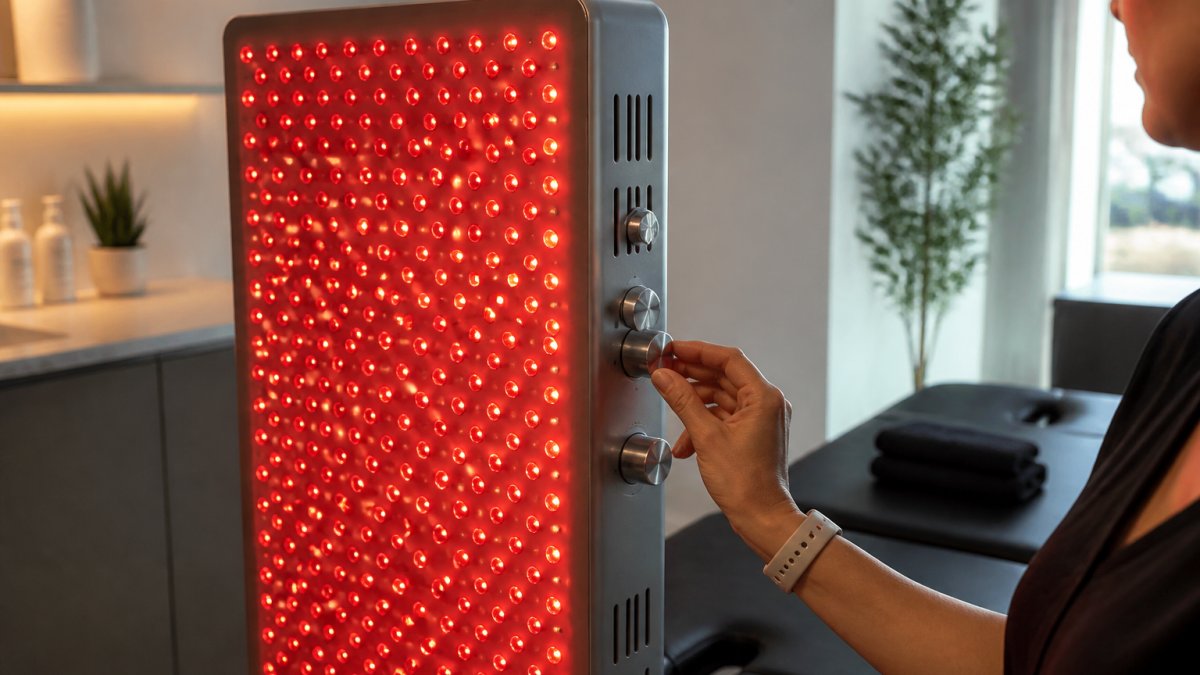
Red light therapy device specifications come down to three numbers: wavelength, irradiance, and treatment distance. Get these wrong and the device underperforms, whatever you paid.
Wavelengths: Why 600-900 nm Matters
Wavelength is measured in nanometers (nm). The red light spectrum runs from about 600 to 700 nm, and near-infrared from about 700 to 900 nm, so the useful range for most devices sits between 600 and 900 nm.
Red light tends to work on surface tissue like skin. Near-infrared light penetrates deeper, reaching muscle and joint tissue. Many quality devices combine both.
Look for stated wavelengths on the spec sheet. If a seller will not name them, walk away.
Irradiance, Power Output, and Treatment Distance
Irradiance is the light power that lands on your skin, measured in milliwatts per square centimeter (mW/cm²).
Treatment distance changes everything: light spreads as it travels, so moving twice as far away drops intensity sharply.
The FDA guidance on light-emitting products classifies many of these devices by their risk level, so check the clearance status before you buy.
Ask suppliers for measured irradiance at a stated distance, not just peak output. That number tells you how long a session should take.
Step 3: Calculate Your Dose (A Practical Guide)
Dose is the total light energy delivered to your skin in one session, measured in joules per square centimeter (J/cm²). It combines irradiance and session time:
Dose (J/cm²) = Irradiance (mW/cm²) × Time (seconds) ÷ 1,000
In practice, say a device lists measured irradiance of 50 mW/cm² at your treatment distance. To reach a 10 J/cm² dose:
- 10 × 1,000 = 10,000
- 10,000 ÷ 50 = 200 seconds
- That is about 3 minutes 20 seconds
Match the dose to the goal. Skin concerns often use lower doses. Deeper muscle and joint work may need more. Always follow the maker's protocol and start low.
Step 4: Red Light Therapy Panel vs. Full-Body System
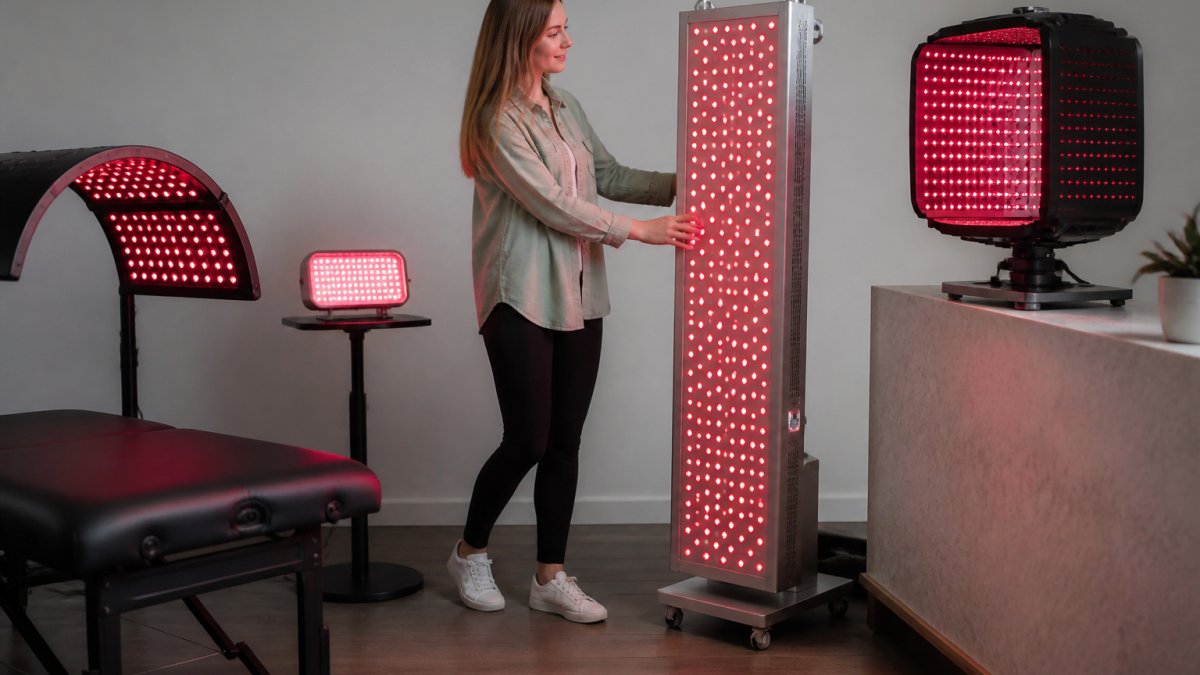
The red light therapy panel vs. full-body system choice depends on coverage and workflow. Panels are smaller and cheaper to start. Full-body systems treat more area in less time.
| Feature | Panel | Full-Body System |
|---|---|---|
| Coverage | One area at a time | Whole body |
| Session time | Longer per area | Shorter overall |
| Space needed | Small wall or stand | Dedicated room |
| Best for | Targeted joint or skin work | High-volume recovery |
| Portability | Often movable | Fixed install |
Panels suit clinics treating one area per visit; full-body systems suit gyms and recovery studios moving clients through quickly. If throughput drives revenue, the bigger unit usually wins.
Step 5: Verify Performance Claims Independently
Independent verification separates real specs from marketing. Ask for third-party test data on irradiance and wavelength; a lab report on measured output outweighs a brochure.
What to request:
- A test report from an accredited lab
- Measured irradiance at a stated distance
- Stated wavelengths with a tolerance range
The FTC guidance on advertising claims requires sellers to back up performance claims with evidence. If a supplier cannot show test data, treat the claim as unproven.
This is the step most buyers skip, and the one that protects your investment.
How to Read an Irradiance Test Report
An irradiance number means nothing without its measurement conditions. Check these four items before trusting the figure:
- Measurement distance. Irradiance falls off as distance increases. A figure measured at the panel surface is not the figure your skin receives at a working distance of several inches or more.
- Measurement instrument. A calibrated spectroradiometer or a calibrated power meter with a known sensor area is the standard. A phone app or an uncalibrated lux meter is not.
- Beam uniformity. A single center-point reading can hide hot spots and dead zones. A useful report samples multiple points across the emitting face.
A common red flag is a headline irradiance figure with no distance stated. If the seller cannot tell you the distance at which the number was measured, assume it was measured at the surface and discount it heavily for your working distance.
Distance, Irradiance, and Why the Headline Number Misleads
Light spreads as it travels, so the same panel produces very different irradiance at one inch versus six inches.
Ask the supplier for irradiance at the distance you plan to use, not at the surface. If they only have surface data, request the measurement distance and beam profile, then plan session time around the lower, realistic figure.
Safety Features, Eye Protection, and Contraindications
Verification is also about safety. Red and near-infrared light are generally well tolerated but not appropriate for everyone, and eye exposure deserves attention.
Safety features to confirm before purchase:
- Eye protection included or recommended, and whether the device is designed so clients do not stare into the emitters
- Thermal cutoffs or timers that prevent overexposure
- Clear instructions for session duration and distance
Situations where a buyer or user should consult a qualified clinician before use include:
- Photosensitivity, or a history of reactions to light
- Medications known to increase light sensitivity, such as certain antibiotics, diuretics, and acne treatments
- Pregnancy, where guidance varies and a clinician's input is appropriate
This is not a complete list or medical advice, but a prompt to check the manufacturer's contraindications and ask a clinician when in doubt. A supplier who cannot produce a written contraindication list is one to avoid.
Certifications and Regulatory Status
The FDA page on medical device safety explains how cleared devices are tracked, which helps you confirm a product's status. Ask the supplier which regulatory pathway applies to their device and whether they hold the corresponding clearance or registration.
A supplier who explains their regulatory status, test reports, and contraindications in plain language will usually support you after the sale too. Verification is a preview of how they behave when something goes wrong.
Step 6: Understand Red Light Therapy Equipment Cost and Total Cost of Ownership
Red light therapy equipment cost is more than the sticker price. Total cost of ownership includes power, upkeep, staff time, and repairs over the device's life.
Ongoing costs to plan for:
- Electricity for daily sessions
- Replacement parts and bulbs over time
- Staff training and scheduling time
Pricing depends on size, features, and supplier, so ask for a current quote rather than trusting a list price. At Eternall Wellness, we offer financing that preserves capital while you add a new service line.
Step 7: Vetting Your Red Light Therapy Equipment Supplier
Your red light therapy equipment supplier matters as much as the device.
Check these before you commit:
- Will they share measured irradiance data?
- Do they offer training and setup help?
- What does the warranty cover, and for how long?
A supplier who disappears after the sale leaves you with an expensive problem.
The FDA page on medical device safety explains how cleared devices are tracked, which helps you confirm a product's status.
At Eternall Wellness, we treat equipment as a business decision, not just a purchase.
Frequently Asked Questions
How can you tell if a red light therapy device is legitimate?
Look for FDA clearance for the intended use, independent third-party irradiance measurements, and transparent specifications that list wavelength in nanometers and power output in mW/cm². A legitimate supplier will provide test reports and explain how irradiance was measured. Be cautious of vague claims like 'medical grade' without documentation. You can also ask for the device's clearance number and verify it in the FDA's public database.
Do cheaper red light therapy devices work?
Lower-cost devices can work if they meet key specifications: wavelengths in the 600-900 nm range, adequate irradiance, and honest measurement data. However, budget devices often overstate power output or use lower-quality LEDs that degrade faster. For a wellness business, the total cost of ownership (including replacements and downtime) usually favors equipment with verified performance and reliable supplier support over the cheapest option.
What questions should you ask a red light therapy equipment supplier?
Ask for independent irradiance test reports, the exact wavelengths and their ratios, whether the device has FDA clearance for your intended use, what training and support are included, and how replacement parts are handled. Also ask about warranty terms, financing options, and whether they can provide references from similar facilities. A supplier that answers clearly and provides documentation is more likely to support you long-term.
How do you choose red light therapy equipment for a wellness business?
Start by defining your treatment goals and target areas, then match device type (panel, mask, or full-body system) to those needs. Verify specifications like wavelength, irradiance, and dose calculations. Compare total cost of ownership, not just purchase price. Finally, vet the supplier for FDA clearance, independent verification, training, and ongoing support. This approach ensures the equipment fits your business model and delivers consistent results.
Adding red light therapy sounds simple until you weigh specs, dose, cost, and support. That is where most facilities stall. Eternall Wellness helps gyms, spas, and clinics turn a device decision into a revenue plan, with premium commercial systems, financing that preserves capital, and support that lasts. Get started with Eternall Wellness and build a recovery service your clients keep coming back for.