 ultimate-guide
Operational Risks of Recovery Business Units in 2026
Table of Contents
- What Are the Operational Risks of Recovery Business Units?
- Hyperbaric Oxygen Therapy Compliance Requirements You Cannot Ignore
- Building a Risk Assessment Template for Recovery Centers
- Equipment Maintenance Protocols for Recovery Units That Prevent Downtime
- The Hidden Costs: Psychological Impact and Post-Incident Analysis
- Budgeting for Recovery Infrastructure and AI-Driven Predictive Recovery
- Frequently Asked Questions
Last Updated: September 16, 2026
What Are the Operational Risks of Recovery Business Units?
The operational risks of recovery business units are the internal failures that can shut down service delivery, damage client trust, and drain revenue even when demand is strong. At Eternall Wellness, we see facility owners focus on equipment specs while overlooking the people, processes, and systems that keep those machines running. This guide breaks down the specific risks recovery units face and how to close them.
People, Processes, and Systems: The Three Pillars of Risk
Operational risk management rests on three pillars: people, processes, and systems. Weakness in any one pillar undermines the other two.
Hyperbaric Oxygen Therapy Compliance Requirements You Cannot Ignore
Hyperbaric oxygen therapy compliance requirements center on device classification, operator training, and facility safety documentation. The FDA classifies hyperbaric chambers as medical devices, and facilities must meet the requirements that apply to their specific chamber type and intended use. But chamber compliance is only one layer. A recovery unit that treats chamber rules as its entire compliance program will still fail an audit, a survey, or an insurance review.
Layer 1: Device and Chamber Compliance
- Device labeling and cleared indications for your specific chamber type (monoplace vs. multiplace carry different requirements)
- Documented operator training and competency records, refreshed on a defined cycle
- Facility safety protocols, including fire prevention, oxygen handling, and emergency egress procedures
- Maintenance and inspection logs retained for audit, most facilities retain these for a minimum of several years, and longer if state law requires it
- Clear client consent and screening documentation, including contraindication checks
Because these requirements vary by chamber type and state, confirm the specifics with the FDA's device classification database and your state health department before launch. Never assume a protocol from another facility applies to yours.
Layer 2: Workplace Safety Compliance
The Occupational Safety and Health Administration (OSHA) requirements apply to recovery units the same way they apply to any workplace. The risks that trip up wellness facilities most often are oxygen-enriched atmospheres, compressed gas handling, electrical safety near wet treatment areas, and bloodborne pathogen exposure for any staff who handle client skin or wounds. OSHA's hazard communication standard requires that every chemical on site, including cleaning agents and sanitizers, has a current Safety Data Sheet accessible to staff.
Layer 3: Client Data and Privacy Compliance
If your unit bills insurance, coordinates with physicians, or stores treatment records electronically, the Health Insurance Portability and Accountability Act (HIPAA) Privacy and Security Rules likely apply. Even cash-pay wellness units that store health information can fall under state privacy laws that mirror HIPAA. The practical requirements are unglamorous: access controls on your booking and EHR systems, audit logs, a written breach notification procedure, and business associate agreements with any vendor that touches client data.
Layer 4: Licensure, Accreditation, and Payer Requirements
State health departments license some recovery services and not others, and the line moves. Accreditation bodies such as the Joint Commission and the Undersea and Hyperbaric Medical Society (UHMS) publish facility standards that many payers require before they will reimburse hyperbaric treatments. If you accept Medicare or commercial insurance, the payer's coverage determinations function as de facto compliance rules, a chamber indication that is FDA-cleared may still be non-covered, and billing for it creates fraud and abuse exposure.
The Documentation Discipline That Ties It Together
Every layer above is proven through records, not through intent. A common pattern in failed audits is a facility that actually followed the right procedure but cannot produce the log, the training certificate, or the signed consent form that proves it. Build a single compliance calendar that lists every recurring obligation, training refreshes, log reviews, SDS updates, business associate agreement renewals, with a due date and an owner.
Building a Risk Assessment Template for Recovery Centers
A risk assessment template for recovery centers should score each risk by likelihood and impact, then assign an owner and a review date. Without a template, risk reviews become vague conversations that never produce action.
Here is a practical template you can adapt:
| Risk Category | Example Risk | Likelihood (1-5) | Impact (1-5) | Owner | Review Date |
|---|---|---|---|---|---|
| People | Untrained staff operating chamber | 3 | 5 | Clinical lead | Quarterly |
| Process | Missed maintenance log entries | 4 | 3 | Operations manager | Monthly |
| Systems | Booking software fails to sync | 2 | 4 | IT coordinator | Quarterly |
| Compliance | Expired operator certification | 2 | 5 | Compliance officer | Monthly |
| Financial | Idle equipment during peak hours | 3 | 3 | Revenue manager | Monthly |
Equipment Maintenance Protocols for Recovery Units That Prevent Downtime
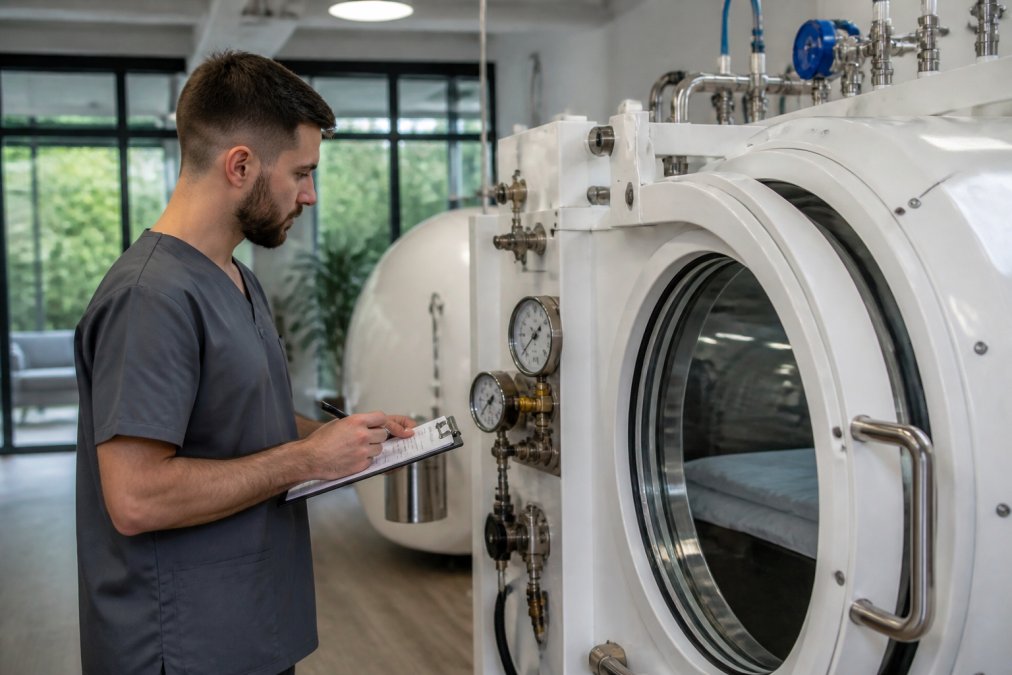
Equipment maintenance protocols for recovery units should combine daily checks, scheduled servicing, and documented repairs. Downtime is one of the most expensive operational risks because it stops revenue and frustrates booked clients.
The Hidden Costs: Psychological Impact and Post-Incident Analysis
The psychological impact on recovery teams after an incident is one of the most overlooked operational risks. When equipment fails or a client is harmed, staff carry stress that shows up as errors, absenteeism, and turnover.
Budgeting for Recovery Infrastructure and AI-Driven Predictive Recovery
Budgeting for recovery infrastructure should account for equipment, maintenance, training, and contingency reserves, not just the purchase price. Owners who budget only for acquisition often get caught by the ongoing costs that follow. This is the section most competitors skip, because it requires talking about money in specifics rather than strategy in generalities.
The Four Cost Buckets Nobody Budgets For
When you model a recovery unit, split the budget into four buckets instead of one:
- Acquisition, the equipment purchase price, installation, and any facility buildout (oxygen lines, electrical upgrades, ventilation, flooring).
- Operating, consumables, sanitization supplies, utilities (hyperbaric and thermal equipment draw real power), software subscriptions, and insurance premiums.
- Maintenance and compliance, scheduled servicing contracts, calibration, inspection fees, training refreshes, and the staff hours that go into documentation.
- Contingency, a reserve for unplanned downtime, emergency repairs, and the revenue you lose while a unit is offline. Facilities that skip this bucket are the ones that panic when a chamber goes down during peak season.
How to Justify the Spend to Stakeholders
The C-suite question is never "is this equipment good?" It is "what does this cost us per month, and what does it return?" Build the case around three numbers:
- Cost per treatment slot, total monthly operating cost divided by the number of treatment slots you can realistically fill.
- Utilization rate, the percentage of available slots actually booked. This is the single biggest lever on profitability, and it is an operational risk metric, not a marketing one.
- Downtime cost, the revenue lost per day a unit is offline, plus the client churn that follows a cancelled appointment.
AI-Driven Predictive Recovery: What It Actually Does
AI-driven predictive recovery is changing how facilities manage this. The mechanism is straightforward: sensors on equipment capture operating data, pressure cycles, temperature curves, vibration, run hours, and a model learns the normal pattern for that specific machine. When the live data drifts from the learned baseline, the system flags the anomaly before it becomes a failure. That is the difference between scheduled maintenance (replace the part on a calendar) and predictive maintenance (replace the part when the data says it is about to fail).
The Trade-Offs to Weigh Honestly
Predictive systems carry real costs: sensor installation, integration with your existing maintenance workflow, staff training, and the ongoing subscription. For a single-chamber facility, the payback may not justify the complexity. For a multi-modality unit with several high-value machines, the math usually favors it, because unplanned downtime on any one unit drags down utilization across the whole schedule. The honest framing is that predictive maintenance is a utilization play, not a technology play.
Frequently Asked Questions
What are the primary operational risks for wellness recovery units?
The main operational risks for recovery business units include equipment failure, staff error, regulatory non-compliance, supply chain disruptions, and cybersecurity threats. Equipment breakdowns can halt revenue and damage client trust. Human error during treatments like hyperbaric oxygen therapy can lead to safety incidents. Regulatory compliance gaps can result in fines or shutdowns. Supply chain issues may delay critical parts. Each risk requires a mitigation strategy tailored to your facility's size and services.
How does operational resilience differ from risk management in recovery services?
Risk management focuses on identifying and reducing threats before they occur, while operational resilience is about maintaining business operations during and after a disruption. For recovery centers, risk management might involve regular equipment inspections. Operational resilience means having backup power, cross-trained staff, and contingency plans so you can keep serving clients even when something fails. Both are essential: risk management prevents issues, resilience ensures you recover quickly.
What regulatory compliance standards apply to hyperbaric and thermal recovery equipment?
Hyperbaric chambers and thermal recovery equipment are regulated medical devices in many cases, subject to FDA oversight for safety and effectiveness. Facilities must follow manufacturer guidelines, state health department rules, and occupational safety standards. Compliance requirements vary by state and device classification. Always verify current regulations with the FDA and your state health agency before offering new services. Documentation of staff training, equipment maintenance, and incident reports is typically required.
How can businesses mitigate equipment downtime in recovery business units?
Mitigate downtime by implementing preventive maintenance protocols, keeping critical spare parts on hand, and training staff to perform basic troubleshooting. Schedule regular inspections based on manufacturer recommendations. Use predictive maintenance tools where available to catch issues early. Have a backup plan for each modality, such as a partnership with a nearby facility or a mobile unit. Document all maintenance and repairs to identify patterns and reduce future failures.
Recovery units face real operational risk, but the biggest exposure is usually the gap between what you planned and what you actually document. Eternall Wellness helps facility owners build recovery services that hold up under scrutiny, with premium commercial-grade systems, financing that preserves working capital, and support that treats the business case as seriously as the equipment. Get started with Eternall Wellness and build a recovery unit that runs reliably from day one.