 ultimate-guide
Hyperbaric Chamber Safety and Compliance Guide
Table of Contents
- NFPA 99 Hyperbaric Safety Requirements Explained
- FDA Hyperbaric Chamber Regulations for Wellness Facilities
- Your Hyperbaric Facility Operational Checklist
- Patient Screening and Clinical Safety Protocols
- Staff Training and Competency Certification for Hyperbaric Safety
- Fire Suppression, Incident Reporting and Root Cause Analysis
- Building a Compliance-Ready Hyperbaric Program: Your Next Steps
- Frequently Asked Questions
Last Updated: September 10, 2026
NFPA 99 Hyperbaric Safety Requirements Explained
Hyperbaric chamber safety and compliance in the United States starts with NFPA 99, the health care facilities code governing how hyperbaric chamber safety systems are classified, installed, and maintained. This guide from Eternall Wellness breaks down what the code requires, where facilities get cited, and how to build protocols that hold up under inspection.
NFPA 99 divides hyperbaric chambers into two classes based on the oxygen environment inside the vessel. Class A chambers operate above 23.5 percent oxygen by volume, the threshold at which materials ignite far more readily; Class B chambers stay at or below it. This distinction drives every downstream requirement: wiring, grounding, fire suppression, and allowed materials.
Most compliance failures trace back to one misunderstanding: operators treat NFPA 99 as a document you read once at installation. It isn't. The code sets ongoing maintenance, testing, and documentation obligations for the life of the equipment.
Class A vs. Class B and C Chambers: What the Code Expects
Class A chambers carry the strictest requirements because a high-oxygen atmosphere turns ordinary materials into fuel. NFPA 99 expects limited-combustible construction, dedicated electrical circuits, and fire suppression rated for the space. Class B and C chambers face lighter requirements, but every class still needs documented maintenance, verified grounding, and staff trained on emergency procedures.
Electrical Isolation, Grounding and Bonding Rules
Electrical isolation, grounding, and bonding protect against the ignition sources that cause most hyperbaric fires. NFPA 99 requires electrical equipment inside or near a chamber to be isolated from the patient and chamber structure, with grounding and bonding verified at installation and rechecked on a schedule. Static discharge is a real hazard in oxygen-rich environments, so conductive flooring, humidity control, and restrictions on synthetic clothing all serve a purpose.
What most guides miss is that grounding degrades. A system that passed inspection three years ago can fail today because a connection loosened or corrosion set in. Test it, log it, and treat the results as part of your compliance record.
FDA Hyperbaric Chamber Regulations for Wellness Facilities
The FDA regulates hyperbaric chambers as medical devices, so the claims you make matter as much as the equipment. A chamber cleared for specific medical indications cannot be marketed for general wellness benefits outside that clearance.
This is where wellness facilities get into trouble: the equipment may be safe and properly installed, but the marketing copy promises outcomes the device was never cleared to deliver. That gap between cleared use and advertised use is a regulatory exposure, not a technical one.
Cleared Indications vs. Wellness Claims: Staying on the Right Side of the Line
The FDA maintains a defined list of cleared indications for hyperbaric oxygen therapy: certain wound care applications, decompression sickness, and other conditions documented in the agency's device guidance. A wellness facility offering sessions for general recovery, energy, or anti-aging benefits operates outside that cleared scope.
The line is not about whether the chamber works, but what you claim it does. Facilities that describe sessions in neutral, experience-based terms and direct medical questions to a qualified clinician stay on the right side of it; those that publish treatment claims for unapproved conditions do not.
Medical Device Reporting and Adverse Event Obligations
Facilities that operate FDA-regulated devices carry reporting obligations when something goes wrong. Adverse events, malfunctions, and injuries connected to the device may need reporting through the FDA's device reporting system; thresholds and timelines are set by the agency, so check current guidance rather than secondhand summaries.
The operational point is simpler: build an incident log from day one. If a patient reports ear pain, dizziness, or any symptom during or after a session, that entry becomes part of your compliance record and your defense if a question arises.
Your Hyperbaric Facility Operational Checklist
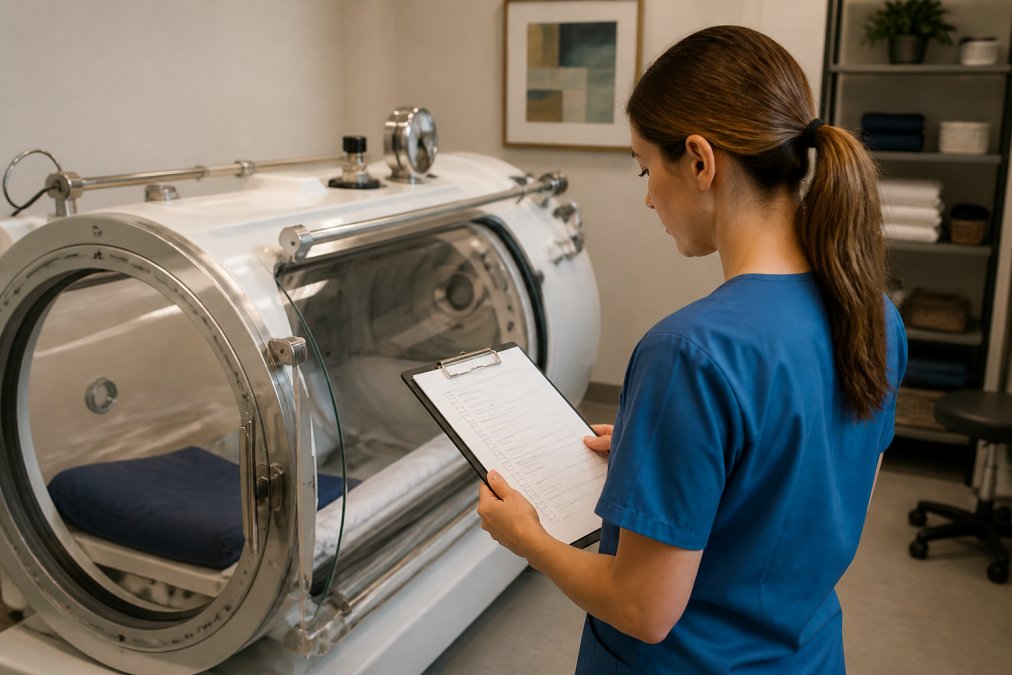
A hyperbaric facility operational checklist turns the code into daily action. The goal is audit readiness: if an inspector walked in tomorrow, your logs should tell the whole story. What separates a checklist that survives inspection is specificity, named tasks, owners, and intervals tied to NFPA 99 and manufacturer requirements rather than generic reminders.
Daily, Monthly and Annual Tasks That Keep You Audit-Ready
The table below reflects the cadence most compliant facilities follow. Your manufacturer's manual and medical director's protocols may add to it, but rarely subtract.
| Frequency | Task | Owner | Why It Matters |
|---|---|---|---|
| Each session | Inspect chamber interior, confirm no prohibited materials (oils, alcohol-based lotions, synthetic fabrics, electronics) | Chamber operator | Eliminates ignition sources before pressurization |
| Each session | Verify oxygen concentration readings and atmosphere logs | Chamber operator | Confirms the chamber is operating within its Class A or Class B limit |
| Daily | Confirm fire suppression system is in ready state and gauges read in range | Safety officer | A suppression system that is offline is the single largest fire risk in an oxygen-enriched space |
| Weekly | Test emergency depressurization and communication systems | Safety officer | Verifies the two systems patients depend on in an emergency |
| Monthly | Test grounding and bonding continuity on chamber and connected equipment | Biomedical or facilities engineer | Catches degradation from corrosion or loosened connections before it becomes a hazard |
| Monthly | Review incident, maintenance, and training logs for gaps | Safety officer | Keeps documentation current and reveals patterns before they become events |
| Quarterly | Staff competency spot-check (emergency drill, equipment operation) | Medical director or designee | Confirms training is retained, not just completed |
| Annually | Full safety audit, fire suppression system inspection, and electrical re-verification | Third-party inspector or qualified engineer | Meets code inspection cycles and resets the compliance clock |
What Belongs in Every Log Entry
An inspector does not grade the quality of your equipment, but the quality of your records. Each log entry should carry five elements: date and time, name of the person performing the task, the specific task performed, the result or reading observed, and a signature or initials. Entries that say "checked chamber" without a reading or name are treated as missing.
A common pattern in facilities that fail audits is a gap of days or weeks in the log, followed by a burst of backfilled entries. Inspectors recognize this and it undermines the credibility of the entire record. The fix is not more paperwork, it is a checklist short enough that staff complete it daily.
Assigning Ownership So the Checklist Actually Runs
A checklist without an owner is a wish. Assign each row to a named role, not a department: chamber operator, safety officer, biomedical engineer, medical director. Without an owner, tasks default to whoever is least busy, how monthly grounding tests slip to quarterly and quarterly drills disappear. Review ownership at least annually and whenever a staff member leaves.
Patient Screening and Clinical Safety Protocols
Patient screening prevents the complications that make hyperbaric sessions risky. A referring physician's evaluation, documented health history, and contraindication check should happen before anyone enters a chamber.
Key screening elements include:
- Contraindications: Certain lung conditions, untreated pneumothorax, and specific implant types may rule out hyperbaric treatment. A qualified clinician makes that call, not front-desk staff.
- Barotrauma prevention: Ear and sinus pressure injuries are the most common side effect. Teaching patients equalization techniques before the first session reduces them significantly.
- Oxygen toxicity signs: Central nervous system and pulmonary oxygen toxicity are rare but serious. Staff must recognize early symptoms and know how to depressurize safely.
Every facility should have written protocols for each of these, reviewed by a medical director and updated as clinical guidance changes.
Staff Training and Competency Certification for Hyperbaric Safety
Competency certification should cover chamber operation, emergency depressurization, fire response, patient monitoring, and documentation. It isn't a one-time orientation: staff need initial certification, periodic refreshers, and documented competency checks. When a new hire takes over chamber operations, their training record becomes part of the compliance file.
This is also where Eternall Wellness factors in. Our commercial hyperbaric systems are designed for facility environments, and we help operators think through the training, use, and workflow questions that determine whether a chamber becomes a functioning service line or an expensive room nobody uses.
Fire Suppression, Incident Reporting and Root Cause Analysis
Fire suppression in a hyperbaric space is engineered, not improvised. NFPA 99 expects suppression systems matched to the chamber's class, with testing on a defined cycle. Water mist and other approved systems are common in Class A installations, and every system needs documented inspection. What most guides skip is the testing cadence and post-incident process, the two areas where facilities actually get cited.
Fire Suppression System Testing Intervals
Suppression systems inside and serving hyperbaric chambers are typically inspected on a cadence combining manufacturer requirements with the applicable NFPA inspection, testing, and maintenance standard. Compliant facilities follow this pattern:
- Monthly: Visual inspection of suppression components, gauges, and nozzles; confirm the system is in a ready state and no components are obstructed.
- Quarterly: Verify detection and alarm circuits, confirm activation pathways, and test any interlock that shuts down chamber systems on alarm.
- Annually: Full system inspection and test by a qualified contractor, including discharge-path verification and replacement of any components past their service life.
- After any activation or near-activation: Inspect, recharge, and document before returning the chamber to service.
Documentation for each interval should name the system, the inspector, the result, and any corrective action. A suppression system that is in place but undocumented is treated the same as one that is not tested.
Incident Reporting: What to Capture and When
Incident reporting and root cause analysis close the loop. When something goes wrong, the goal isn't blame, it's finding the condition that allowed the failure and fixing it. Facilities operating FDA-regulated devices also carry reporting obligations for adverse events, malfunctions, and injuries; thresholds and timelines are set by the agency, so check current guidance rather than secondhand summaries.
A workable incident log captures, at minimum:
- Date, time, and duration of the session
- Chamber class, pressure profile, and oxygen concentration at the time of the event
- Personnel present and their roles
- Patient-reported symptoms or observed equipment behavior
- Immediate action taken and outcome
- Whether the event meets the facility's threshold for external reporting
A Root Cause Analysis Framework You Can Run in an Hour
Most facilities never run a formal root cause analysis because they assume it requires a committee and a week of meetings. It doesn't. A structured one-hour review covers the ground:
- Log the incident with time, personnel, chamber conditions, and the sequence of events as observed.
- Identify the immediate cause, the event that directly produced the outcome.
- Identify the underlying condition, the missing check, unclear protocol, or untrained step that allowed the immediate cause to matter.
- Assign a corrective action with a named owner and a deadline.
- Verify the fix at the next review cycle and update protocols, checklists, or training if the condition was systemic.
A worked example: a patient aborts a session due to ear pain. The immediate cause is failed equalization. The underlying condition may be that the pre-session equalization coaching was delivered verbally and inconsistently. The corrective action is a written patient handout and a documented coaching step in the intake checklist. The verification is a review of aborted-session rates over the next quarter.
Facilities that run this loop consistently catch small problems before they become reportable events, and it is the strongest defense if a regulator or plaintiff later asks what was done after a near-miss.
Building a Compliance-Ready Hyperbaric Program: Your Next Steps
Compliance is a program, not a purchase. Facilities that stay audit-ready share three habits: they document everything, train continuously, and treat every incident as information rather than a problem to hide.
The regulatory landscape is dense, and it shifts. The FDA's device reporting guidance and NFPA 99 code documentation are the sources that actually govern your operation, so check them directly rather than relying on summaries. For facilities weighing a hyperbaric addition, the CDC's healthcare safety resources offer useful context on infection control and facility hygiene.
If you're adding a hyperbaric chamber to a gym, med spa, or wellness clinic, the equipment is the easy part. The program around it determines whether it runs safely and profitably for years.
Adding a hyperbaric chamber to your facility means taking on real compliance obligations, and getting them right from day one saves you from costly corrections later. Eternall Wellness helps gyms, spas, and wellness clinics evaluate hyperbaric systems as revenue-generating services, with financing options that preserve your capital while you expand. Our team supports you through equipment selection, integration into your existing operations, and the use planning that keeps a chamber busy rather than idle. Get started with Eternall Wellness and build a hyperbaric service line that's both compliant and profitable.
Frequently Asked Questions
What are the safety standards for using a hyperbaric chamber?
Hyperbaric chamber safety rests on three layers: NFPA 99 (Health Care Facilities Code), which covers construction, electrical isolation, fire protection and chamber atmosphere; FDA regulations for the device itself, including cleared indications and medical device reporting; and your own operational protocols for patient screening, staff training and preventative maintenance. Most states also require facility accreditation or a licensed physician serving as medical director. Together these standards govern everything from grounding and bonding to emergency depressurization procedures. Review the current editions of NFPA 99 and FDA guidance directly, since requirements update on multi-year cycles.
Do you need to be certified to operate a hyperbaric chamber?
Yes. NFPA 99 hyperbaric safety requirements expect every chamber operator to complete a formal training program with documented competency assessment before working unsupervised. Typical programs cover chamber atmosphere monitoring, oxygen toxicity signs, barotrauma prevention, emergency depressurization and fire response, and run 40 hours or more. Certification should be refreshed on a set schedule, and many facilities cross-train at least two staff members per shift so a trained operator is always present. Keep training records on file; they are one of the first items a safety audit or accreditation survey will request.
Are there any dangers to hyperbaric oxygen therapy?
Yes, and honest patient education matters more than reassurance. The most common risks are barotrauma (ear and sinus injury from pressure changes), oxygen toxicity affecting the central nervous system or lungs, and temporary vision changes. Fire is the most serious hazard because a high-oxygen chamber atmosphere accelerates combustion, which is why NFPA 99 bans combustible materials and requires electrical isolation. Most complications are preventable through patient screening, slow compression and decompression rates, and clear communication during treatment. Anyone with a pacemaker, implanted device, untreated pneumothorax or certain lung conditions should be evaluated by a qualified physician before use.
How does NFPA 99 impact hyperbaric chamber installation and safety?
NFPA 99 classifies chambers (Class A for multiplace, Class B and C for monoplace) and sets different construction, electrical and fire protection requirements for each. It addresses grounding and bonding to prevent sparks, limits combustible materials inside the chamber, and requires medical gas systems to meet specific purity and handling standards. Installation also involves the room itself: fire suppression, emergency lighting and ventilation are all covered. Because the code is updated on a multi-year cycle, confirm which edition your state or local authority has adopted before you build out a room or accept delivery of a chamber.
How often must hyperbaric equipment undergo safety inspections for compliance?
A practical hyperbaric facility operational checklist runs on three cadences. Daily: pre-treatment checks of chamber atmosphere, oxygen levels, communication systems, emergency equipment and cleanliness. Monthly: inspection of hoses, seals, valves, grounding connections and fire suppression components. Annually: full preventative maintenance by a qualified technician, calibration of gas monitors and pressure gauges, and a documented safety audit. NFPA 99 and manufacturer instructions set the specific intervals for your chamber model, so build the schedule around both. Log every inspection with date, findings and corrective action; auditors want the paper trail, not just the work.
Do wellness facilities need specific certifications to operate hyperbaric oxygen therapy units?
Requirements vary by state, so check with your state health department before opening. Many states treat hyperbaric oxygen therapy as a medical service and require a licensed physician as medical director, credentialed operators, and facility accreditation from a recognized body. Some states permit non-medical wellness use of mild hyperbaric chambers under looser rules, but the FDA hyperbaric chamber regulations for wellness still apply to the device itself, including cleared indications and adverse event reporting. Operating without the right credentials exposes your business to liability and shutdown risk. Build compliance into your opening plan, not after.
What are the primary fire safety risks associated with hyperbaric oxygen therapy?
A high-oxygen chamber atmosphere turns ordinary ignition sources into serious hazards. The main risks are electrical sparks from ungrounded equipment, static discharge from synthetic clothing or bedding, and prohibited items like electronics, oils, alcohol-based sanitizers or synthetic fabrics brought inside. NFPA 99 addresses these with electrical isolation and grounding and bonding rules, combustible material restrictions and fire suppression requirements. Staff training should cover what patients can wear and bring in, how to respond to a fire alarm during treatment, and emergency depressurization procedures. Fire drills specific to the chamber room are worth running at least twice a year.
How should a facility handle incident reporting and root cause analysis for hyperbaric safety?
Treat every incident, near miss included, as a data point. Log the date, time, chamber pressure, patient status, staff on duty and a factual description of what happened. Then run a root cause analysis within a few days: ask why the event occurred, trace it back past the immediate cause to the system or training gap behind it, and assign a corrective action with an owner and deadline. Share lessons in staff meetings without blame. This practice satisfies accreditation expectations, feeds your safety audit documentation, and catches small problems before they become reportable events.