 how-to
How to Start a Hyperbaric Oxygen Therapy Business in 2026
Table of Contents
- Step 1: Choose Your Business Model and Location
- Step 2: Build Your Recovery Studio Business Plan Template for 2026
- Step 3: Understand HBOT Equipment Costs and Chamber Types
- Step 4: Navigate FDA Regulations for Hyperbaric Chambers
- Step 5: Meet Hyperbaric Technician Certification Requirements
- Step 6: Set Up Safety Protocols and Facility Compliance
- Step 7: Marketing Your Hyperbaric Oxygen Therapy Business and Attracting Patients
- Step 8: Manage Ongoing Operational Costs and Maintenance
- Frequently Asked Questions
Last Updated: September 20, 2026
Step 1: Choose Your Business Model and Location
Starting a hyperbaric oxygen therapy business begins with one decision: cash-pay wellness studio or clinical provider billing insurance? That choice shapes your location, equipment, staffing, and margins.
Here is how the two models actually compare:
| Model | Best For | Chamber Type | Revenue Source | Payer Mix Reality |
|---|---|---|---|---|
| Cash-pay wellness | Gyms, med spas, recovery studios | Soft-shell or mild hard-shell | Memberships, packages, single sessions | 100% out-of-pocket; price-sensitive; fast cash flow |
| Clinical | Hospitals, wound care clinics, physician-owned practices | Hard-shell, 2.0+ ATA | Insurance, Medicare, CPT codes | 60-80% payer mix; slow cash flow; credentialing required |
| Hybrid | Established wellness clinics with a medical director | Both | Mixed | Blended; hardest to run cleanly |
The cash-pay model: fast, simple, capped
Cash-pay is the model most gym owners and med spa directors should start with. You already have members, treatment rooms, and a front desk, so adding hyperbaric oxygen therapy gives them a new reason to visit, with no credentialing, claims, or 45-90 day payment waits.
The clinical model: higher revenue per patient, slower cash
Clinical HBOT bills through medical insurance using CPT codes for wound care, radiation tissue damage, and other cleared indications. Revenue per patient is far higher, but so is everything else: a medical director on retainer, certified technologists, hard-shell chambers rated to 2.0 ATA and above, and billing that handles prior authorizations and denials.
The hybrid trap
The hybrid model, cash-pay wellness plus insurance-billed clinical treatments under one roof, sounds like the best of both but is the hardest to run. You need two sets of protocols, consent processes, and marketing messages, plus a compliance wall so a wellness claim never contaminates a clinical claim. Go hybrid only after cash-pay is profitable.
Location: what actually matters
Location matters more than most guides admit, and the two models want different things.
- Cash-pay wants foot traffic, parking, and visibility near gyms, med spas, or chiropractic offices. A retail-adjacent suite works.
- Clinical wants proximity to referring physicians, wound care clinics, oncology practices, vascular surgeons. A medical office building beats a strip mall every time.
How to decide
Ask three questions:
- Do you already have a patient or member base? If yes, cash-pay is almost always the faster path to revenue.
- Do you have a physician willing to serve as medical director? If no, the clinical model is off the table until you find one.
- Can you fund 6-9 months of overhead before insurance revenue starts? If no, start cash-pay and add clinical later.
Operators fail when they pick the model that sounds most prestigious rather than the one their capital and network can support.
Step 2: Build Your Recovery Studio Business Plan Template for 2026
A recovery studio business plan template for 2026 should cover five things: your model, startup capital, revenue projections, operating costs, and break-even point.
Use this structure:
- Executive summary - what you offer and who buys it
- Market analysis - local demand for recovery services
- Services and pricing - sessions, packages, memberships
- Startup costs - equipment, buildout, licensing, insurance
- Financial projections - revenue, overhead, break-even timeline
- Operations plan - staffing, protocols, maintenance
Step 3: Understand HBOT Equipment Costs and Chamber Types
HBOT equipment costs depend on chamber type, which decides your space, staffing, and safety requirements. There are three main options.
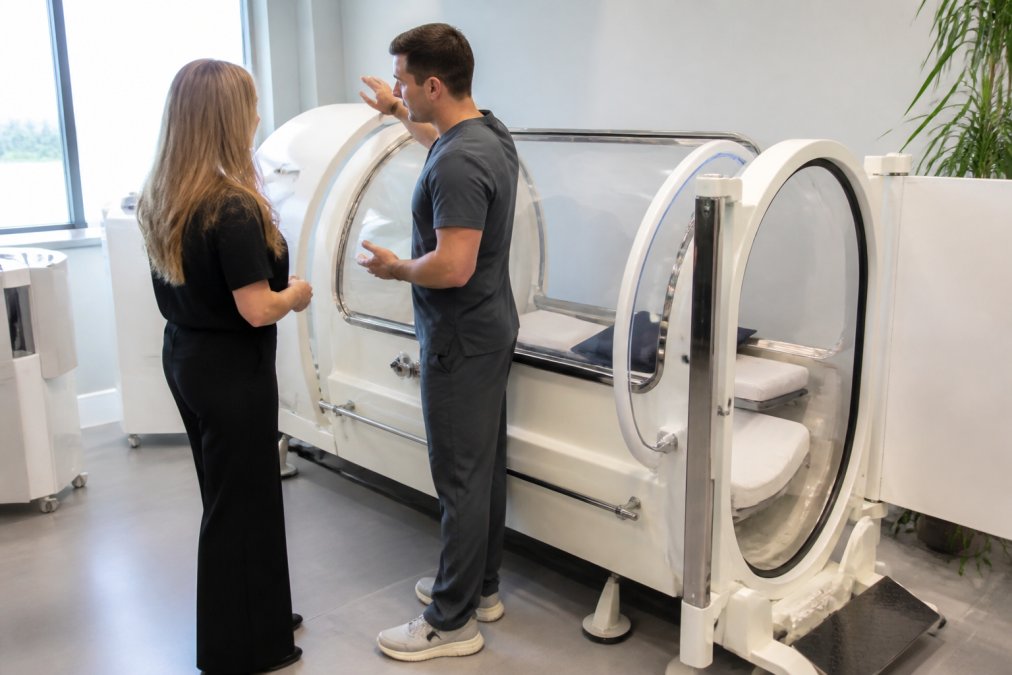
A few cost realities to plan around:
- Equipment leasing spreads the upfront hit and preserves capital
- Installation can include electrical work, ventilation, and room prep
- Oxygen supply is a recurring cost, not a one-time buy
- Maintenance contracts protect your uptime
Step 4: Navigate FDA Regulations for Hyperbaric Chambers
FDA regulations for hyperbaric chambers separate cleared clinical uses from wellness claims. The FDA has cleared HBOT for specific indications and regulates the chambers as medical devices. Marketing for a cleared indication is a medical claim; marketing for general wellness is not.
The practical path:
- Decide whether you are clinical or wellness before you write any marketing copy
- Match every claim to what your chamber and your oversight actually support
- Keep your language honest and specific
Step 5: Meet Hyperbaric Technician Certification Requirements
Hyperbaric technician certification requirements vary by state and model. A clinical operation typically needs a certified hyperbaric technologist and a physician medical director. A cash-pay wellness studio may operate under different rules, but still needs trained staff who understand pressure, oxygen, and emergency response.
For staff, look for training that covers:
- Chamber operation and pressure control
- Oxygen concentration and fire risk
- Patient monitoring during sessions
- Emergency depressurization procedures
Step 6: Set Up Safety Protocols and Facility Compliance
Safety protocols and facility compliance protect your business and your license. Hyperbaric chambers concentrate oxygen under pressure, making fire the number one hazard: in an oxygen-enriched atmosphere, materials that never burn in normal air ignite easily and burn violently. That risk is why the regulatory framework around HBOT exists.
The standards that actually apply
Three bodies shape commercial HBOT safety in the United States:
- NFPA 99 (Health Care Facilities Code), Chapter 14 covers hyperbaric facilities. It governs construction, electrical classification, fire suppression, and the materials allowed inside the chamber. This is the core standard for any commercial HBOT room.
- NFPA 53, Recommended practice on fire hazards in oxygen-enriched atmospheres. It explains why certain materials are banned and how to select compliant gowns, bedding, and equipment.
- OSHA, Your obligations as an employer. OSHA's general duty clause and the standards for oxygen-enriched atmospheres apply to your staff, and you are required to document training and hazard communication.
What NFPA 99 actually requires
The details are not optional:
- Electrical classification. The chamber interior and any oxygen-rich zone must use equipment rated for the hazard. Standard consumer electronics are prohibited inside the chamber.
- Fire suppression. You need detection and suppression appropriate to the space, plus a means to rapidly depressurize and evacuate.
- Materials control. Patient gowns, bedding, and any item entering the chamber must be made of approved, non-static, fire-resistant materials. Cotton and synthetic blends that shed lint or generate static are restricted.
- Oxygen handling. Oxygen supply, storage, and piping must meet code, and you need a documented procedure for emergencies.
- Signage and access control. No smoking, no open flame, no unauthorized entry.
Your compliance checklist
- Fire safety plan specific to oxygen-rich environments, reviewed by your local fire marshal
- No smoking, no open flame, no unapproved electronics inside the chamber
- Approved gowns and materials for patients and staff, sourced from HBOT-compliant suppliers
- Working fire suppression and detection, tested on a documented schedule
- Documented emergency evacuation and rapid-depressurization drills, run at least quarterly
- Regular chamber inspection and maintenance logs, retained for the life of the equipment
- Staff training records, including initial and refresher training
- Oxygen supply and storage inspection records
- Medical director sign-off on all clinical protocols (clinical model)
Review OSHA standards for oxygen-enriched atmospheres to understand the workplace safety expectations that apply to your staff. Also check the NFPA fire safety codes that govern oxygen handling and chamber environments in your area.
The documentation is the defense
If an incident happens, the first thing an investigator, insurer, or plaintiff's attorney asks for is your records. A chamber that ran three years without a documented drill is a liability, not an asset, the paperwork is the evidence you ran a safe operation.
Facility accreditation
Clinical programs often pursue accreditation to bill insurance and build referral trust. Wellness studios may not need it, but it signals quality to high-end clients. Accreditation is separate from code compliance, you can be fully code-compliant and still not accredited, and vice versa.
Step 7: Marketing Your Hyperbaric Oxygen Therapy Business and Attracting Patients
Marketing your hyperbaric oxygen therapy business works best when you sell outcomes people already want: faster recovery, better energy, improved performance. Lead with the benefit, not the technology.
The channels that work for recovery services:
- Your existing base first. Gym members, spa clients, and chiropractic patients are your warmest leads.
- Intro offers. A single discounted session gets people in the door. Memberships keep them.
- Referral partners. Physical therapists, trainers, and physicians send clients your way.
- Local search. People search for recovery services near them. Show up.
Step 8: Manage Ongoing Operational Costs and Maintenance
Ongoing operational costs decide whether your hyperbaric oxygen therapy business stays profitable after the novelty fades. Equipment is the headline cost, not the biggest long-term one.
Your recurring costs include:
- Oxygen supply - refills and delivery
- Chamber maintenance - inspections, parts, service contracts
- Staffing - trained operators and oversight
- Insurance - liability coverage for the service
- Utilities - power and ventilation, especially for hard-shell units
- Marketing - ongoing patient acquisition
Frequently Asked Questions
Do you need to be certified to operate a hyperbaric chamber?
Yes, most facilities require certification for chamber operators. The National Board of Diving and Hyperbaric Medical Technology (NBDHMT) offers the Certified Hyperbaric Technologist (CHT) credential, which requires completing an approved training program, passing an exam, and documenting clinical hours. State health departments may also have specific licensing requirements for hyperbaric facilities. Always verify current rules with your state's health department and the NBDHMT before hiring or operating a chamber.
How much does it cost to start a hyperbaric oxygen therapy business?
Startup costs vary widely based on chamber type, facility buildout, and location. A soft-shell chamber for a single treatment room may cost less than a hard-shell monoplace chamber, but hard-shell chambers typically allow higher pressures and more clinical applications. Additional expenses include facility modifications, liability insurance, medical director fees, staff training, and marketing. Eternall Wellness offers financing options to help preserve capital. Request a personalized quote from Eternall Wellness for current pricing on chambers and recovery systems.
Is hyperbaric oxygen therapy covered by insurance for wellness clinics?
Insurance coverage for HBOT depends on the indication and the clinic's accreditation. The FDA has cleared HBOT for specific medical conditions, and Medicare and many private insurers cover treatment for those approved indications when provided in an accredited facility under physician supervision. For wellness-focused uses like recovery or performance enhancement, coverage is generally not available, and clinics typically operate on a cash-pay model. Check with your state insurance department and individual payers for details.
What are the FDA regulations for hyperbaric oxygen chambers?
The FDA classifies hyperbaric chambers as Class II medical devices, which means they require 510(k) clearance before marketing. The FDA has cleared HBOT for specific indications, including wound healing and decompression sickness. Using a chamber for non-cleared purposes is considered off-label and must be handled carefully with proper patient consent and physician oversight. Facilities should verify that any chamber they purchase has the appropriate FDA clearance and consult a healthcare attorney to ensure compliance with federal and state rules.