 ultimate-guide
Commercial Hyperbaric Chamber Pricing Guide
Table of Contents
- Understanding Commercial Hyperbaric Chamber Types and Pricing
- Key Factors That Influence Total Cost
- Hyperbaric Oxygen Therapy Business Plan Essentials
- FDA Regulations for Hyperbaric Chambers
- Commercial Hyperbaric Chamber ROI and Financial Projections
- Hyperbaric Chamber Installation Requirements and Startup Costs
- Financing and Leasing Options for Wellness Facilities
- Operational Expenses and Maintenance Considerations
Last Updated: August 30, 2026
Understanding Commercial Hyperbaric Chamber Types and Pricing
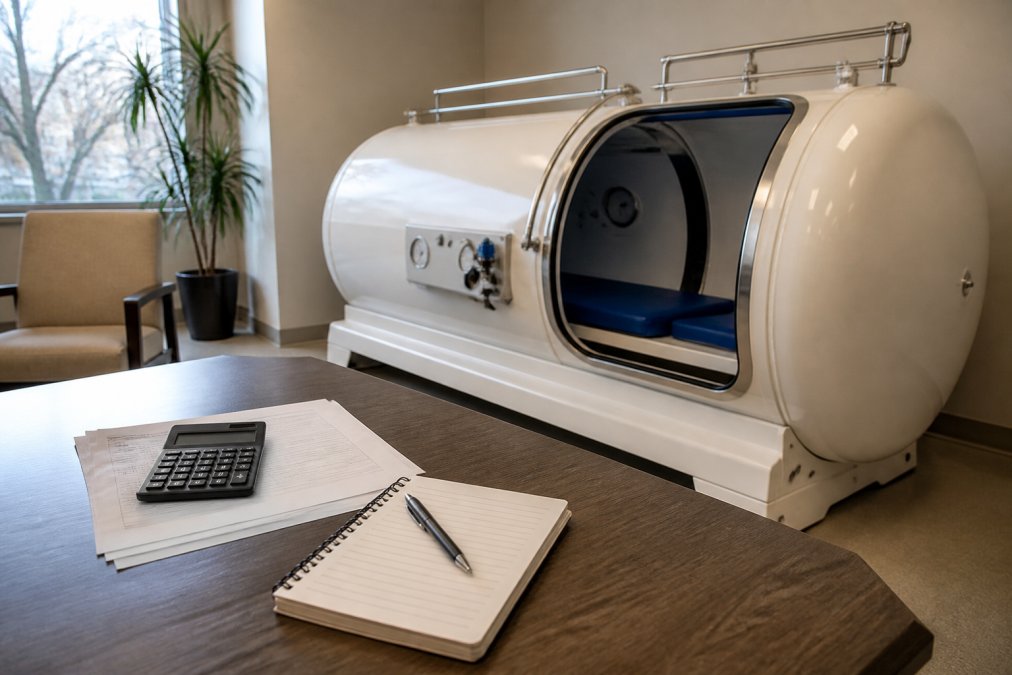
Hyperbaric chamber pricing varies dramatically based on chamber design, capacity, and intended use. The commercial market splits into two primary categories: monoplace and multiplace chambers, each serving different business models and patient volumes. Within those categories, hard-shell and soft-shell construction affect upfront cost, installation complexity, operational expenses, and long-term maintenance.
At Eternall Wellness, we help facility owners evaluate hyperbaric oxygen therapy equipment as revenue-generating services, understanding what drives pricing to project realistic ROI and operational costs.
Monoplace vs. Multiplace Chambers
A monoplace chamber accommodates one patient in a single-occupant tube design. A multiplace chamber holds multiple patients simultaneously, typically 4 to 14 people, in a larger pressurized room.
Monoplace systems are generally more affordable upfront, require less facility space, and have simpler installation and maintenance. A typical monoplace operates at 2.4 to 3.0 atmospheres absolute (ATA) (the FDA). The trade-off is throughput: you treat one person per session, limiting revenue potential for high-volume facilities.
Multiplace chambers command higher initial investment but enable greater patient throughput. A single multiplace session treats 4 to 14 patients simultaneously, dramatically improving revenue per hour of operation. However, they require dedicated facility infrastructure, reinforced walls, specialized gas delivery systems, and trained operators.
For a smaller wellness facility with 150 to 300 members, a monoplace chamber often makes sense. For larger facilities, spas, or dedicated recovery studios, multiplace chambers justify their higher cost through superior patient throughput and revenue scaling.
Hard-Shell vs. Soft-Shell Chambers
Hard-shell chambers use rigid acrylic or steel construction. They're durable, withstand repeated pressurization cycles with minimal wear, and typically last 15 to 20 years with proper maintenance. They're the industry standard for clinical-grade applications and command premium pricing.
Soft-shell chambers use flexible fabric or vinyl construction. They're portable, require minimal facility modification, and cost significantly less. However, they have shorter operational lifespans of 5 to 10 years, are more susceptible to seal degradation, and require more frequent maintenance.
The choice often comes down to facility constraints and long-term commitment. A gym testing hyperbaric services might start with soft-shell to validate demand before committing to hard-shell infrastructure. A dedicated wellness clinic planning decade-long operations should budget for hard-shell durability.
Key Factors That Influence Total Cost
Total cost of ownership extends far beyond the chamber's purchase price. Installation, facility modifications, regulatory compliance, ongoing maintenance, and staffing all factor into real operating expenses.
Chamber specifications and capacity: Larger chambers with higher ATA ratings cost more. A monoplace operating at 2.4 ATA costs less than a 3.0 ATA monoplace. Multiplace chambers with 8-person capacity cost more than 4-person models. Patient volume projections should drive this decision; oversizing adds unnecessary expense while undersizing limits revenue potential.
Facility infrastructure requirements: Hard-shell chambers often require structural reinforcement, specialized electrical service, and dedicated oxygen delivery systems. Some facilities need wall modifications or separate treatment rooms. These construction costs can rival or exceed the chamber's purchase price. Soft-shell chambers minimize facility modifications, appealing to facilities with space or budget constraints.
Safety standards and regulatory compliance: Hyperbaric chambers must meet FDA regulations and ASME standards. Compliance documentation, safety certifications, and operator training add to startup costs. Facilities must also carry appropriate liability insurance, which varies by chamber type and operational model.
Oxygen delivery systems: Monoplace chambers typically use onboard oxygen concentrators. Multiplace systems require dedicated oxygen delivery from bulk tanks or manifold systems, affecting both upfront costs and ongoing operational expenses.
Installation and commissioning: Professional installation, pressure testing, and operator training are essential. Installation timelines vary from weeks to months depending on facility readiness and chamber complexity.
Hyperbaric Oxygen Therapy Business Plan Essentials
A successful hyperbaric business requires a clear operational plan, realistic patient volume projections, and a pricing strategy that covers costs while remaining competitive.
Patient volume projections: A new wellness service typically attracts 5 to 15 sessions per week initially, ramping to 20 to 40 sessions weekly within six months.
Pricing strategy: Most wellness facilities charge $60 to $150 per session for hyperbaric oxygen therapy, depending on location, facility positioning, and chamber type. Premium facilities in affluent markets command higher rates; budget facilities in competitive markets may charge less.
Staffing and operator certification: Most states require certified hyperbaric technicians to operate chambers. Certification typically requires 40 to 100 hours of training and passing an exam. Budget for initial technician training and ongoing continuing education. For multiplace operations, you may need multiple certified operators to maintain consistent scheduling.
Use targets: A monoplace chamber operating 40 hours per week at 80% use (32 billable hours) generates meaningful revenue. Multiplace chambers need higher use to justify their cost, but their per-hour revenue is substantially higher due to multiple simultaneous patients.
FDA Regulations for Hyperbaric Chambers
Hyperbaric chambers are FDA-regulated Class II medical devices, requiring 510(k) premarket notification (the FDA). Manufacturers must demonstrate that their chambers are substantially equivalent to legally marketed predicate devices. As a facility operator, verify that any chamber you purchase has FDA clearance.
Hyperbaric chambers must comply with ASME standards, particularly ASME PVHO-1 (Pressure Vessels for Human Occupancy), which covers design, fabrication, inspection, testing, and maintenance. Regular inspections and maintenance records are essential for regulatory compliance and liability protection.
Operator training and certification requirements vary by state. Some states require certification through organizations like the National Board of Diving and Hyperbaric Medical Technology (NBDHMT). Verify your state's specific regulations before launching operations.
Maintain detailed logs of all chamber sessions, maintenance performed, safety inspections, and operator certifications. These records protect you in the event of regulatory inquiry or liability claim.
Commercial Hyperbaric Chamber ROI and Financial Projections
Return on investment depends on chamber type, patient volume, pricing, and operational efficiency. A realistic financial model should account for all costs, not just the chamber purchase.

Revenue modeling: A monoplace chamber generating 30 billable sessions per week at $100 average produces $156,000 in annual revenue. A multiplace chamber treating 8 patients per session, 30 sessions weekly at $100 per patient, generates $1.248 million in annual revenue. This illustrates why multiplace chambers appeal to high-volume facilities despite higher initial cost.
Cost structure: Operating costs include oxygen supply, electricity, maintenance, technician wages, liability insurance, and facility overhead. Oxygen costs for monoplace chambers typically run $5 to $15 per session. Maintenance for hard-shell chambers averages $2,000 to $5,000 annually. Technician wages depend on your market; full-time operators in major markets may cost $40,000 to $60,000 annually.
Break-even analysis: A monoplace chamber with $80,000 to $150,000 in total startup cost, operating at 30 sessions weekly with $100 average revenue and $35 per-session operating cost, breaks even within 18 to 24 months. Multiplace chambers with higher upfront costs but superior revenue per hour can break even within 12 to 18 months if use targets are met.
Sensitivity to use: A 10% drop in patient volume significantly impacts ROI. A monoplace chamber dropping from 30 to 27 sessions weekly loses $15,600 in annual revenue, underscoring the importance of realistic volume projections and effective marketing.
Hyperbaric Chamber Installation Requirements and Startup Costs
Installation complexity varies dramatically by chamber type and facility condition.
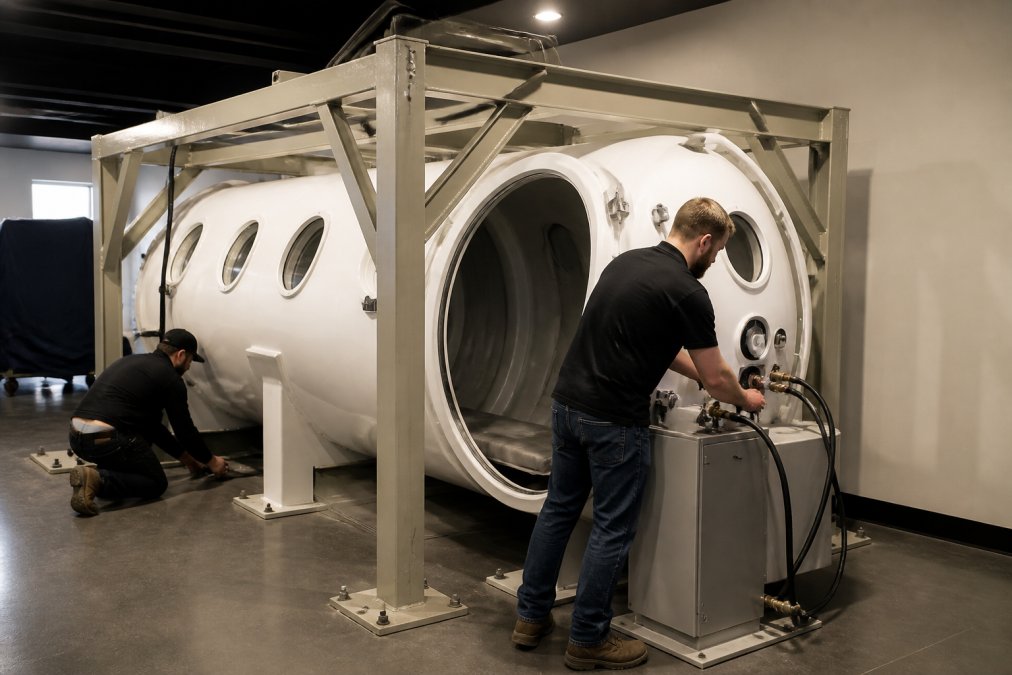
Monoplace installation: Soft-shell monoplace chambers require minimal facility modification and typically take 1 to 2 weeks. Hard-shell monoplace chambers require floor reinforcement, electrical upgrades, and possibly wall modifications, extending installation to 4 to 6 weeks.
Multiplace installation: Multiplace chambers demand substantial facility preparation including a reinforced concrete pad, dedicated electrical service (often 400+ amps), oxygen manifold systems, and air handling modifications. Installation timelines extend to 8 to 12 weeks or longer.
Pre-installation requirements: Ensure your facility has necessary electrical capacity, adequate floor load-bearing capability, and proper ventilation. Have a structural engineer evaluate your facility if uncertain. Some facilities discover mid-installation that they need expensive upgrades.
Commissioning and testing: After physical installation, chambers undergo pressure testing, safety system verification, and operator training, typically lasting 2 to 4 weeks.
Startup costs beyond the chamber: Facility modifications, electrical upgrades, oxygen delivery systems, safety equipment, and initial operator training can equal or exceed the chamber's purchase price. A realistic startup budget should allocate 50% to 100% of the chamber cost for installation and infrastructure.
Financing and Leasing Options for Wellness Facilities
Equipment financing spreads the cost over 3 to 7 years, allowing you to match payments against revenue generation. Monthly payments typically range from 2% to 4% of the equipment cost, depending on term length and credit profile. This approach preserves working capital for marketing, staffing, and operational needs.
Leasing transfers ownership risk to the lessor while providing operational flexibility. Lease terms typically run 3 to 5 years, with monthly payments often lower than financed ownership, though you don't build equity. Leasing makes sense if you're testing demand or uncertain about long-term hyperbaric integration.
At Eternall Wellness, we recognize that financing options enable facilities to expand service offerings without depleting capital reserves. By structuring equipment costs as operational expenses rather than large capital purchases, growing wellness businesses can invest in hyperbaric services while maintaining financial flexibility.
Equipment financing requires demonstrating reliable revenue projections and stable operational history. Established facilities with strong financial records qualify for better terms.
Operational Expenses and Maintenance Considerations
Long-term profitability depends on controlling operational costs and maintaining equipment reliability.
Oxygen supply costs: Monoplace chambers with onboard oxygen concentrators consume electricity but no bulk oxygen, with monthly electricity costs typically running $200 to $400 per chamber. Multiplace chambers using bulk oxygen have higher variable costs of $1,000 to $3,000 monthly depending on use and oxygen pricing.
Maintenance and repairs: Hard-shell chambers require annual inspections and seal replacements every 3 to 5 years, budgeting $2,000 to $5,000 annually for preventive maintenance. Soft-shell chambers cost less to maintain but may need more frequent repairs, budgeting $1,500 to $3,000 annually.
Technician training and certification: Operator certification requires initial investment of $1,000 to $3,000 per technician, with continuing education adding $500 to $1,000 annually. Maintain at least one backup-certified operator to ensure coverage during absences.
Liability insurance: Hyperbaric oxygen therapy carries inherent risks. Liability insurance typically costs $2,000 to $6,000 annually, depending on facility size, chamber type, and claims history. Verify that your insurance covers hyperbaric operations specifically.
Utility costs: Factor in electricity for pressurization systems, air compressors, and facility climate control. Monthly utility costs typically add $500 to $1,500 to your facility's baseline consumption.
Regulatory compliance: Annual inspections, documentation, and potential recertification add $500 to $2,000 annually depending on your state's requirements.
A comprehensive operational budget should allocate 30% to 40% of revenue toward these ongoing expenses, leaving 60% to 70% for facility overhead, staffing, and profit margin.
Adding hyperbaric oxygen therapy services to your wellness facility addresses real market demand for premium recovery modalities. Success requires realistic financial modeling, proper facility preparation, and committed operational management. Eternall Wellness helps facility owners evaluate hyperbaric chambers as business solutions, considering installation requirements, financing options, and realistic ROI projections. [FDA guidance on hyperbaric chamber(/hyperbaric-chamber-training-for-staff) regulation and compliance | fda.gov] provides official requirements for your jurisdiction. Start with a clear business plan, conservative volume projections, and commitment to operator training and maintenance. Facilities that succeed treat hyperbaric services as core revenue drivers, not peripheral amenities.
Frequently Asked Questions
What is the typical cost range for a commercial hyperbaric chamber?
Commercial hyperbaric chamber pricing varies significantly based on chamber type, capacity, and grade. Monoplace units generally cost less than multiplace chambers, while hard-shell models typically exceed soft-shell alternatives. Clinical-grade equipment commands premium pricing compared to wellness-grade systems. Capital expenditure depends on your facility's throughput goals and patient volume projections. Contact Eternall Wellness for current pricing and a customized quote based on your specific business requirements.
How quickly can a commercial hyperbaric chamber pay for itself?
Return on investment depends on utilization rates, session pricing, and operational efficiency. Your ROI timeline depends on factors including patient throughput, average session fees, operational costs, and financing terms. A detailed financial projection should account for realistic utilization rates for your facility size and market. Eternall Wellness helps clients model ROI scenarios specific to their business model and location.
What are the ongoing operational costs of running a hyperbaric chamber?
Operational expenses include oxygen supply (concentrator or bulk oxygen), air compressor maintenance, chamber seal replacements, insurance, staff training, and facility utilities. Monthly costs typically range based on utilization and chamber type. Maintenance frequency depends on usage patterns and equipment grade. Budgeting for preventive maintenance extends equipment lifespan and reduces emergency repair costs. Total cost of ownership should account for these recurring expenses when evaluating financial projections.
Do I need FDA clearance to operate a commercial hyperbaric chamber?
Hyperbaric chambers used for medical purposes must comply with FDA regulations and be cleared as medical devices. Clinical-grade chambers treating approved indications require proper FDA classification and documentation. Wellness-grade chambers used for non-medical purposes may have different compliance pathways. Your facility must ensure proper regulatory compliance based on your intended use, patient population, and claimed therapeutic benefits. Eternall Wellness guides clients through regulatory requirements and compliance documentation specific to their business model.
This article was written using GrandRanker